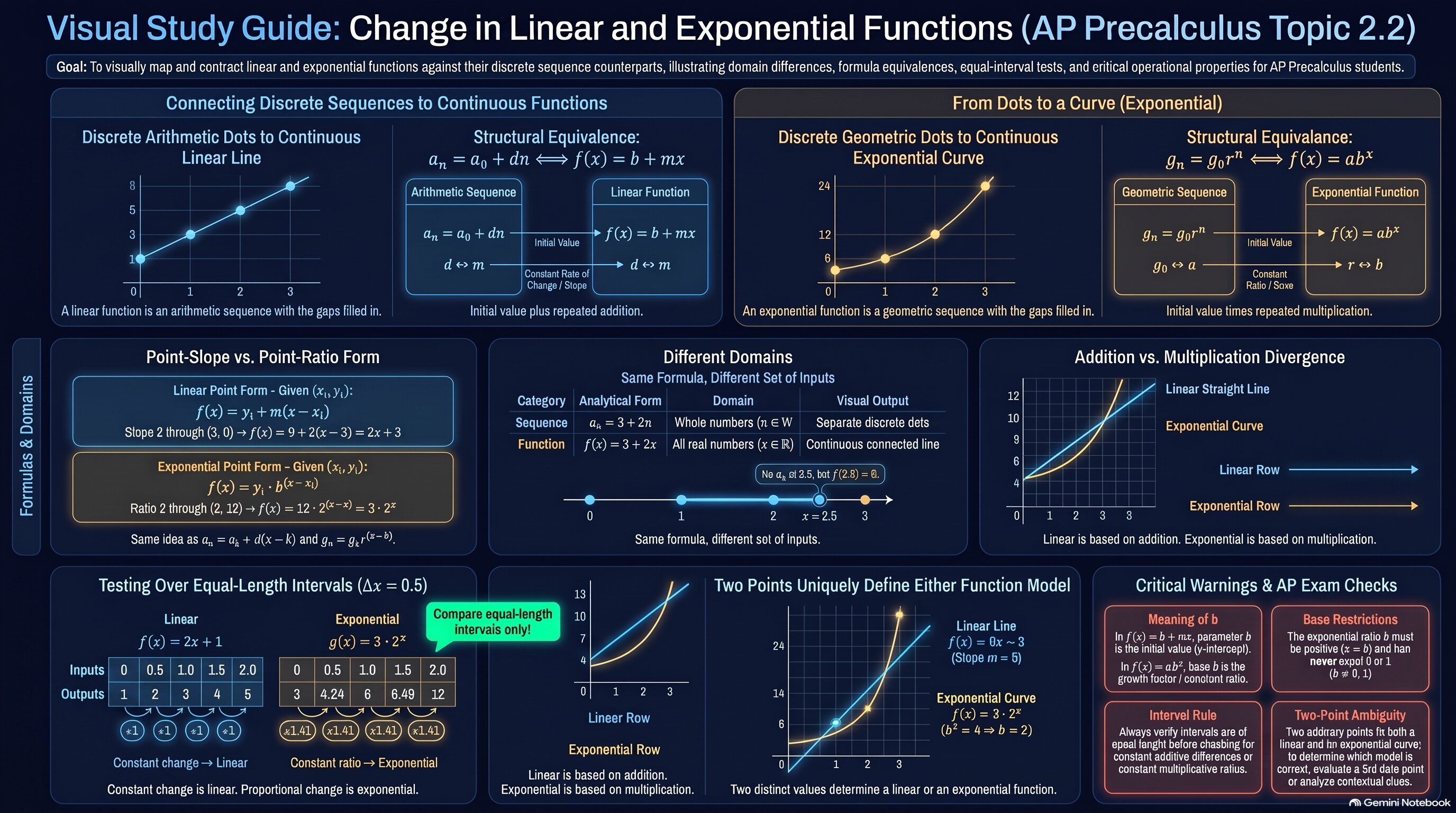
Use this as a quick reference for how linear functions match arithmetic sequences, how exponential functions match geometric sequences, and how to tell the two apart.
🧭 Plot Summary
In Lesson 2.1 you worked with sequences, which only exist at the whole numbers. This lesson fills in the gaps. A linear function f(x) = b + mx is an arithmetic sequence that is defined for every real number: an initial value plus repeated addition of a constant rate of change. An exponential function f(x) = abx is a geometric sequence that is defined for every real number: an initial value times repeated multiplication by a constant ratio. The big question is how to tell them apart. Look at equal-length input intervals. If the outputs change by a constant amount, the function is linear. If the outputs change proportionally, it is exponential.
What you'll do in this lesson
Connect arithmetic sequences to linear functions: both are an initial value plus repeated addition of a constant rate of change.
Write a linear function from a slope and any point, using f(x) = yi + m(x − xi).
Connect geometric sequences to exponential functions: both are an initial value times repeated multiplication by a constant ratio.
Write an exponential function from a ratio and any point, using f(x) = yibx − xi.
Explain why a sequence and its function have different domains.
Use equal-length input intervals to decide whether outputs change by a constant amount (linear) or by a constant factor (exponential).
Compare the families, then build either one from two distinct input-output values.
Why it matters
Real quantities do not only change on whole-number days or years. A phone loses value continuously, a savings account can be checked at any moment, and a cooling drink has a temperature at every instant. Linear and exponential functions are the two basic models for that kind of change, and Topic 2.3 will take a close look at the exponential one. Knowing which one fits a situation is the skill this lesson builds.
✅ Self-Check Before You Move On
Check off each item as you get there. These aren't grades — they're your own signal.