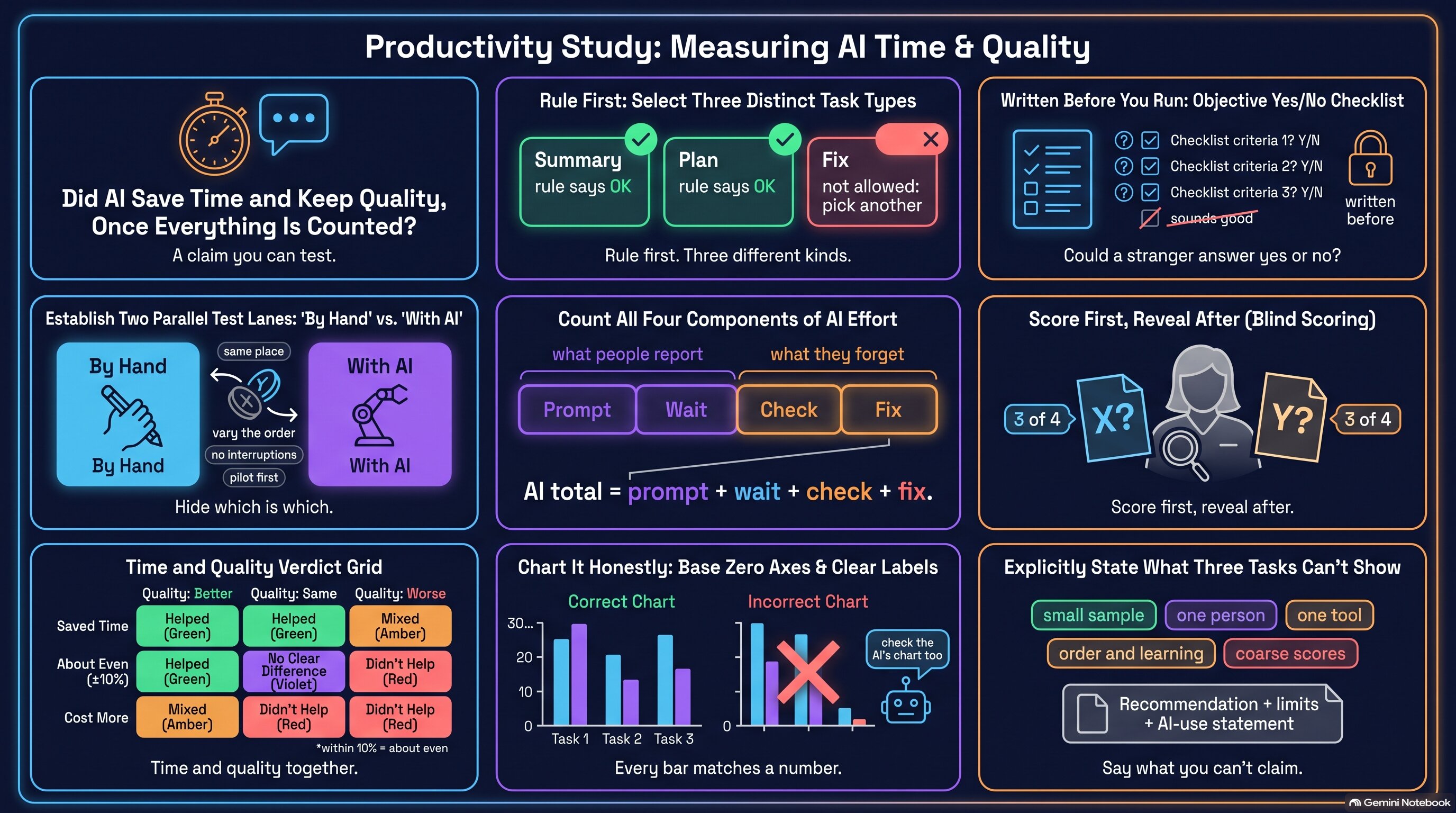
Quick reference for the whole study: clear the task, write criteria first, run it both ways, count all four AI times, score blind, chart it honestly, and say what the study cannot show.
🧭 Plot Summary
"AI makes me more productive" is a claim. In 2.1.2 you tested it on a task someone else designed, and you saw that the time it costs includes prompting, waiting, checking and fixing. Now you design the test yourself.
You pick three real tasks, decide what a good result looks like before you start, do each one by hand and with AI, and have a partner score the results without knowing which one the AI made. Then you chart your numbers, compare your chart with one an AI makes, and write a memo that says when AI helps you, when it doesn't, and what your evidence can't show.
What you'll do in this project
- Choose three real tasks of three different kinds and clear each one against the rule that applies to you.
- Write four yes/no criteria for each task before you start, so you can't grade the results to fit what you hoped.
- Do every task by hand and with AI, timing the prompt, the wait, the checking and the fixing.
- Have a partner score the results blind, using a coin flip to hide which one the AI made.
- Chart your minutes, then ask an AI for the same chart and check it against yours.
- Write the Productivity Study Memo: a verdict for each task, a recommendation, and the limits of your evidence.
Ground rules
- Check the rule first (2.1.3). If a task isn't allowed, choose a different one.
- Don't put anyone's private details in a prompt. Use your own notes, invented situations or public material.
- Report what you found, even if the AI didn't help. A clear "it didn't help" is a good result.
Why it matters
Most claims about AI and productivity are one person's feeling. A small, fair test with your own numbers is how you decide when to reach for AI, and how you tell whether someone else's claim holds up.
✅ Self-Check Before You Share
Check off each item as you get there. These aren't grades. They're your own signal.