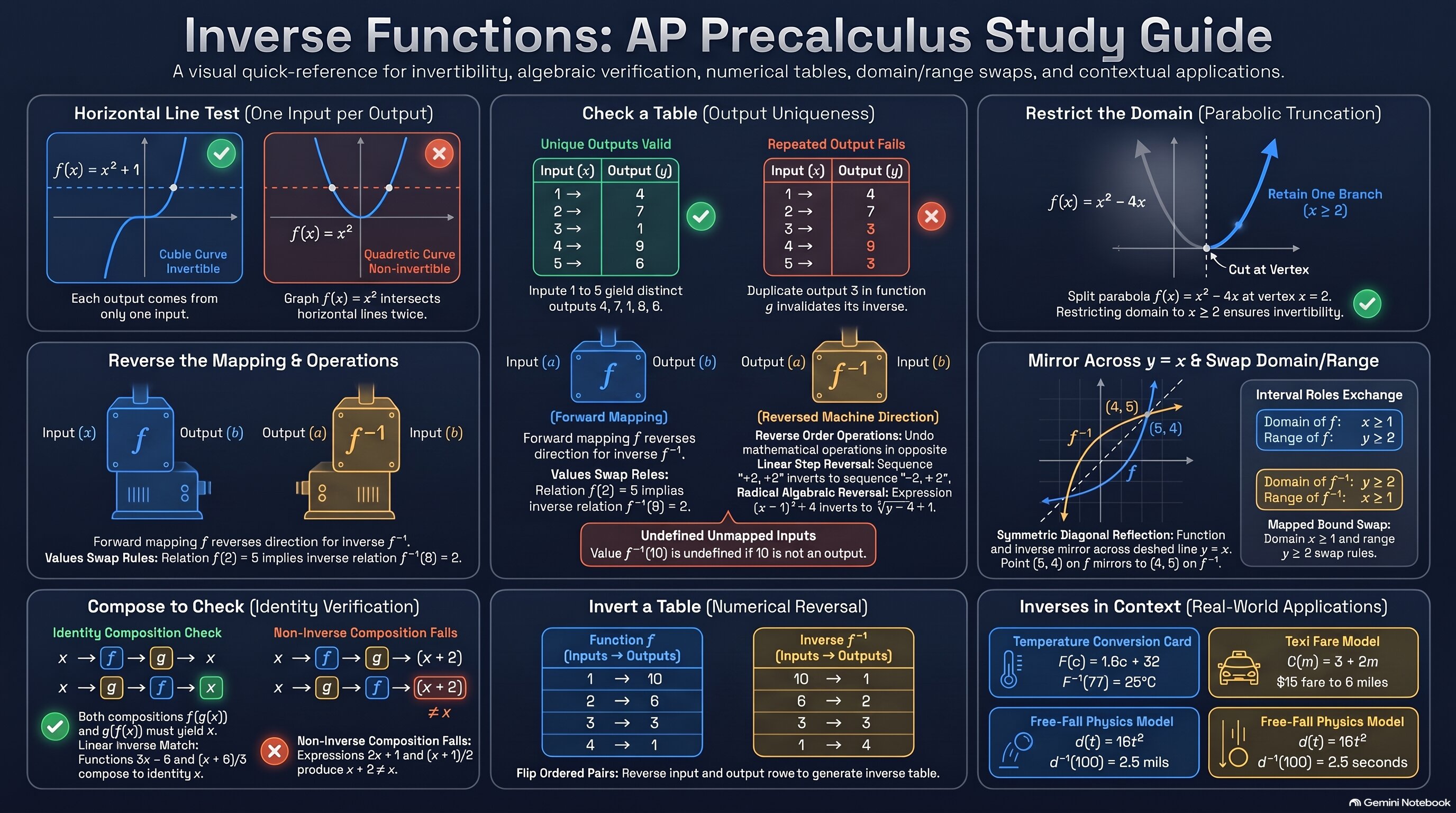
Use this as a quick reference for invertible functions, the reverse mapping, composing with an inverse, domain and range, finding inverses, and inverses in context.
🧭 Plot Summary
Some functions can be run backward. A function is invertible when each output comes from a unique input, and then its inverse function f⁻¹ is a reverse mapping: if f(a) = b, then f⁻¹(b) = a. You will restrict domains to make functions invertible, check inverses by composing them to get the identity function, trade domain and range, find inverse formulas by undoing the steps in reverse order, and say what an inverse means in a real situation, with its units.
What you'll do in this lesson
- Decide when a function is invertible, and restrict a domain to make one invertible.
- Treat the inverse as a reverse mapping: pairs (a, b) become (b, a).
- Check an inverse by composing: f(f⁻¹(x)) = f⁻¹(f(x)) = x, the identity function.
- Swap domain and range, and see the mirror line y = x.
- Find an inverse formula by undoing steps in reverse order.
- Interpret an inverse in context, with the meaning and units swapped.
Why it matters
Converting Celsius to Fahrenheit and back, finding how far a taxi ride goes for a fixed fare, and finding how long an object falls all use an inverse. This topic is the foundation for Topic 2.9, where the inverse of an exponential function gets a name: the logarithm.
✅ Self-Check Before You Move On
Check off each item as you get there. These aren't grades — they're your own signal.