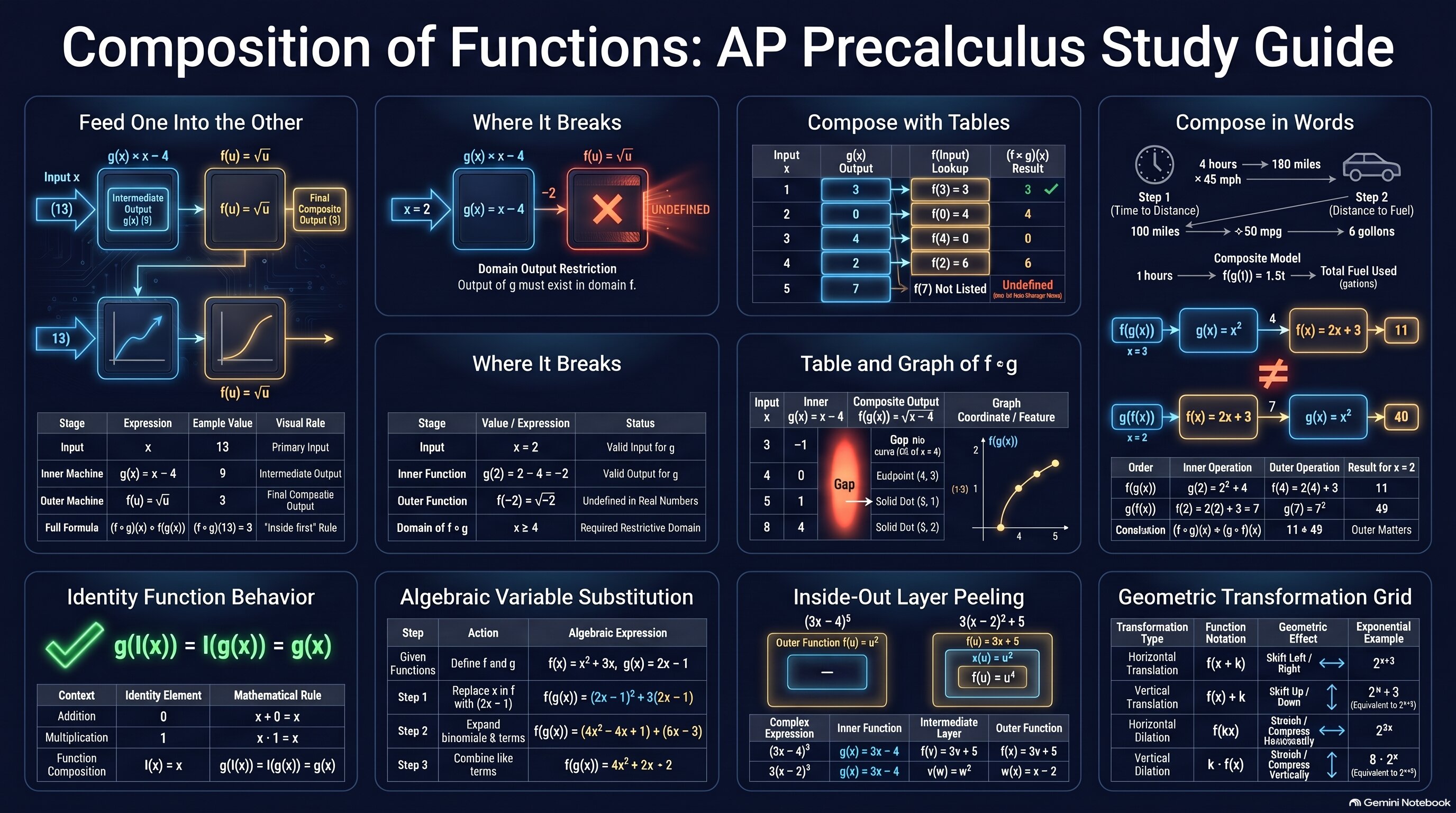
Use this as a quick reference for reading f(g(x)), domains, order, the identity function, building and decomposing compositions, and transformations.
🧭 Plot Summary
A composition feeds the output of one function into another. The composite function f∘g does g first and then f, so (f∘g)(x) = f(g(x)). You will evaluate compositions from tables, graphs, formulas, and words, notice where they are undefined, and see that order matters: f∘g and g∘f are typically different. You will meet the identity function I(x) = x, build new formulas by substitution, decompose a function into simpler parts, and see translations and dilations as compositions.
What you'll do in this lesson
Evaluate f(g(x)) from tables, graphs, formulas, and words, and notice when it is undefined.
Show that order matters, and meet the identity function that acts like 0 and 1.
Build a composition by substitution, and make a table or graph of it.
Relate two quantities that are not directly linked by a formula.
Decompose a function into simpler pieces and check that they rebuild the original.
See translations and dilations as compositions with x + k and kx.
Why it matters
Converting units, applying a discount and then a coupon, or turning time into radius into area all chain one rule into another. Composition is also the setup for the next topic: a function and its inverse compose to give the identity, which is the key to logarithms.
✅ Self-Check Before You Move On
Check off each item as you get there. These aren't grades — they're your own signal.