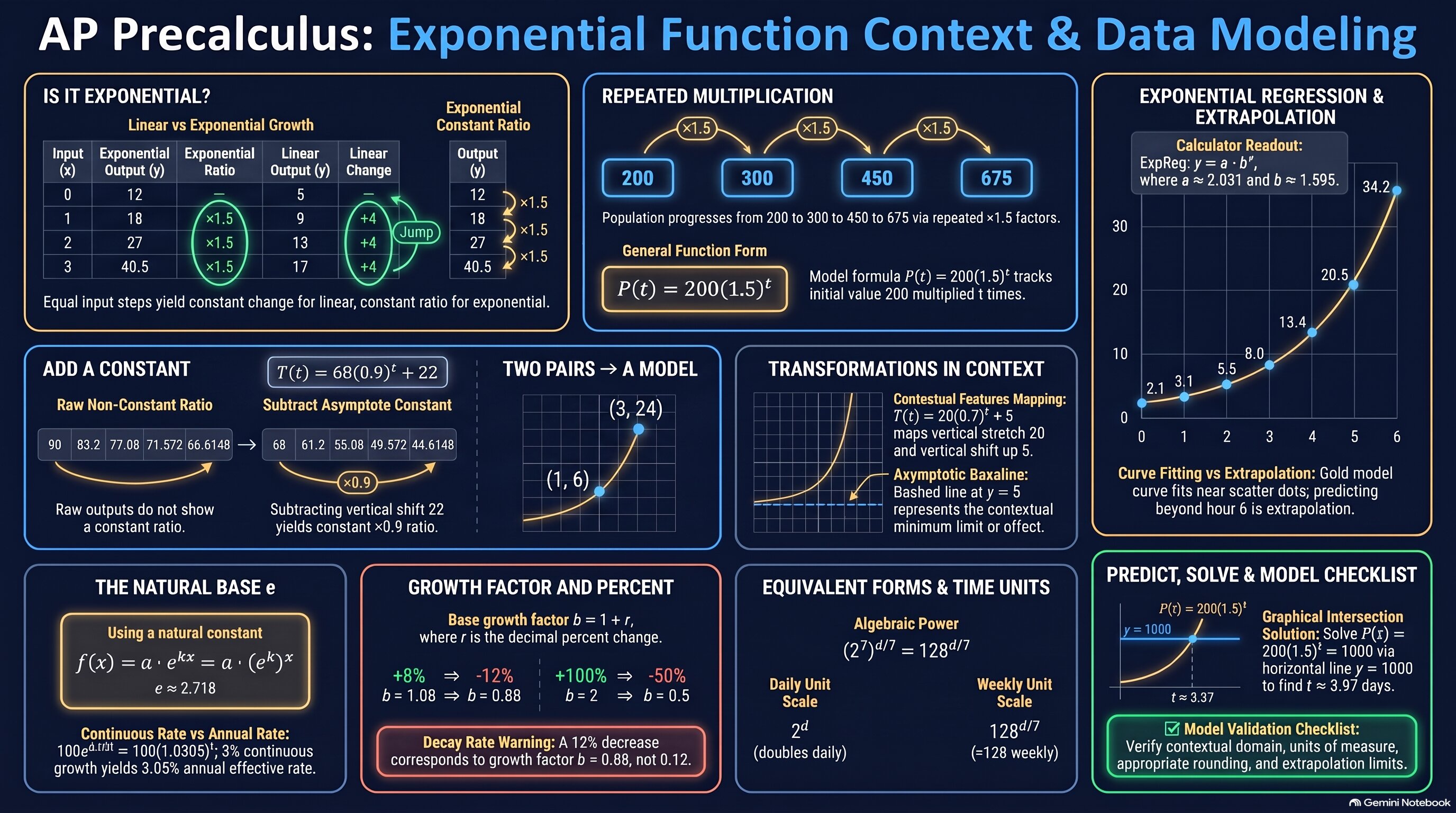
Use this as a quick reference for building models from ratios, pairs, and data, the growth factor, equivalent forms, and making predictions.
🧭 Plot Summary
Lessons 2.3 and 2.4 gave you the general form and the tools to rewrite exponential expressions. Now we use them on real situations. Exponential functions model growth patterns where successive outputs over equal-length intervals are proportional. You will build models from a ratio and an initial value, from two input-output pairs, by adding a constant to reveal a hidden pattern, by transformations, and with exponential regression on a calculator. You will meet the natural base e, interpret the base as a growth factor tied to a percent change, and use predictions that respect the limits of the context.
What you'll do in this lesson
Decide whether a situation or data set is exponential, using proportional outputs over equal-length intervals.
Reveal a hidden exponential pattern by adding or subtracting a constant, and model it with abx + k.
Build a model from a ratio and initial value, from two input-output pairs, or with exponential regression.
Use transformations of abx and the natural base e in models.
Interpret the base as a growth factor tied to a percent change, and choose the equivalent form that answers your question.
Predict values, respect the contextual domain, and find the input that reaches a target output.
Why it matters
Populations, investments, cooling drinks, and medicine in the body are all modeled this way. The skill is not just computing a number. It is choosing a model that fits, saying what its base means in the situation, and deciding whether a prediction is believable. Topic 2.6 compares exponential models with linear and quadratic ones.
✅ Self-Check Before You Move On
Check off each item as you get there. These aren't grades — they're your own signal.