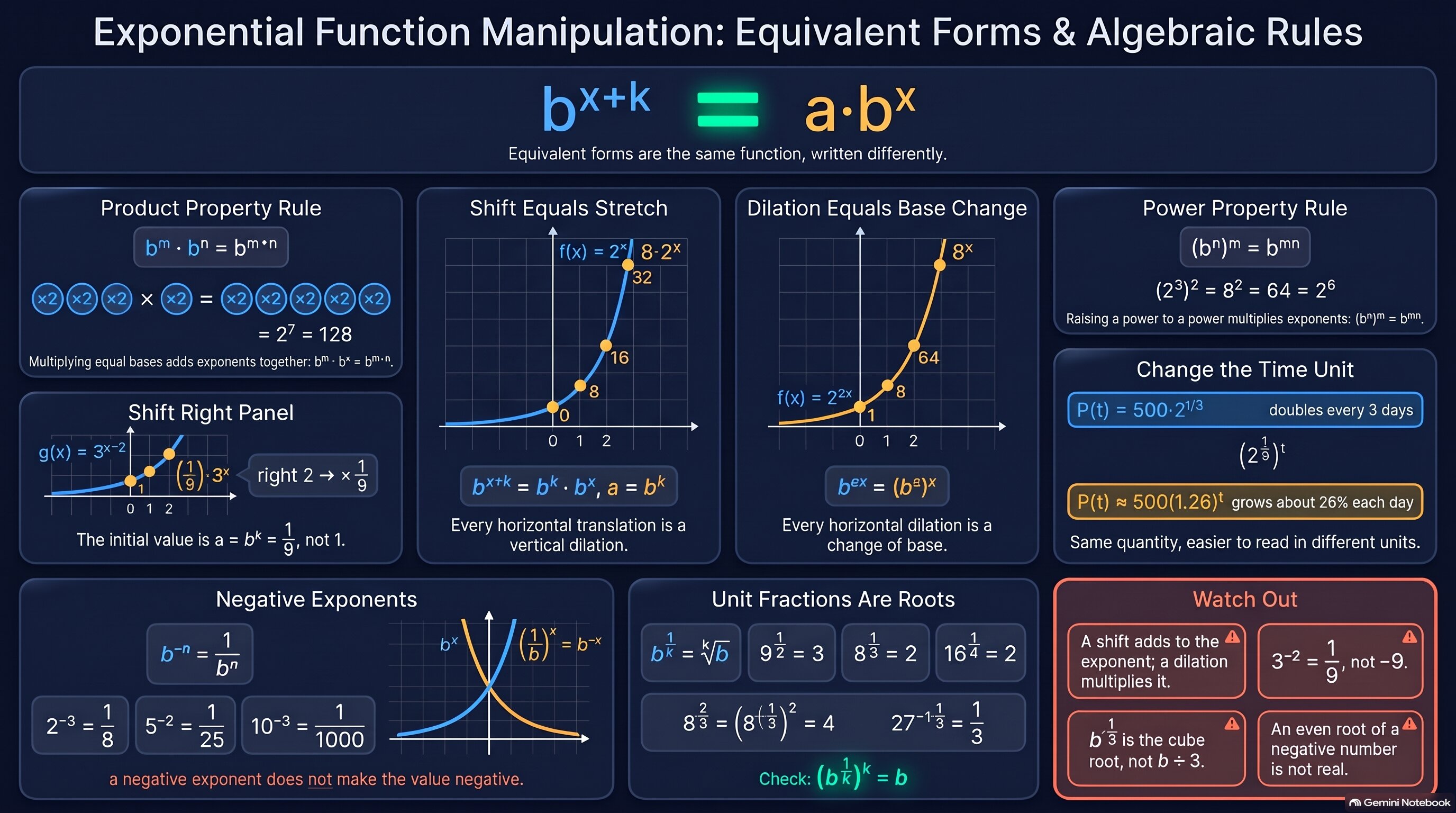
Use this as a quick reference for the product property, the power property, negative exponents, and unit fraction exponents.
🧭 Plot Summary
Lesson 2.3 gave you the general form f(x) = abx. Now we rewrite exponential expressions in equivalent forms so that the information you need is easy to see. The product property turns a horizontal translation into a vertical dilation. The power property turns a horizontal dilation into a change of base. The negative exponent property turns a negative exponent into a reciprocal, and unit fraction exponents are roots. Together they let you change the time unit of a model, for example from "doubles every 3 days" to "grows by about 26% each day."
What you'll do in this lesson
Use the product property to turn a horizontal translation into a vertical dilation: bx + k = bk·bx.
Use the power property to turn a horizontal dilation into a new base: bcx = (bc)x.
Rewrite negative exponents as reciprocals: b−n = 1 / bn.
Evaluate unit fraction exponents as roots: b1/k is the kth root of b, when it exists.
Combine the properties to change the time unit of a model, such as from every 3 days to every day.
Why it matters
Models are often given in one form but needed in another. A population that doubles every 3 days is written 2t/3, but a daily growth factor is easier to compare with a percent change. Rewriting is how you move between the two without changing the function. Topic 2.5 uses these equivalent forms to build and interpret exponential models.
✅ Self-Check Before You Move On
Check off each item as you get there. These aren't grades — they're your own signal.