Use this as a quick reference for the general form, growth and decay, the shape of the graph, shifted exponentials, and end behavior.
🧭 Plot Summary
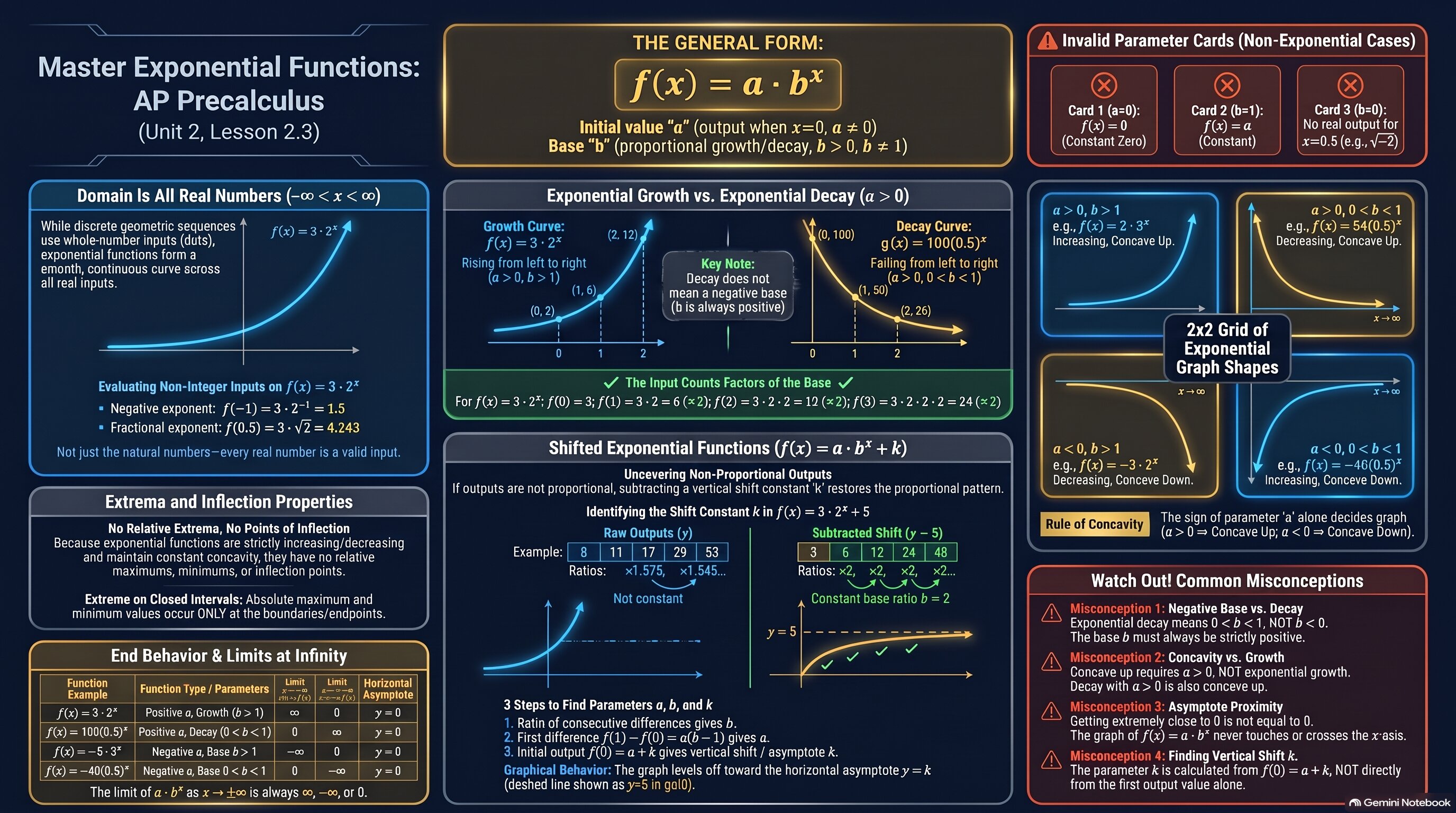
Lesson 2.2 showed that an exponential function f(x) = abx is a geometric sequence with the gaps filled in. Now we study the function itself. Its general formhas an initial value a and a base b, with a ≠ 0, b > 0, and b ≠ 1. When a > 0 it shows growth if b > 1 and decayif 0 < b < 1. Because its outputs are proportional over equal-length input intervals, the function is always increasing or always decreasing, its graph is always concave up or always concave down, and it has no relative extrema and no points of inflection. We also look at what happens at the far ends of the graph, and at shifted exponentials of the form abx + k.
What you'll do in this lesson
- Write the general form f(x) = abx and state why a ≠ 0, b > 0, and b ≠ 1.
- Classify an exponential function as growth (a > 0, b > 1) or decay (a > 0, 0 < b < 1).
- Read the exponent as a count of factors of the base, and know that the domain is all real numbers.
- Explain why every exponential function is always increasing or always decreasing, and always concave up or always concave down.
- Model a function whose outputs become proportional after adding a constant, using f(x) = abx + k.
- Describe end behavior with limits: the outputs increase without bound, decrease without bound, or get arbitrarily close to zero.
Why it matters
Populations, savings with interest, medicine in the body, and cooling drinks all behave like exponential functions. Knowing the shape (always rising or always falling, always bending the same way) and the end behavior lets you describe such a model before you compute a single value. Topics 2.4 and 2.5 build on this to rewrite and fit exponential functions.
✅ Self-Check Before You Move On
Check off each item as you get there. These aren't grades — they're your own signal.