Use this as a quick reference for sequences as functions, common difference and common ratio, general terms, and how arithmetic and geometric growth compare.
🧭 Plot Summary
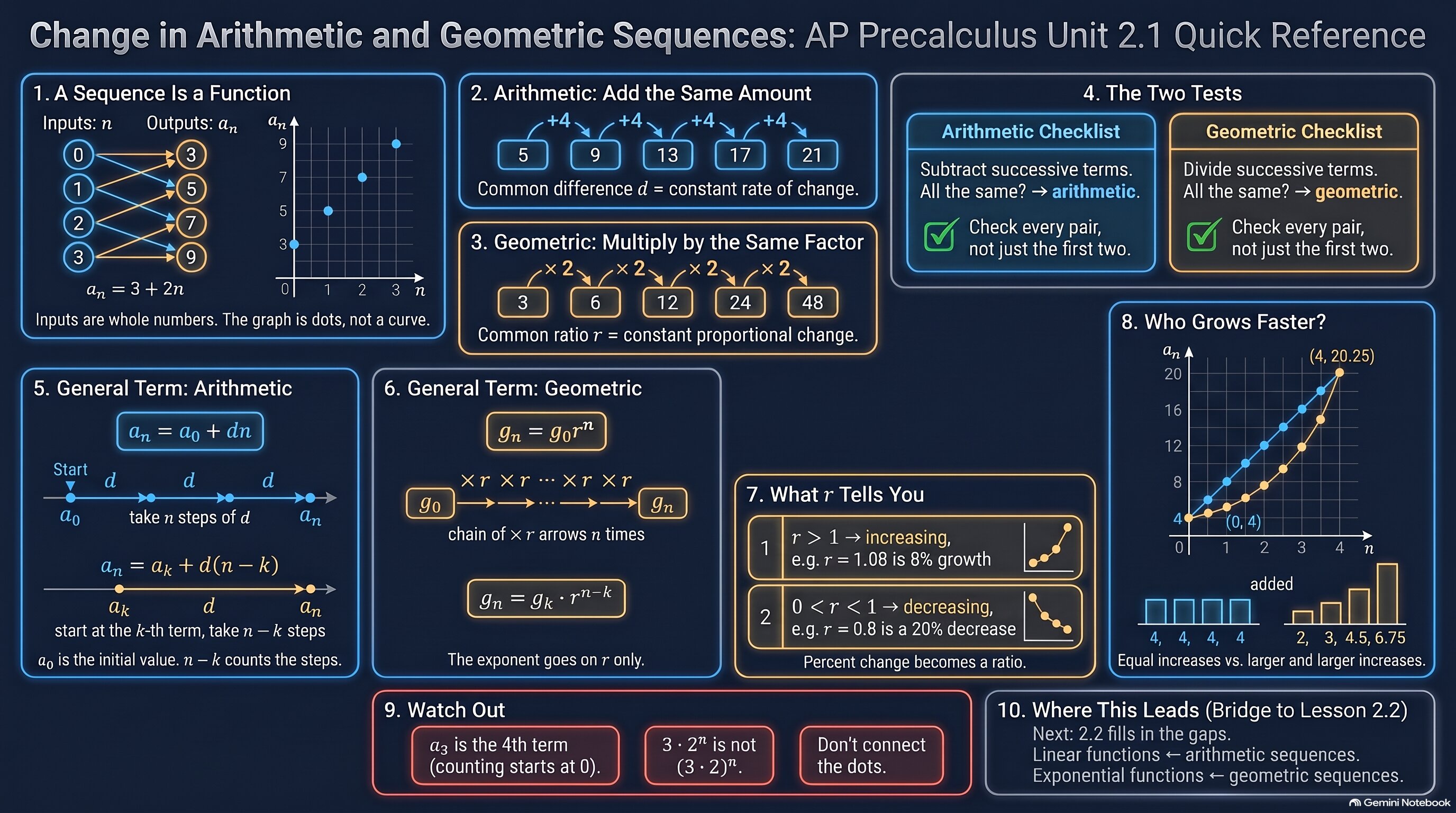
Unit 2 is about quantities that change by the same factor instead of the same amount. Before we meet exponential functions, this lesson starts with the cleanest version of both ideas: lists of numbers indexed by the whole numbers. A sequence is a function from the whole numbers to the real numbers, so its graph is a set of separate points. In an arithmetic sequence, every term is the one before it plus the same common difference. In a geometric sequence, every term is the one before it times the same common ratio. One adds, the other multiplies, and that single difference decides how fast the terms grow.
What you'll do in this lesson
- Define a sequence as a function from the whole numbers to the real numbers, and explain why its graph is a set of discrete points.
- Recognize an arithmetic sequence by its common difference, which is a constant rate of change.
- Write the general term an = a0 + dn, or an = ak + d(n − k) when you know a term other than the first.
- Recognize a geometric sequence by its common ratio, which is constant proportional change.
- Write the general term gn = g0rn, or gn = gkrn − k when you know a term other than the first.
- Compare the two: an increasing arithmetic sequence adds the same amount each step, while an increasing geometric sequence of positive values adds more each step.
Why it matters
In Topic 2.2 you will see that linear functions are arithmetic sequences with the gaps filled in, and exponential functions are geometric sequences with the gaps filled in. Savings that earn interest, populations that grow, and a car that loses value each year are all described by the ideas in this lesson. Get comfortable here and the rest of the unit builds on it.
✅ Self-Check Before You Move On
Check off each item as you get there. These aren't grades — they're your own signal.