Quick reference for claims versus evidence, the four strands, how skills stack, how to read a research chart, and how to choose one skill to add.
🧭 Plot Summary
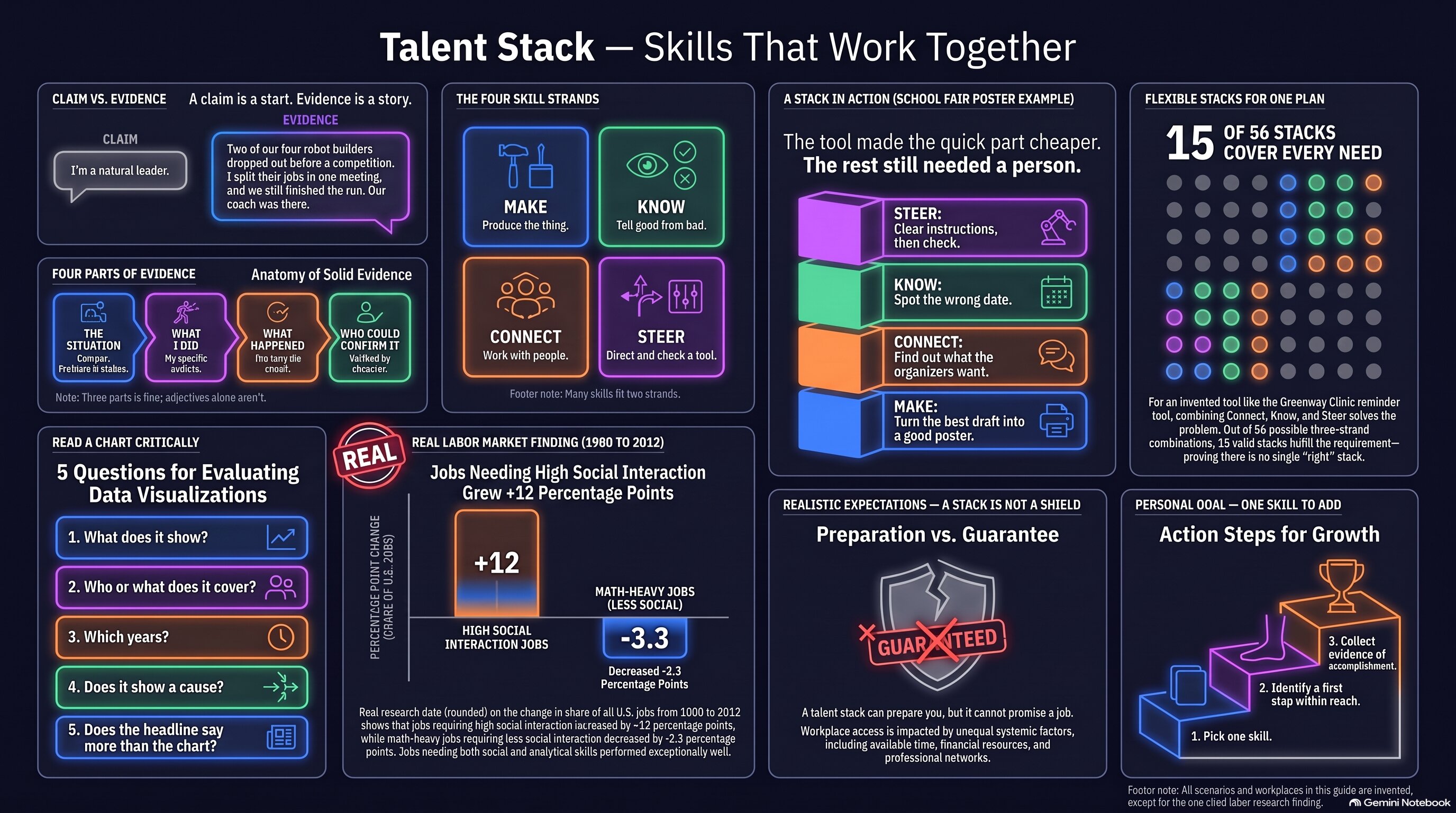
Most jobs call for several skills at once, and when a tool takes over the routine part of a task, the other skills matter more to the result. A talent stack is a few skills that work together. Anyone can say they're good at something. Evidence is a time you used the skill, and it's what makes the claim believable.
Your mission is to audit your own skills with evidence, see how skills combine, read a real research chart without reading more into it than it shows, and choose one skill to add. This sets up 3.2.3 and 3.2.4, where you'll look at the tasks inside a real job.
What you'll do in this activity
- Tell claims from evidence, and turn a claim into a story with four parts.
- Sort skills into four strands: Make, Know, Connect and Steer.
- Build a stack of three skills for an invented workplace where a tool does the routine part.
- Read a real research chart, and judge what it supports and what it doesn't.
- Meet invented people in computing and other jobs, and see how their stacks differ.
- Fill in your own Talent Stack Sheet: evidence for four skills, your stack, and one skill to add.
Ground rules
- Skills come from school, jobs, family, hobbies, sports and community. Evidence from home and work counts.
- Your Talent Stack Sheet is yours. Share only what you're comfortable sharing. It's graded on how specific your evidence is, not on how impressive your skills sound.
- Don't write other people's names or private details. If your teacher lets you use a chatbot to check your sentences, paste only those sentences.
- A stack is not a shield. It can help you prepare, but nobody can promise which skills will protect a job.
Why it matters
When tools change which tasks take time, the people who can say what they can do, with evidence, and who see how their skills fit together, can choose what to learn next instead of guessing.
✅ Self-Check Before You Share
Check off each item as you get there. These aren't grades. They're your own signal.