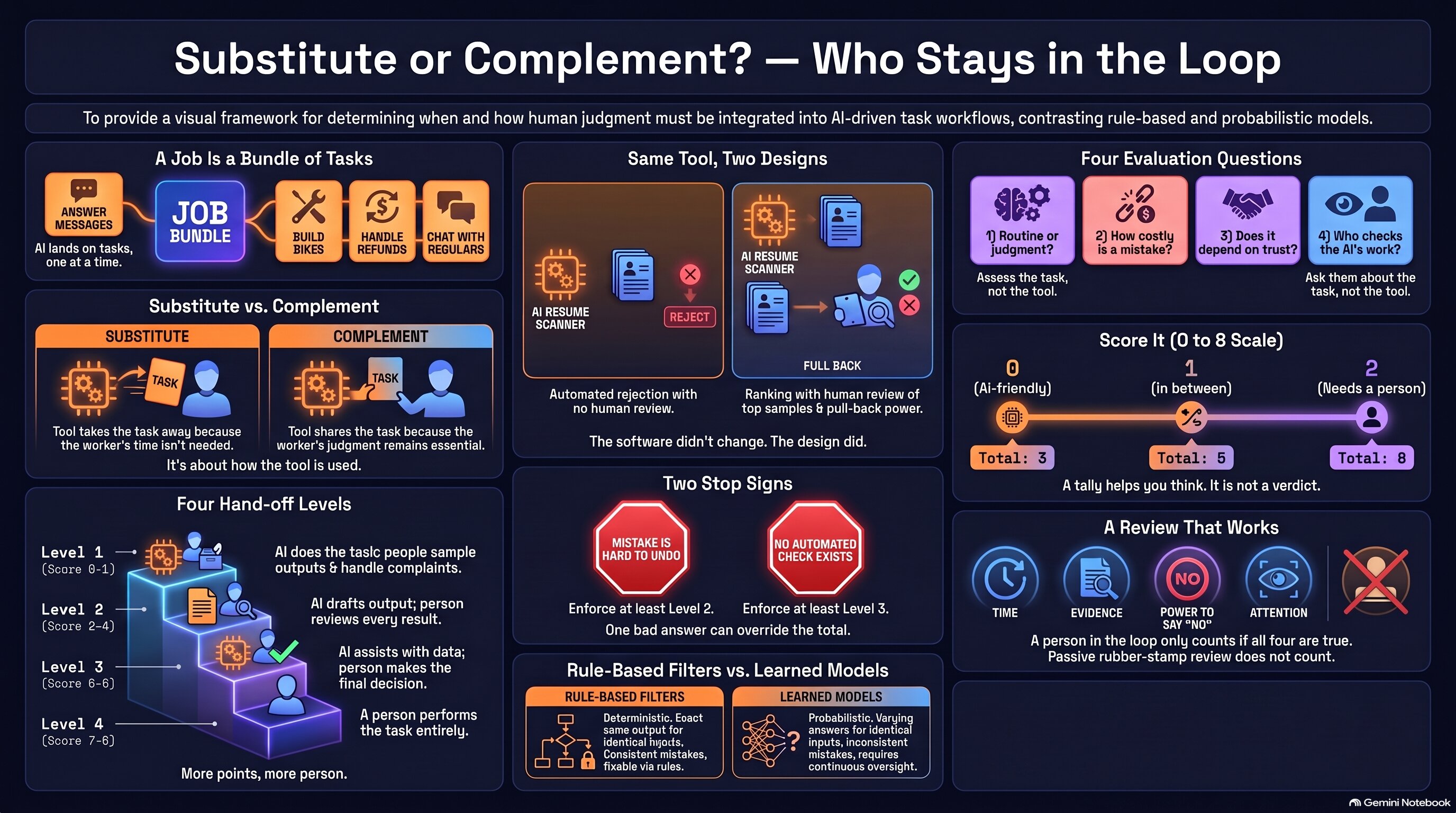
Quick reference for tasks versus jobs, substitute versus complement, the four questions, the hand-off levels and stop signs, and what makes a human in the loop real.
🧭 Plot Summary
A job is a bundle of tasks. When a new tool arrives, it usually lands on one task at a time. Sometimes it substitutes for the task, and the worker's time isn't needed for it anymore. Sometimes it complements the worker, who does the task better or faster and still uses their own judgment.
Your mission is to decide, task by task, how much a person should stay involved. You'll ask four questions, find a hand-off level, and test what makes a human "in the loop" real instead of a rubber stamp. This is the thinking behind the AI-use guide you'll write for a real client at the end of the unit.
What you'll do in this activity
- Sort invented situations: is the tool a substitute for a task, or a complement to the person doing it?
- Score a task with four questions: routine or judgment, cost of a mistake, trust, and who checks.
- Find a hand-off level, and see how two stop signs can lift it.
- Test a keyword scanner and see what a rule-based filter misses.
- Choose which AI decisions get reviewed when a reviewer can only look at some.
- Apply the four questions to tasks in retail, health care, the trades and creative work.
Ground rules
- Practice on the invented examples provided. Don't paste a real résumé, medical information or anyone else's details into a chatbot.
- When you talk about real jobs, talk about tasks. Don't guess whether a particular person's job is "safe."
- The points and levels are a thinking tool, not a verdict. People can reasonably weigh the questions differently, so give a reason for your call.
Why it matters
"Can AI do it?" is rarely the useful question. "Should it do it alone, and who checks?" is. Whoever sets up an AI tool at work, at school or in a club has to answer it.
✅ Self-Check Before You Share
Check off each item as you get there. These aren't grades. They're your own signal.