Quick reference for given, observed and inferred data, structured and unstructured data, reading a privacy label, the necessity test, and how pieces add up.
🧭 Plot Summary
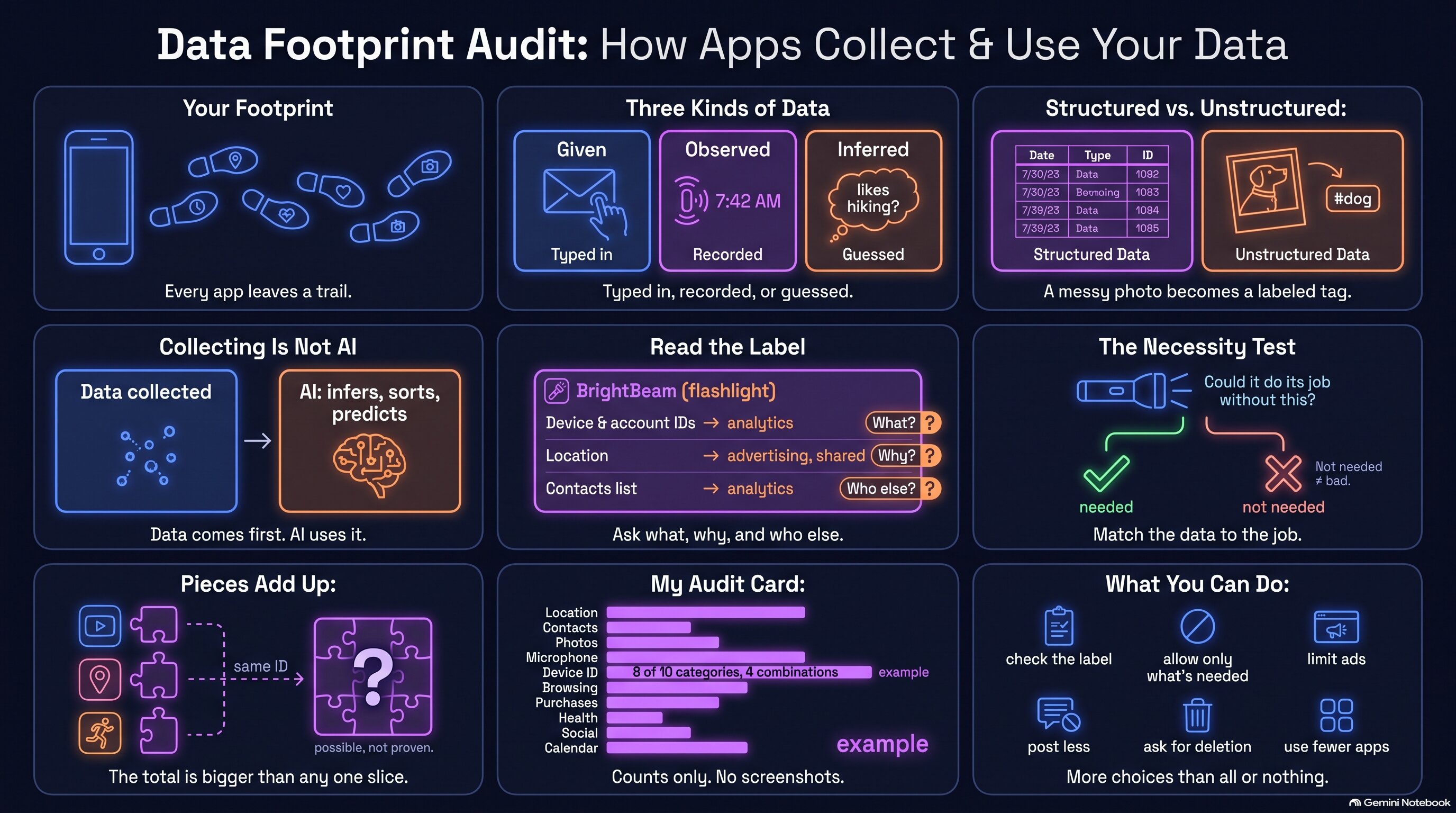
Every app you open is quietly collecting something. Some of it you typed in. Some of it the app recorded while you used it. Some of it the app only guessed. None of that is AI by itself. It is data, and it is what a recommender like the one in 3.1.1 runs on.
Your mission is to audit it. You'll sort data by how the app got it, read an app's privacy label, ask whether the app needs each piece for its job, and see how pieces from several apps could add up. Then you'll decide what you would do about it.
What you'll do in this activity
- Sort data about an invented user: given, observed, or inferred, structured or unstructured.
- Read the privacy labels of invented apps and count what is collected, shared, and used for ads.
- Run the necessity test on each row: does the app need this to do its job?
- Use the audit lab to see how data from several kinds of apps adds up.
- Build your own Audit Card with counts only, no screenshots and no real account data.
- Decide what you would allow, limit, or ask about, and what each choice really changes.
Ground rules
- Practice on the invented apps and labels provided. Don't list the real apps on a classmate's phone, and don't look at anyone else's phone.
- No screenshots of account or settings pages. If you audit a real app, write down counts only.
- Your contacts list belongs to other people too. Don't read out or share names from it.
Why it matters
You can't choose well about data you can't see. Asking what, why, and who else makes a privacy label readable, and it sets you up for the letter you'll write in 3.1.3.
✅ Self-Check Before You Share
Check off each item as you get there. These aren't grades. They're your own signal.