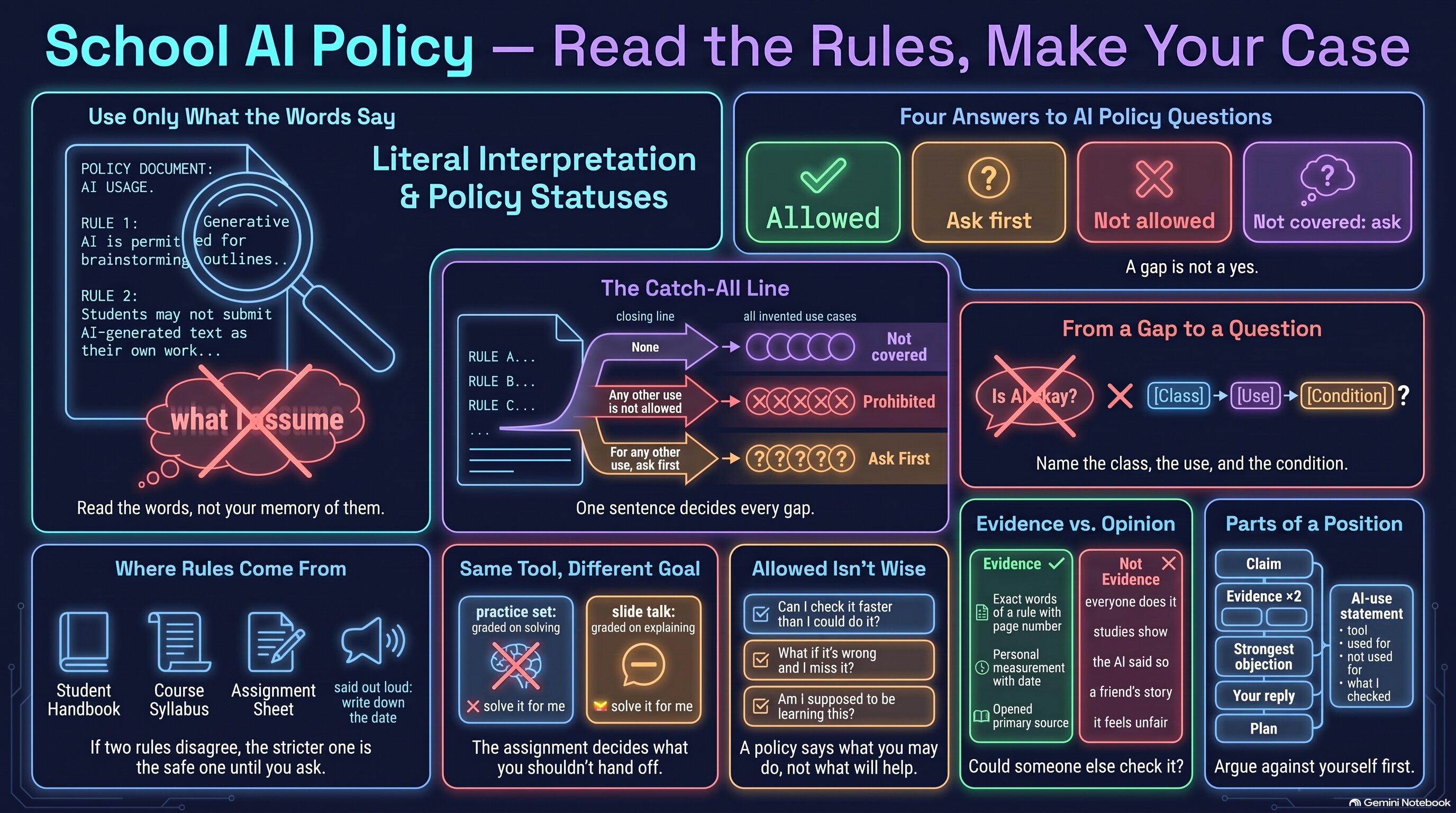
Quick reference for reading a policy, the four answers it can give, the catch-all line, the learning-goal test, what counts as evidence, and the parts of a position.
🧭 Plot Summary
Every school has rules about AI, and most students have never read them. Some rules are written down. Some are one line in a syllabus. Some are only what a teacher said once. In this activity you find the rules that apply to you, read them closely, and work out what they actually say, and what they leave out.
Then you take a position: is your school's rule fair and workable? You back it with evidence someone else can check, argue against yourself, and finish with a plan for how you would use AI, and not use it, on one real assignment. Everything in the practice check is invented, and the policies you read are your school's own.
What you'll do in this activity
- Find the rules that actually apply to you: your school's handbook and two class syllabi, copied word for word.
- Sort every use of AI into allowed, ask first, not allowed or not covered, using only what the words say.
- Turn each gap into a question a teacher could answer in one sentence.
- Learn why the same use can be fine on one assignment and defeat the point of another.
- Write a short position on your school's AI rule, backed by evidence someone else can check, and argue against it yourself.
- Finish with an acceptable-use plan for one assignment and an AI-use statement you could attach to real work.
Ground rules
- Quote the policy exactly. Don't rely on what you remember it saying.
- Leave teachers' names off your worksheet. Write \"Class A\" and \"Class B.\" This activity is about rules, not people.
- If you use AI to look for counterarguments, check any fact it gives you before you use it.
Why it matters
Later in this unit you will make real choices about when to use AI. This activity gives you the habit of checking the rules first, and the words to ask when the rules run out.
✅ Self-Check Before You Share
Check off each item as you get there. These aren't grades. They're your own signal.