Use this as a quick reference for limit notation at both ends, the leading term dominating, the four end-behavior patterns, and reading ends from graphs.
🧭 Plot Summary
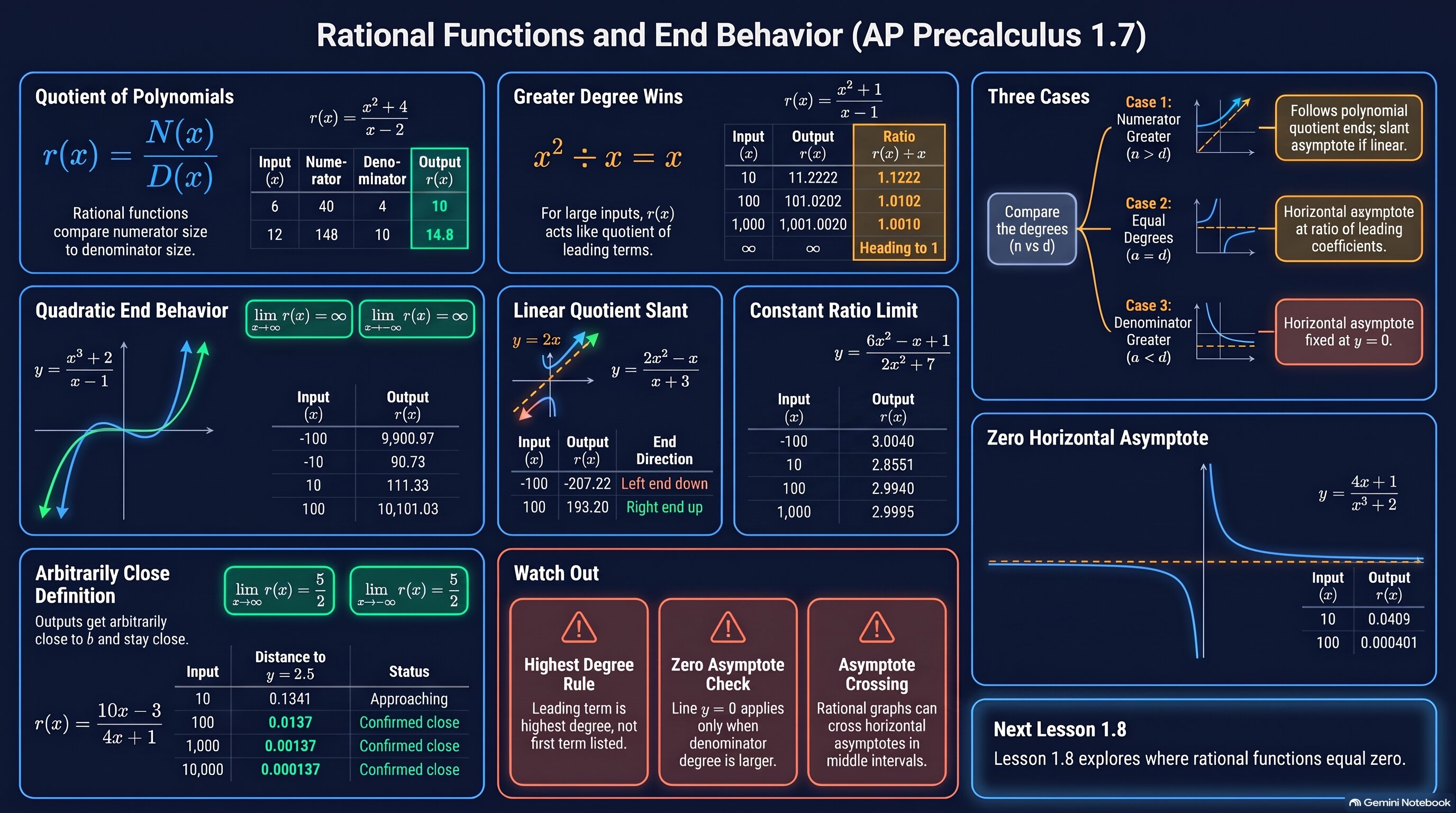
Lesson 1.6 gave polynomials their ends. Now put one polynomial over another. A rational function r(x) = N(x) ÷ D(x) measures how big the numerator is compared with the denominator, so its ends depend on which one dominates. The polynomial of greater degree wins, and the shortcut is the quotient of the leading terms. A bigger numerator gives the ends of a polynomial (a slant asymptote if the quotient is linear). Equal degrees give a horizontal asymptoteat the ratio of the leading coefficients. A bigger denominator gives the horizontal asymptote y = 0.
What you'll do in this lesson
- Read a rational function as a measure of numerator size relative to denominator size.
- Compare degrees to decide which polynomial dominates the ends.
- Form the quotient of the leading terms and simplify it.
- Describe the ends when the numerator dominates, including slant direction.
- Find horizontal asymptotes for equal degrees and for a dominant denominator.
- Write limit statements for end behavior and explain what “arbitrarily close” means.
Why it matters
Many real quantities level off: the average cost per item as production grows, the concentration of a medicine over time, the speed of an object as drag builds. A rational model with a horizontal asymptote says where that long-run value settles. Lesson 1.8 will find where a rational function equals zero.
✅ Self-Check Before You Move On
Check off each item as you get there. These aren't grades — they're your own signal.