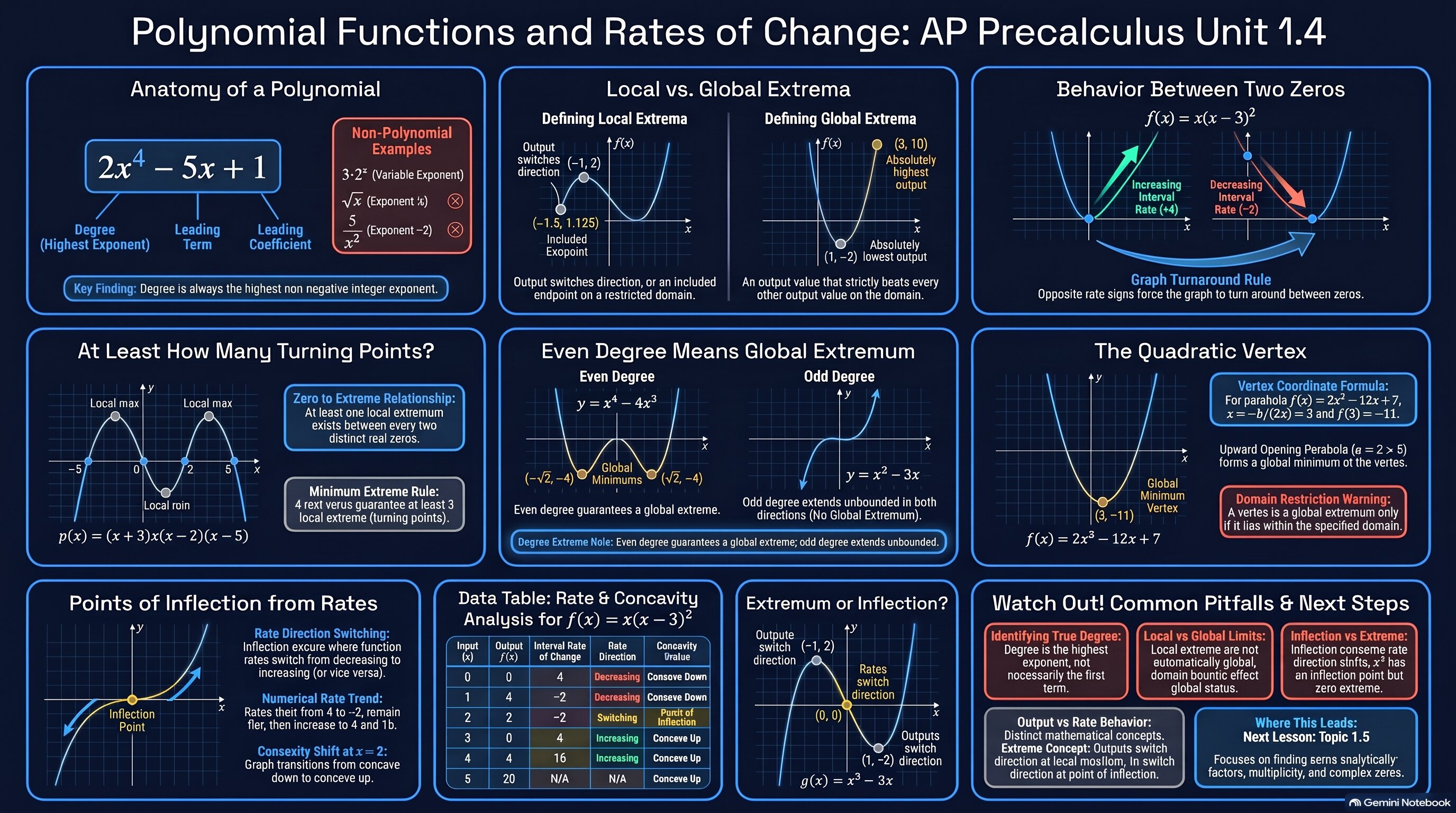
Use this as a quick reference for polynomial vocabulary, local and global extrema, turning points between zeros, even-degree global extremes, and points of inflection.
🧭 Plot Summary
Lesson 1.3 showed how the rates of a function can change. Now you put that to work on polynomial functions. You will name a polynomial's degree and leading coefficient, then find where it switches between increasing and decreasing. Those switches are local maximums and minimums, and the highest or lowest of them can be global. Between every two real zeros there must be one, every even-degree polynomial has a global extreme, and where the rates switch from increasing to decreasing (or the reverse) you find a point of inflection.
What you'll do in this lesson
- Recognize polynomial functions and name the degree, leading term, and leading coefficient.
- Find local maximums and minimums where a polynomial switches between increasing and decreasing.
- Decide which local extrema are global, including endpoints of a restricted domain.
- Show that there is a turning point between every two distinct real zeros.
- Use even degree to know a global extreme exists, and find a quadratic's at its vertex.
- Locate points of inflection where the rates switch from increasing to decreasing, or the reverse.
Why it matters
Maximizing profit, minimizing cost, and finding the peak of a launched object all come down to locating extrema. Reading a graph's turning points and bends is also how you will sketch and analyze polynomials in Lessons 1.5 and 1.6, and it is the idea behind the derivative later on.
✅ Self-Check Before You Move On
Check off each item as you get there. These aren't grades — they're your own signal.