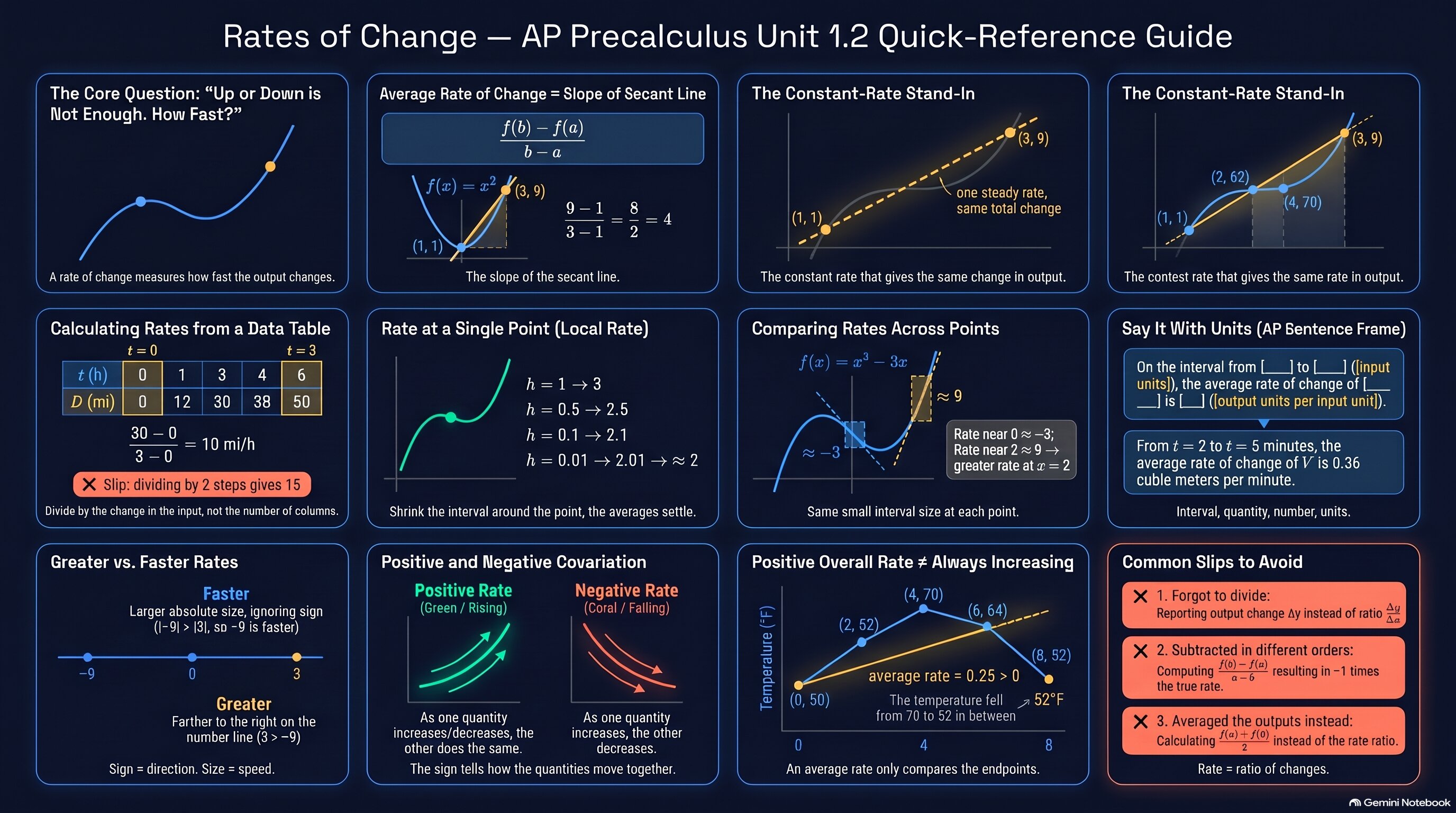
Use this as a quick reference for average rate of change, rates at a point, comparing rates at two points, and what positive and negative rates mean.
🧭 Plot Summary
Lesson 1.1 told you whether outputs go up or down. This lesson says how fast. The average rate of change of a function over an interval is the change in the output divided by the change in the input, the steady rate that would produce exactly the same change. Shrink the interval around a single input and the averages settle toward the rate of change at that point, which lets you compare how fast a function is changing in two different places. The sign tells the story: a positive rate means the two quantities move in the same direction, and a negative rate means they move in opposite directions.
What you'll do in this lesson
Find the average rate of change over an interval: the change in output divided by the change in input.
Read that rate as the slope of the secant line, and as the constant rate that gives the same change.
Approximate the rate of change at a point with average rates over small intervals around it.
Compare the rates of change at two different points.
Use positive and negative rates to describe how two quantities vary together.
Describe rates in context, with the interval and the units.
Why it matters
Average rates of change are the first step toward slopes of secant lines, linear and quadratic models, and eventually the derivative in calculus. Every "how fast" question in this course starts here.
✅ Self-Check Before You Move On
Check off each item as you get there. These aren't grades — they're your own signal.