Use this as a quick reference for all three collision types and the AP skills required for each.
🧭 Plot Summary
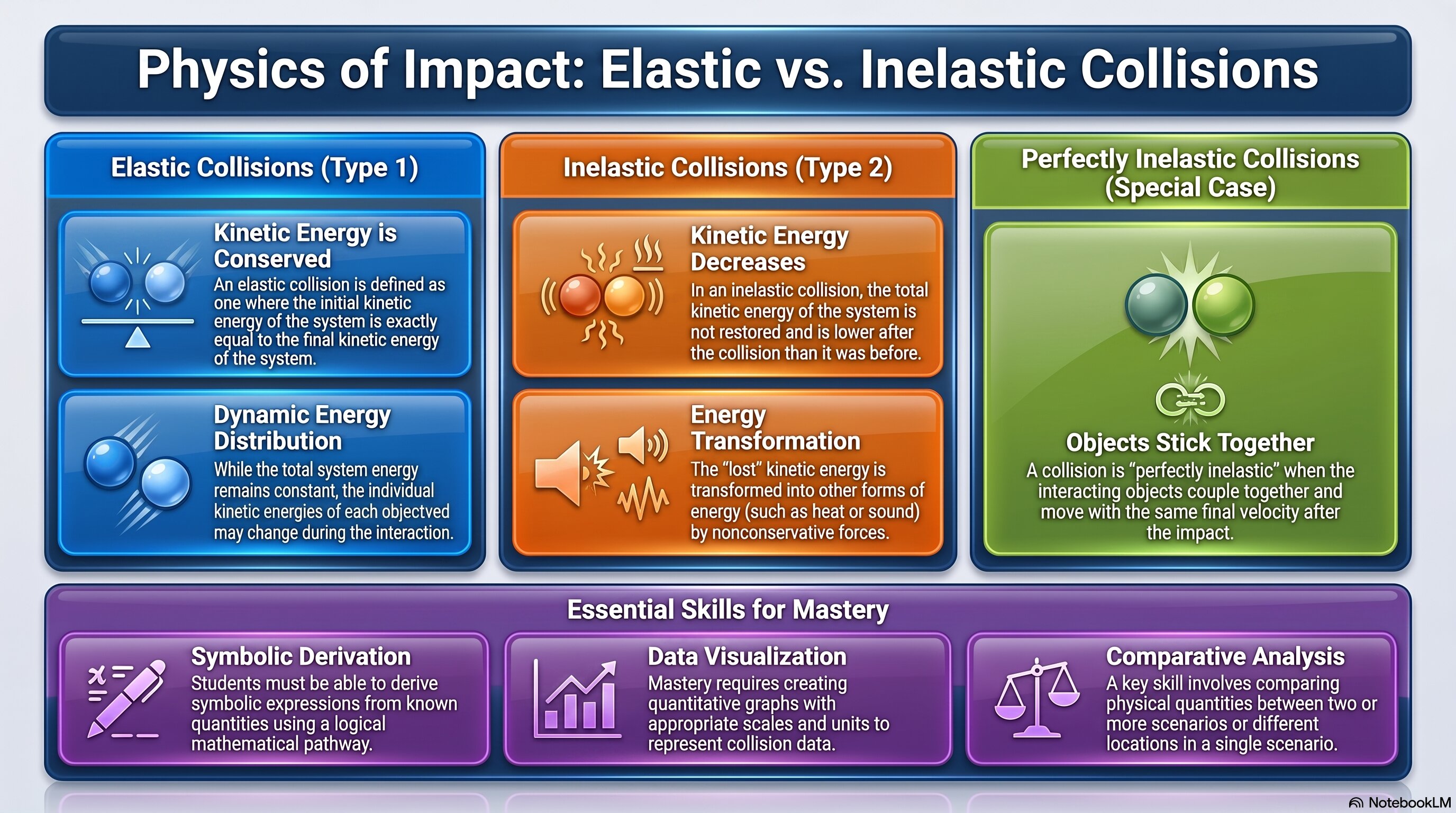
In Lesson 4.3 you established that momentum is always conserved in isolated systems. This lesson adds the crucial question: what about kinetic energy?The answer divides all collisions into three types. Momentum is conserved in every single one. Kinetic energy is only conserved in elastic collisions — which means you get to use two equations instead of one, and solve for two unknowns.
The three collision types
AP Skills this lesson
What you will do in this lesson
- Classify collisions: elastic (p and KE conserved), inelastic (p conserved, KE not), perfectly inelastic (objects stick, maximum KE loss).
- Apply Sp_i = Sp_f to all collision types.
- Apply KE_i = KE_f as an additional constraint for elastic collisions only.
- Solve for final velocities in perfectly inelastic collisions using v_f = Sp_i / (m1+m2).
- Calculate energy lost in inelastic collisions: DKE = KE_f - KE_i.
- Derive symbolic expressions for collision outcomes from known quantities.
Why it matters
This is the season finale of Unit 4 — and it ties together momentum conservation from 4.3 with kinetic energy from Unit 3 in a single problem. Elastic collision problems are the most algebraically demanding in the unit. Master the two-equation system and you have unlocked the full toolkit for every collision the AP exam can throw at you.
✅ Self-Check Before You Roll On
Check off each item as you get there. These are not grades — they are your own signal.