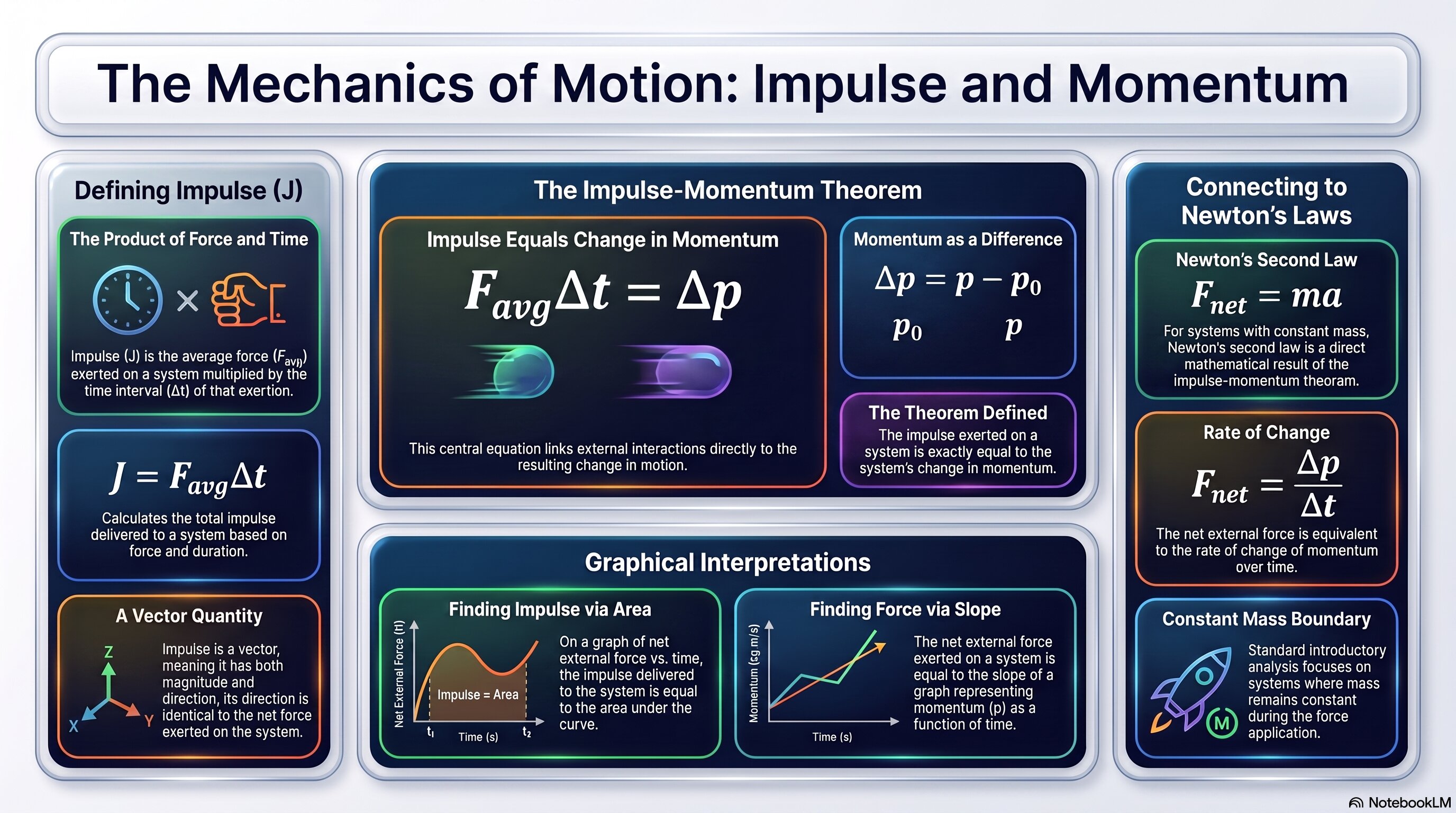
Use this as a quick reference for impulse, the impulse-momentum theorem, and both graphical interpretations.
🧭 Plot Summary
In Lesson 4.1 you learned what momentum is. This lesson answers how it changes. The answer is impulse— the product of the average force applied to an object and the time interval over which it acts. Impulse equals the change in momentum. That one equation — J = Dp — is the impulse-momentum theorem, and it connects force, time, and motion in a way Newton's Second Law cannot do as cleanly.
The real power of this lesson is in the graphs. On a Force vs. time graph, impulse is the area under the curve — even when the force varies. On a momentum vs. time graph, the net force is the slope. These two graphical skills appear on the AP exam almost every year.
Two graphical interpretations
What you will do in this lesson
- Define impulse as J = F_avg * Dt — average force multiplied by the time interval.
- Apply the impulse-momentum theorem: J = Dp = m*vf - m*vi.
- Extract impulse from the area under a Force vs. time graph.
- Extract net force from the slope of a momentum vs. time graph.
- Explain why increasing contact time decreases peak force for the same change in momentum.
- Connect the impulse-momentum theorem to Newton's Second Law algebraically.
Why it matters
The impulse-momentum theorem is the most direct bridge between Unit 2 (forces) and Unit 4 (momentum). It explains why airbags save lives (longer time, smaller force for same Dp), why follow-through matters in sports, and why catching a ball hurts less when you pull your hand back. It also sets up conservation of momentum in 4.3 — understanding impulse makes conservation feel inevitable rather than arbitrary.
✅ Self-Check Before You Roll On
Check off each item as you get there. These are not grades — they are your own signal.