Use this as a quick reference for average and instantaneous power, the Watt unit, and the F·v·cosθ form.
🧭 Plot Summary
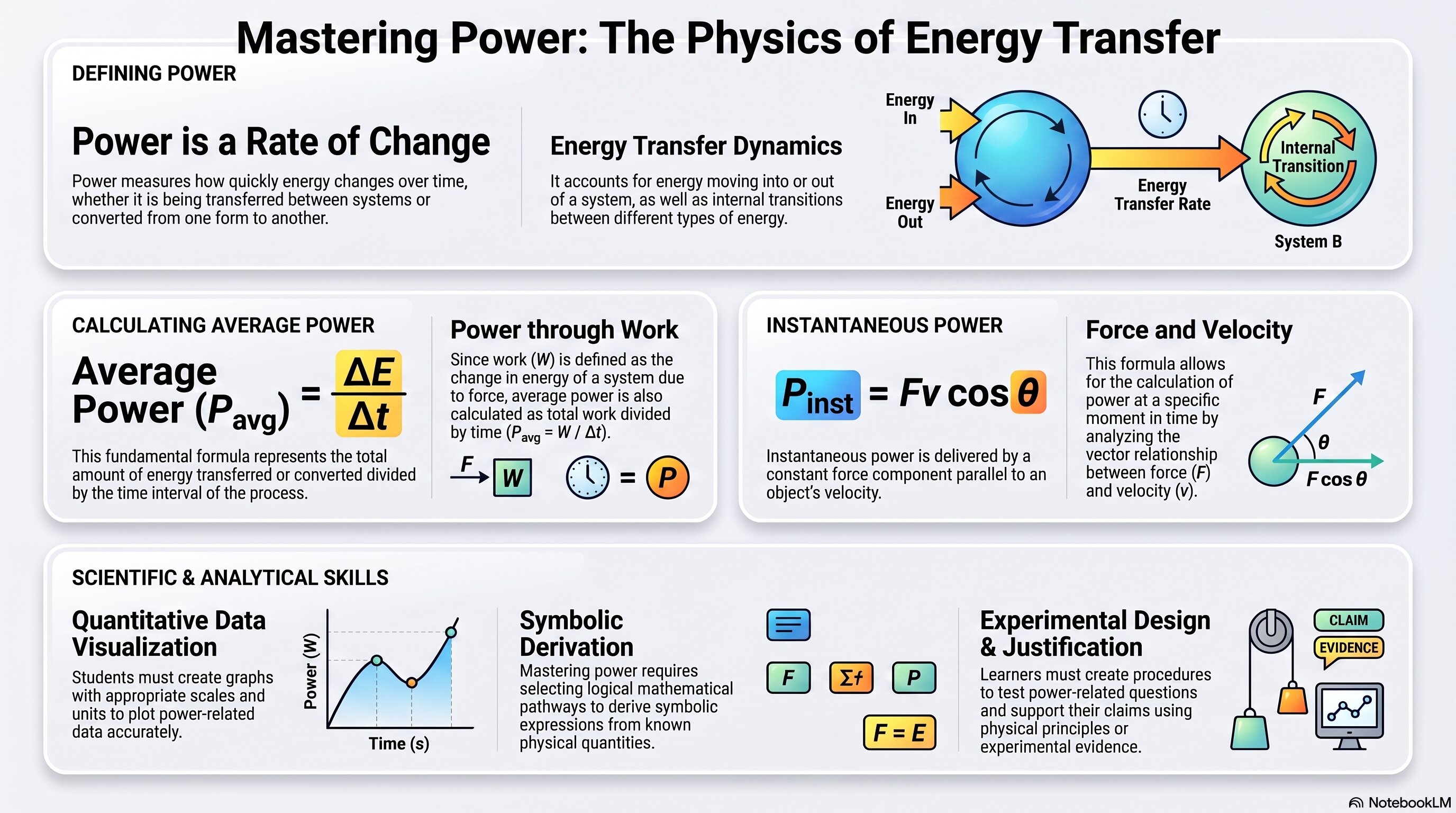
You've spent four lessons tracking how much energy moves between systems. This final episode asks a different question: how fast? Power is the rate of energy transfer — the amount of energy moved per unit time. The same amount of work done in half the time requires twice the power. That's the entire concept.
The unit of power is the Watt (W) — one Joule per second. A 100 W light bulb converts 100 J of electrical energy to light and heat every second. A human climbing stairs at a reasonable pace generates about 100–200 W. A car engine produces tens of thousands of Watts.
Two forms of the equation
What you'll do in this lesson
- Define power as the rate at which energy is transferred or converted: P = ΔE/Δt.
- Calculate average power using P_avg = W/Δt (work divided by time).
- Calculate instantaneous power using P_inst = Fv cosθ.
- Explain that Watts = Joules per second (W = J/s).
- Recognize that power depends on both the amount of energy transferred and how quickly.
- Extract total energy transferred from the area under a P vs. t graph.
Why it matters
Power is the bridge between energy physics and real-world engineering. Every machine, motor, and biological system is rated by how fast it can transfer energy — not just how much. On the AP exam, power problems often connect to work-energy theorem problems from 3.4: given a power output, find the speed achievable against friction, or find how long it takes to do a given amount of work.
🎯 AP Skills This Lesson
Power problems frequently test these AP Physics 1 science practices directly:
✅ Self-Check Before You Roll On
Check off each item as you get there. These aren't grades — they're your own signal.