Use this as a quick reference for total mechanical energy, the KE/PE trade-off, and how amplitude sets total energy.
🧭 Plot Summary
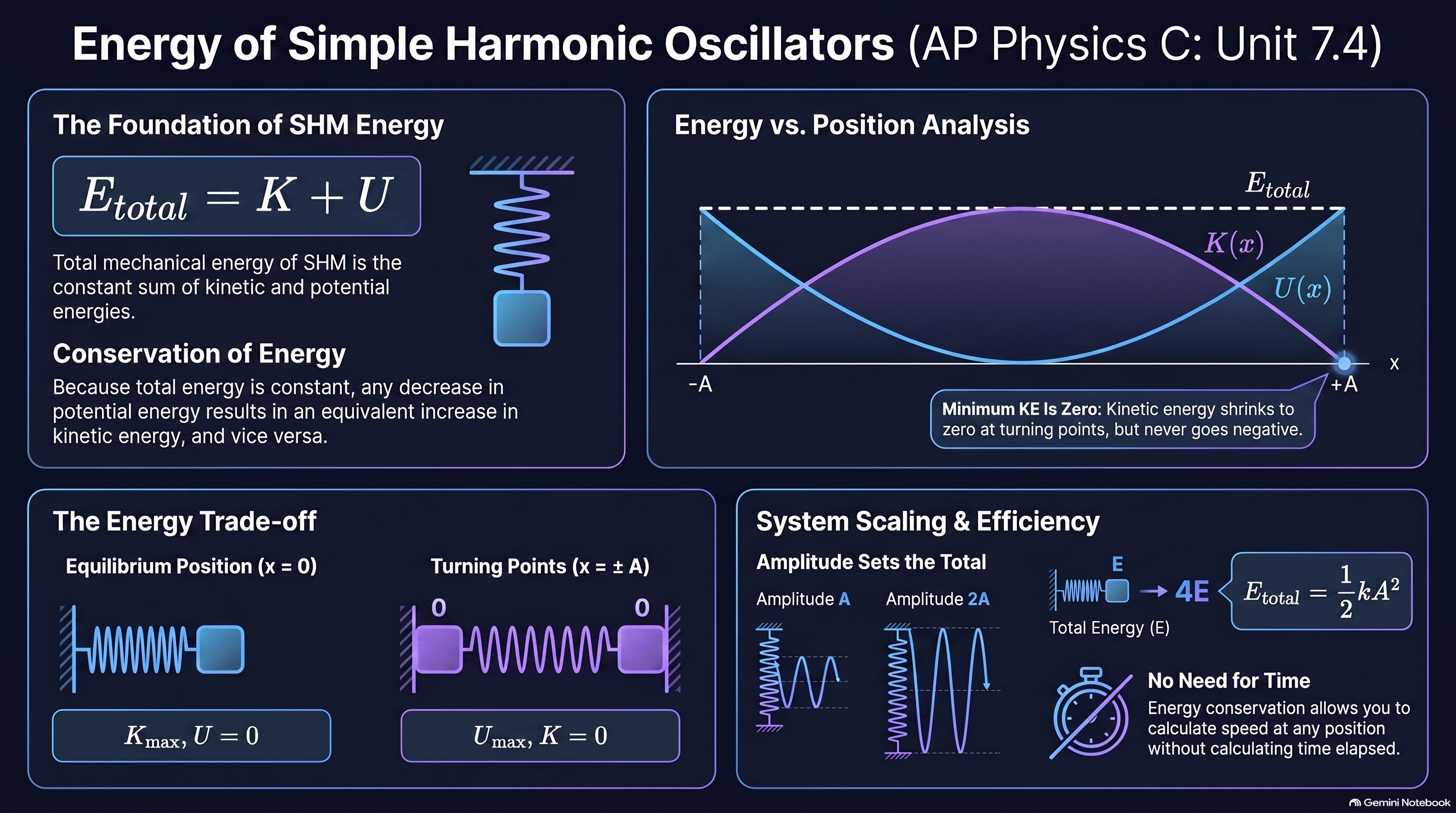
Every SHM system is constantly trading energy back and forth between two forms: kinetic energy and potential energy. Their sum, the system's total mechanical energy Etotal = K + U, never changes — that's just conservation of energy at work. What does change is the split: kinetic energy peaks exactly where potential energy bottoms out (at equilibrium), and potential energy peaks exactly where kinetic energy bottoms out at zero (at the extremes of motion). For a spring–object system, that fixed total energy has a clean formula all its own: Etotal = ½kA² — set entirely by amplitude.
What you'll do in this lesson
- Write total mechanical energy as the sum of kinetic and potential energy: Etotal = K + U.
- Use conservation of energy to explain why Etotal stays constant throughout SHM.
- Identify where KE is maximum and PE is minimum, and where PE is maximum and KE is minimum (zero).
- Find total energy from amplitude for a spring–object system: Etotal = ½kA².
- Predict how total energy changes when amplitude is scaled by some factor.
Why it matters
Energy conservation lets you find an SHM system's speed at any displacement without ever touching time — one of the most efficient problem-solving shortcuts in the whole unit.
✅ Self-Check Before You Balance the Books
Check off each item as you get there. These aren't grades — they're your own signal.