Use this as a quick reference for rolling without slipping, rolling with slipping, and how each affects a system's kinetic energy.
🧭 Plot Summary
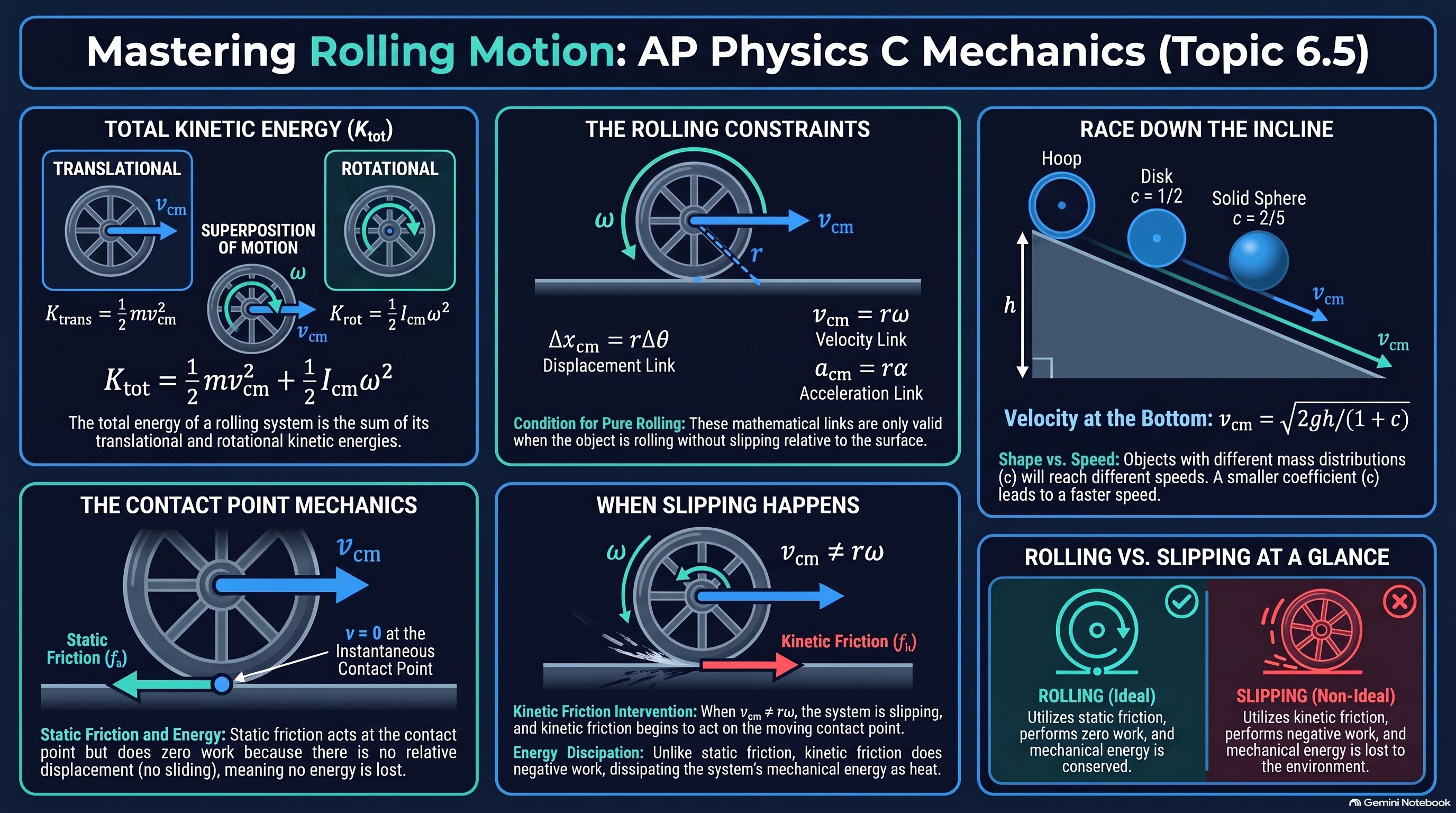
Rolling is where Unit 6 comes full circle: a rolling object both translates and rotates at once, so its total kinetic energy is Ktot = Ktrans + Krot — the equation you first met back in 6.1, now doing real work. What makes rolling special is the constraint that ties the two motions together: when an object rolls without slipping, its center-of-mass speed and its angular speed are locked in a fixed relationship, vcm = rω. That relationship is also why ideal rolling doesn't waste any energy to friction — but the moment a system starts to slip, that clean relationship breaks down, and kinetic friction starts dissipating real energy out of the system.
What you'll do in this lesson
- Find the total kinetic energy of a rolling system as the sum of its translational and rotational kinetic energies.
- Apply the rolling-without-slipping constraints connecting a system's translational and rotational motion: vcm = rω and acm = rα.
- Explain why ideal rolling without slipping conserves energy, with no work done by friction.
- Recognize rolling while slipping, where vcm ≠ rω and kinetic friction dissipates energy.
- Compare how different rolling shapes race down the same incline using energy conservation.
Why it matters
Rolling ties together everything from Unit 6 — rotational kinetic energy (6.1), torque (6.2), angular momentum (6.3 and 6.4) — into the single most commonly tested scenario on the AP exam: an object rolling down an incline.
✅ Self-Check Before You Roll On
Check off each item as you get there. These aren't grades — they're your own signal.