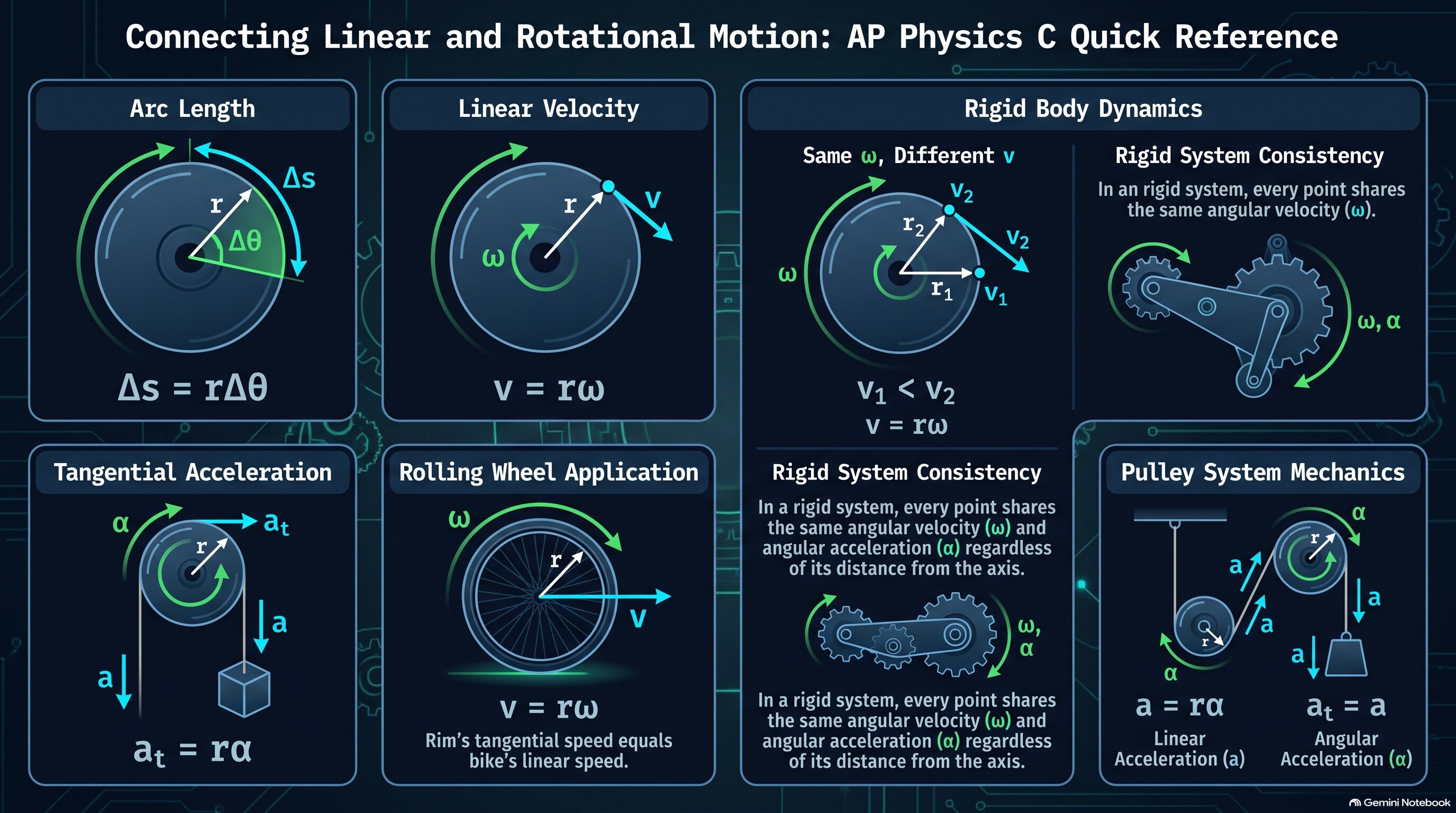
Use this as a quick reference for arc length, v = rω, aT = rα, and pulley/rolling-object applications.
🧭 Plot Summary
This short but essential lesson bridges the angular world of Lesson 5.1 back to the linear world you've lived in since Unit 1. Every point on a rotating rigid system shares the exact same angular velocity and angular acceleration — but their linear speeds and accelerations are completely different, depending entirely on how far each point sits from the axis of rotation: v = rω and aT = rα. This single pair of equations is the workhorse behind every pulley, every rolling wheel, and every gear system you'll encounter for the rest of the course.
What you'll do in this lesson
- Calculate arc length from angular displacement and radius.
- Convert between angular and linear velocity, and between angular and tangential acceleration.
- Recognize that every point on a rigid system shares the same ω and α, even though linear speed depends on distance from the axis.
- Apply v = rω and aT = rα to pulleys, rolling objects, and other connected systems.
Why it matters
Torque (5.3), rotational inertia (5.4), and every pulley-and-hanging-mass problem from here forward all rely on converting between a system's angular motion and the linear motion of specific points on it. This lesson is that conversion.
✅ Self-Check Before You Roll On
Check off each item as you get there. These aren't grades — they're your own signal.