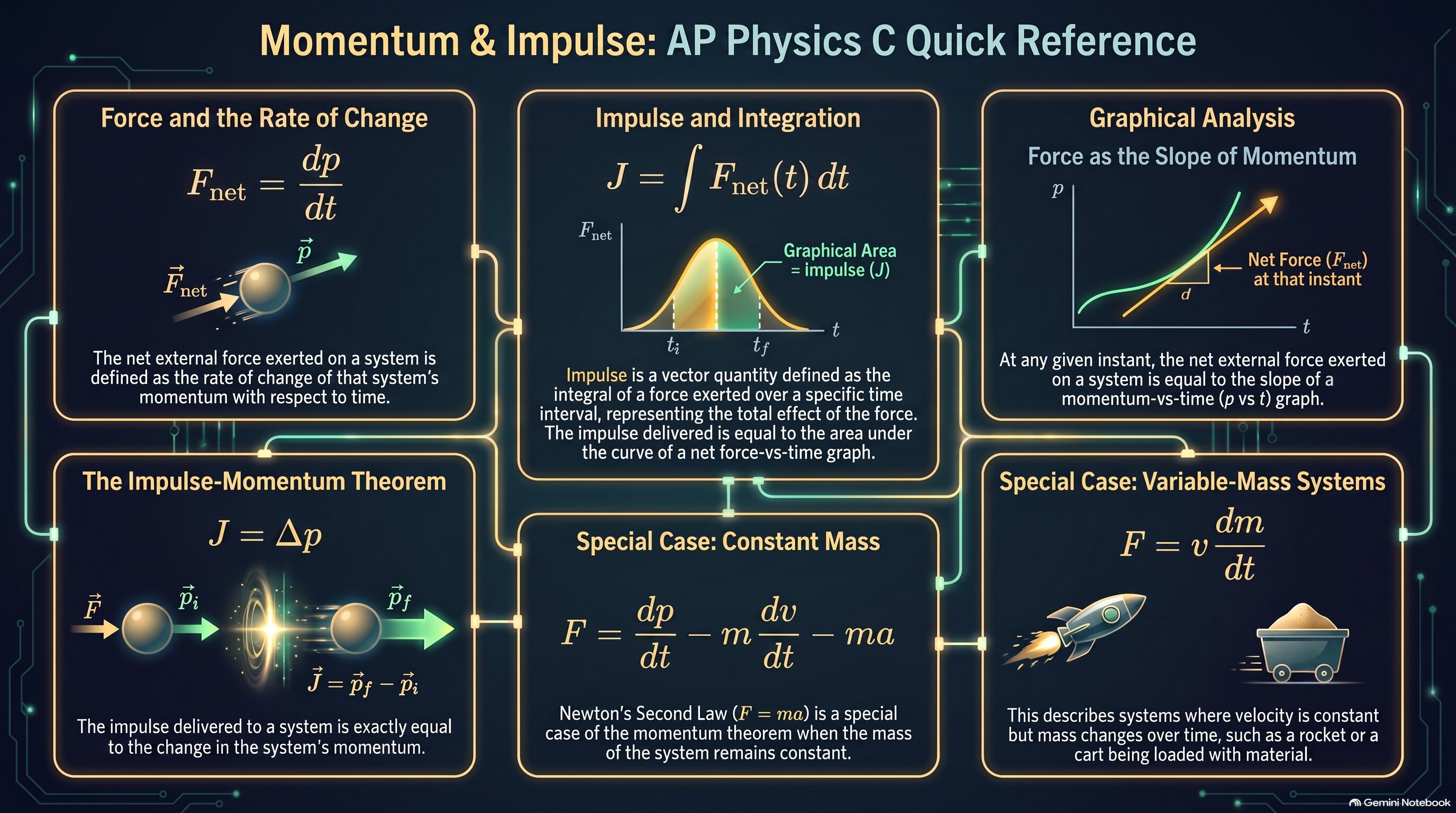
Use this as a quick reference for impulse, the force-time and momentum-time graph pair, and the impulse-momentum theorem.
🧭 Plot Summary
This lesson gives momentum its own calculus, running in perfect parallel to position, velocity, and acceleration from Lesson 1.3. Net force is the rate of change of momentum — its derivative. Impulse is force integrated over time — exactly like displacement was velocity integrated over time. Just like you could read velocity as the slope of a position graph and displacement as area under a velocity graph, here you can read force as the slope of a momentum-time graph, and impulse as the area under a force-time graph. Tie it all together with the impulse-momentum theorem, and you have a second, completely independent way to solve motion problems — one that doesn't require ever mentioning acceleration at all.
What you'll do in this lesson
- Relate net force to the rate of change of a system's momentum.
- Calculate impulse as the integral of force over time, and as area under a force-time graph.
- Find net force as the slope of a momentum-time graph.
- Apply the impulse-momentum theorem to relate impulse to a change in momentum.
- Recognize Newton's second law as a special case of the impulse-momentum theorem.
- Apply the impulse-momentum theorem to systems with changing mass.
Why it matters
Newton's second law turns out to be a special case of this lesson's central theorem — and the same theorem also handles a case F=ma can't touch directly: systems where mass itself is changing, like a rocket burning fuel.
✅ Self-Check Before You Roll On
Check off each item as you get there. These aren't grades — they're your own signal.