Use this as a quick reference for potential energy, the force-slope relationship, equilibrium, and the common potential energy formulas.
🧭 Plot Summary
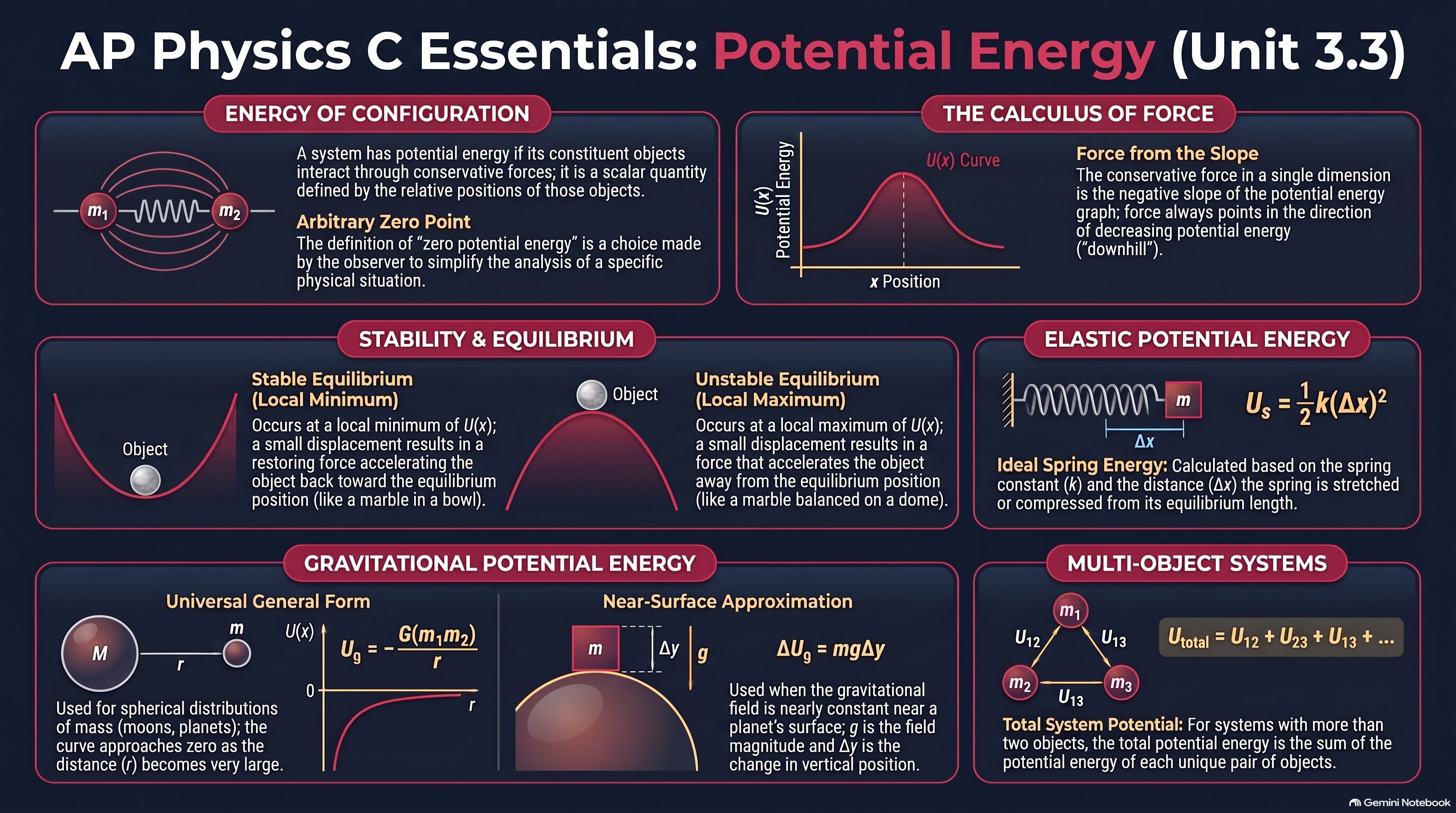
Potential energy is energy stored in a system's configuration — and it only exists when a system's objects interact through conservative forces (Lesson 3.2). Where kinetic energy lives in motion, potential energy lives in position, and the two are locked together by calculus: potential energy is (negative) the integral of force over distance, and — running that relationship backward — force is the negative slope of a potential energy graph. That single fact turns any U(x) graph into a map of every equilibrium point a system has, stable and unstable alike. This lesson closes with three specific, reusable formulas: elastic potential energy in a spring, gravitational potential energy in its full general form, and the familiar near-surface approximation you've been using since Unit 1.
What you'll do in this lesson
- Identify potential energy as existing only for systems interacting through conservative forces.
- Relate potential energy to conservative force through an integral, and force to potential energy through a derivative.
- Read stable and unstable equilibrium positions directly off a potential energy graph.
- Calculate elastic potential energy of a spring and gravitational potential energy in both its general and near-surface forms.
- Find total potential energy for systems with more than two interacting objects.
Why it matters
Potential energy is the missing half of Lesson 3.4's conservation of energy — once you can find U for a system, tracking how energy trades between kinetic and potential forms becomes almost mechanical.
✅ Self-Check Before You Roll On
Check off each item as you get there. These aren't grades — they're your own signal.