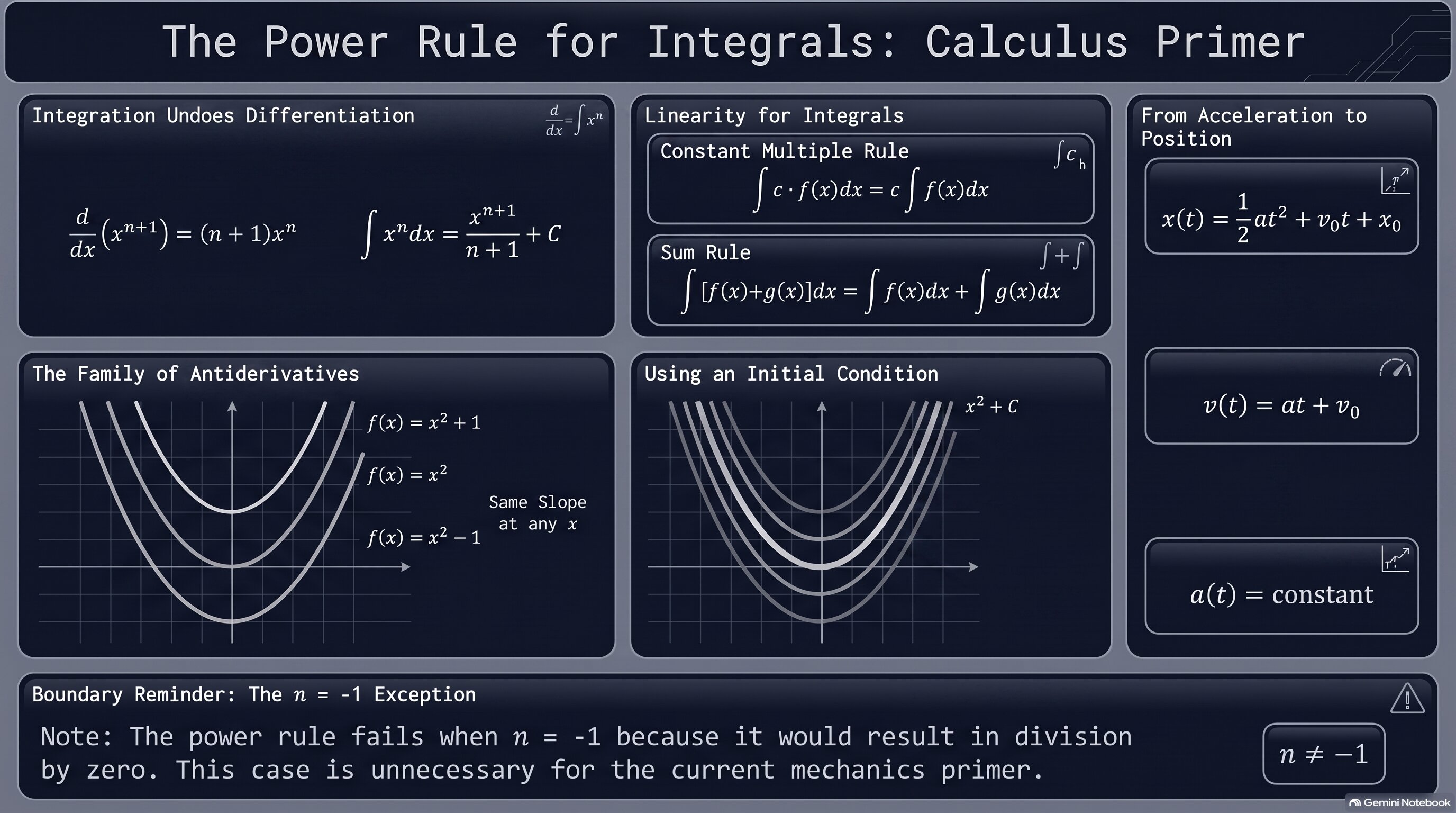
Use this as a quick reference for antiderivatives, the power rule for integrals, and using initial conditions to solve for "+C."
🧭 Plot Summary
Lessons 0.1 through 0.3 all moved in the same direction: given a function, find its rate of change. This lesson turns around and runs the process backward. Given a rate of change, can you recover the original function? That reverse operation is called integration, and — just like differentiation had a power rule shortcut — so does integration. The catch: undoing a derivative doesn't quite get you back to a single function. It gets you back to an entire familyof functions, all differing by a constant.
What you'll do in this lesson
- See why integration is differentiation run backward.
- Apply the power rule for integrals, including to negative and fractional exponents.
- Integrate full polynomials term by term.
- Understand the "+C" and use an initial condition to pin down its exact value.
- Integrate a constant acceleration twice to recover velocity and position — using real initial conditions.
Why it matters
Acceleration is easy to measure or model, but velocity and position are usually what you actually want. Integration is how you get from one to the other — and the "+C" is where initial conditions like v₀ and x₀ enter the picture.
✅ Self-Check Before You Roll On
Check off each item as you get there. These aren't grades — they're your own signal.