Use this as a quick reference for the power rule, linearity, and applying both to negative and fractional exponents.
🧭 Plot Summary
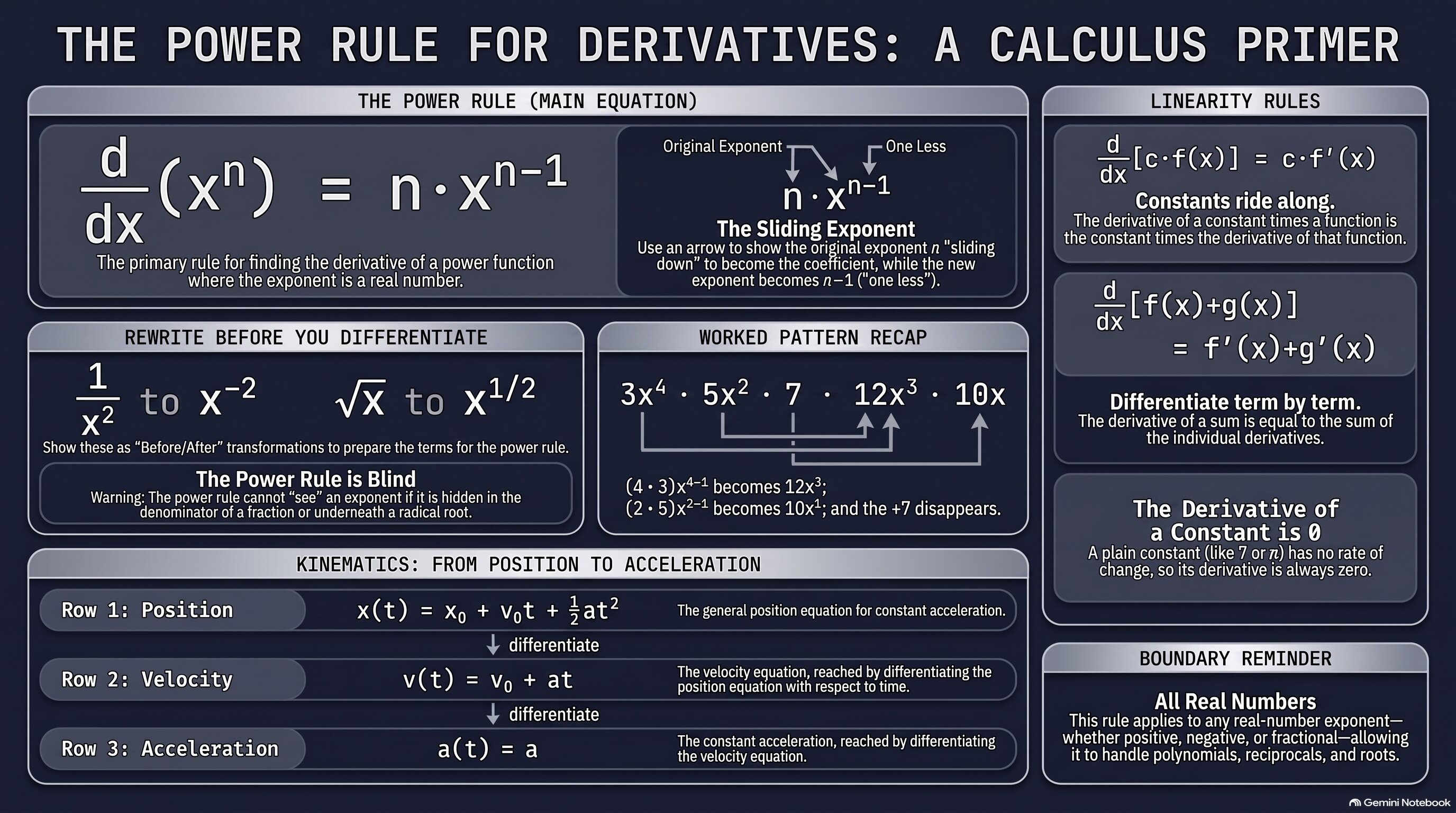
Lesson 0.1 found derivatives from scratch, using a limit, every single time. That's a great way to understand why a derivative works — a terrible way to actually get through a physics problem set. The power rule is the shortcut that pattern-matches what you already discovered: bring the exponent down as a multiplier, then subtract one from it. Pair that with two more rules — how to handle constants multiplying a function, and how to handle functions added together — and you can differentiate almost any polynomial you'll meet this year on sight.
What you'll do in this lesson
- See where the power rule pattern comes from — a direct callback to Lesson 0.1's results.
- Differentiate full polynomials term by term using the constant multiple and sum rules.
- Extend the power rule to negative and fractional exponents.
- Rewrite roots and reciprocals as powers so the rule actually applies.
- Differentiate a real kinematics equation, x(t), all the way down to a(t).
Why it matters
Nearly every position function you'll differentiate in Unit 1 is a polynomial in t — things like x(t) = x₀ + v₀t + ½at². The power rule is what turns that into v(t) = v₀ + at in about five seconds, instead of a full limit computation.
✅ Self-Check Before You Roll On
Check off each item as you get there. These aren't grades — they're your own signal.