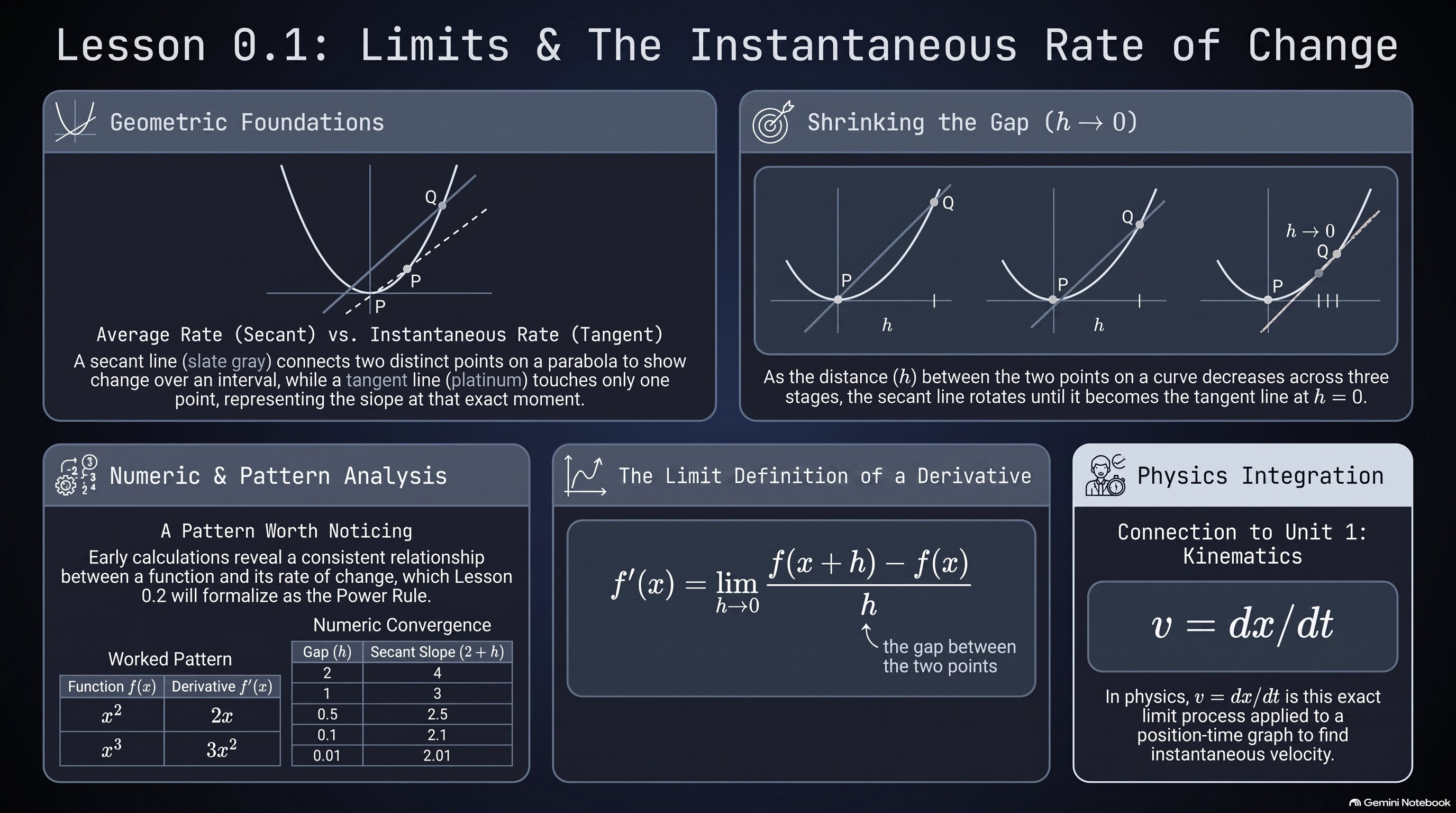
Use this as a quick reference for average vs. instantaneous rate of change and the limit definition of a derivative.
🧭 Plot Summary
Welcome to Unit 0 — a short detour before the physics starts. Every "rate" you'll meet this year — velocity, acceleration, power, torque — is secretly the same idea wearing a different costume: an instantaneous rate of change. Before you can trust a shortcut rule for finding one, it helps to see where that rate actually comes from. It starts as an average rate over some interval, and then that interval gets squeezed down to nothing. What's left over when the interval disappears is a limit — and that limit is a derivative.
What you'll do in this lesson
- Compare average and instantaneous rate of change using the same function.
- Watch a secant line collapse into a tangent line as the interval shrinks toward zero.
- Estimate a derivative numerically by narrowing an interval step by step.
- Apply the formal limit definition of a derivative to a simple polynomial.
- Connect this definition directly to v = dx/dt, which Unit 1 uses immediately.
Why it matters
In Lesson 1.2, velocity gets defined as v = dx/dt. That notation only means something if you already understand it as a limit of Δx/Δt. Lesson 0.2 will give you a fast shortcut for taking derivatives — but the shortcut only works because of the limit you're about to build by hand, once, right here.
✅ Self-Check Before You Roll On
Check off each item as you get there. These aren't grades — they're your own signal.