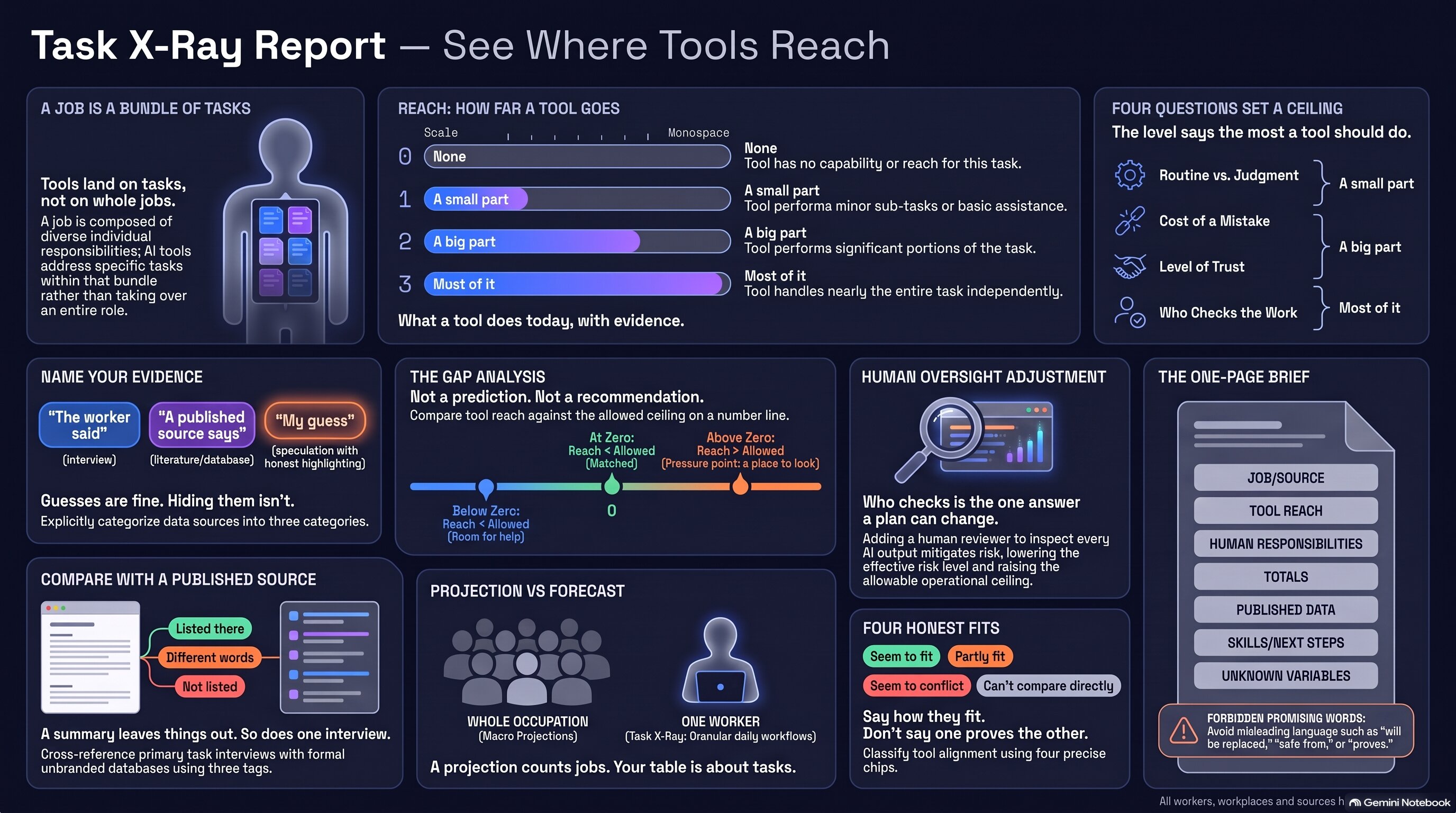
Quick reference for the whole project: list the tasks, score a tool's reach with evidence, answer the four questions, find the gap, compare with a published source, and write a brief that stays inside what you found.
🧭 Plot Summary
A job is a bundle of tasks, and tools reach some tasks further than others. In 3.2.1 you learned four questions for deciding who should do a task. In 3.2.2 you learned the four strands of human strengths. In 3.2.3 you gathered what one real job involves. Now you use all three.
You'll X-ray the job: score each task for how far a tool reaches and how far the four questions say it should, compare what you found with a published source, and write a one-page brief. The score isn't a prediction. It's a way to see where to look.
What you'll do in this project
- Turn your 3.2.3 notes into rows: the task, the time it takes, its strand, and what a tool does.
- Score how far a tool reaches into each task, and name the evidence for every score.
- Answer the four questions and see where reach and caution disagree.
- Compare your tasks and the job's outlook with a published source, and read it carefully.
- Write a one-page career brief that says what you found and what you don't know.
- Review a partner's brief, answer theirs, and hand yours to your teacher.
Ground rules
- Use the alias from your notes. No real names, and no employer, customer, patient or client details.
- A quote from the worker needs their clear yes. If you didn't ask, don't use it.
- Say what you found, not what will happen. One worker and one table can't predict a job's future.
- Name your sources and the date you looked. Copy outlook sentences exactly.
Why it matters
Headlines say jobs will vanish or be safe, and neither is a finding. Looking at one job task by task, with evidence you can name, is the skill that lets you read those claims and write your own honest ones.
✅ Self-Check Before You Hand In
Check off each item as you get there. These aren't grades. They're your own signal.