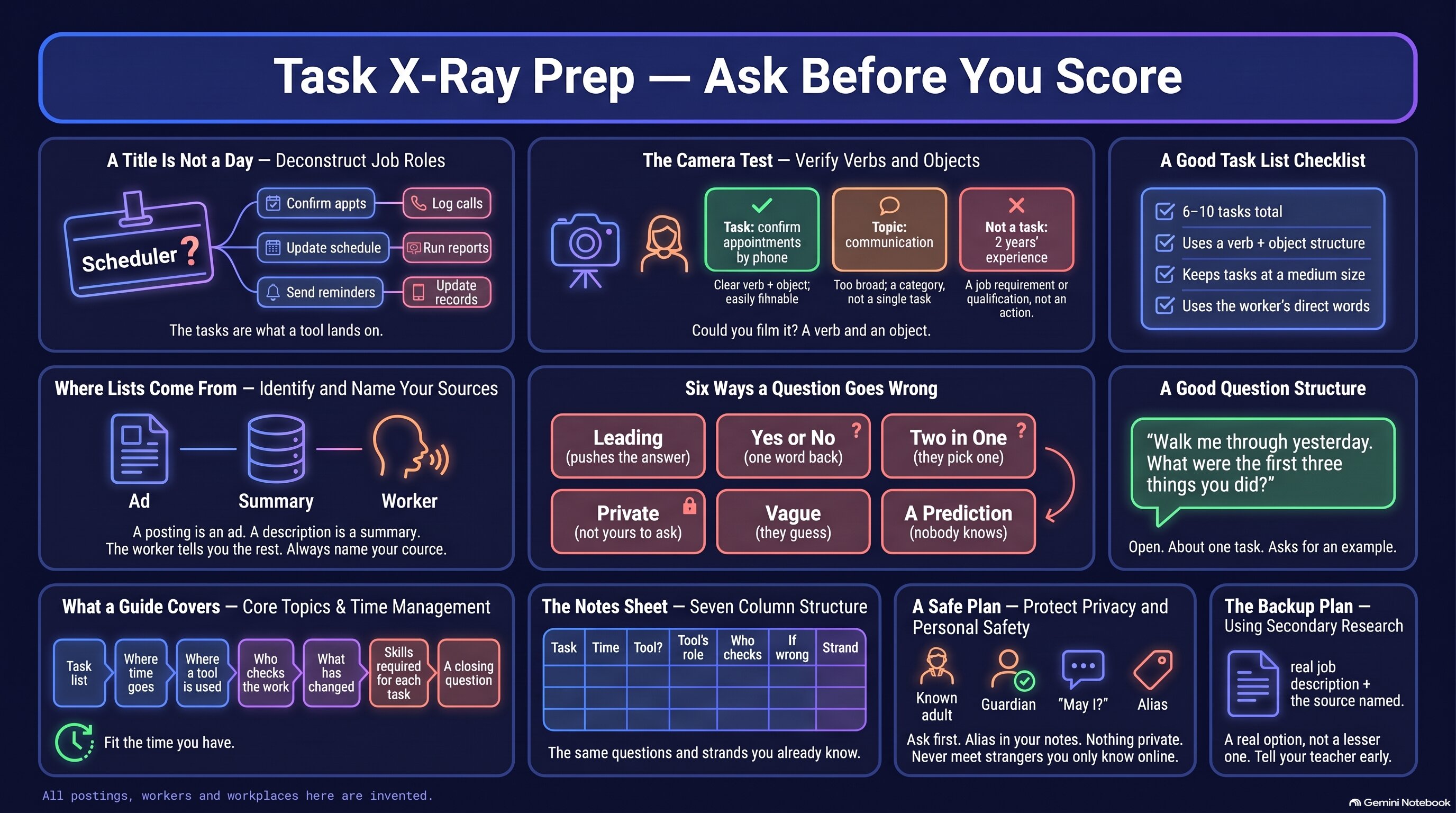
Quick reference for turning a title into tasks, the camera test, six ways a question goes wrong, what a guide has to cover, and how to plan an interview safely.
🧭 Plot Summary
A job title tells you almost nothing about a day at work. The tasks inside the job are what a tool lands on, and the way to find them is to ask someone who does the work. In this activity you'll build the task list and the interview guide for a real worker. The interview itself is homework, and it feeds the Task X-Ray Report in 3.2.4.
Your mission is to turn a title into tasks you could film, write questions that get true answers instead of opinions, fit them into the time you have, and plan the interview so everyone stays safe and comfortable. If you can't reach a worker, there's a backup: a real job description, with the source named.
What you'll do in this activity
- Turn a job title or posting into a short list of tasks you could film.
- Learn six ways an interview question goes wrong, and fix them.
- Build an interview guide that fits the time and covers what you need to learn.
- Plan the interview safely: who to ask, what to say, and what stays private.
- Fill in your Interview Guide and Interview Notes sheets.
- Do the interview at home, or use the backup, and bring your notes to 3.2.4.
Ground rules
- Interview an adult you already know, and tell your guardian who, when, and where or how. Never arrange to meet or message strangers you only know online.
- Ask first, and say what it's for. The worker can skip any question or stop at any time. Record only if they say yes.
- Use an alias in your notes. Leave out other people's names, pay, and anything confidential from the workplace.
- If you can't reach a worker, use the backup and say so on your sheet. Tell your teacher early. Nobody loses credit because the adults in their life work far away or at night.
Why it matters
The Task X-Ray in 3.2.4 is only as good as the task list and the answers behind it. A guide with weak questions gets opinions and guesses. A guide with good ones gets examples you can check, which is the same difference you learned between a claim and evidence.
✅ Self-Check Before You Share
Check off each item as you get there. These aren't grades. They're your own signal.