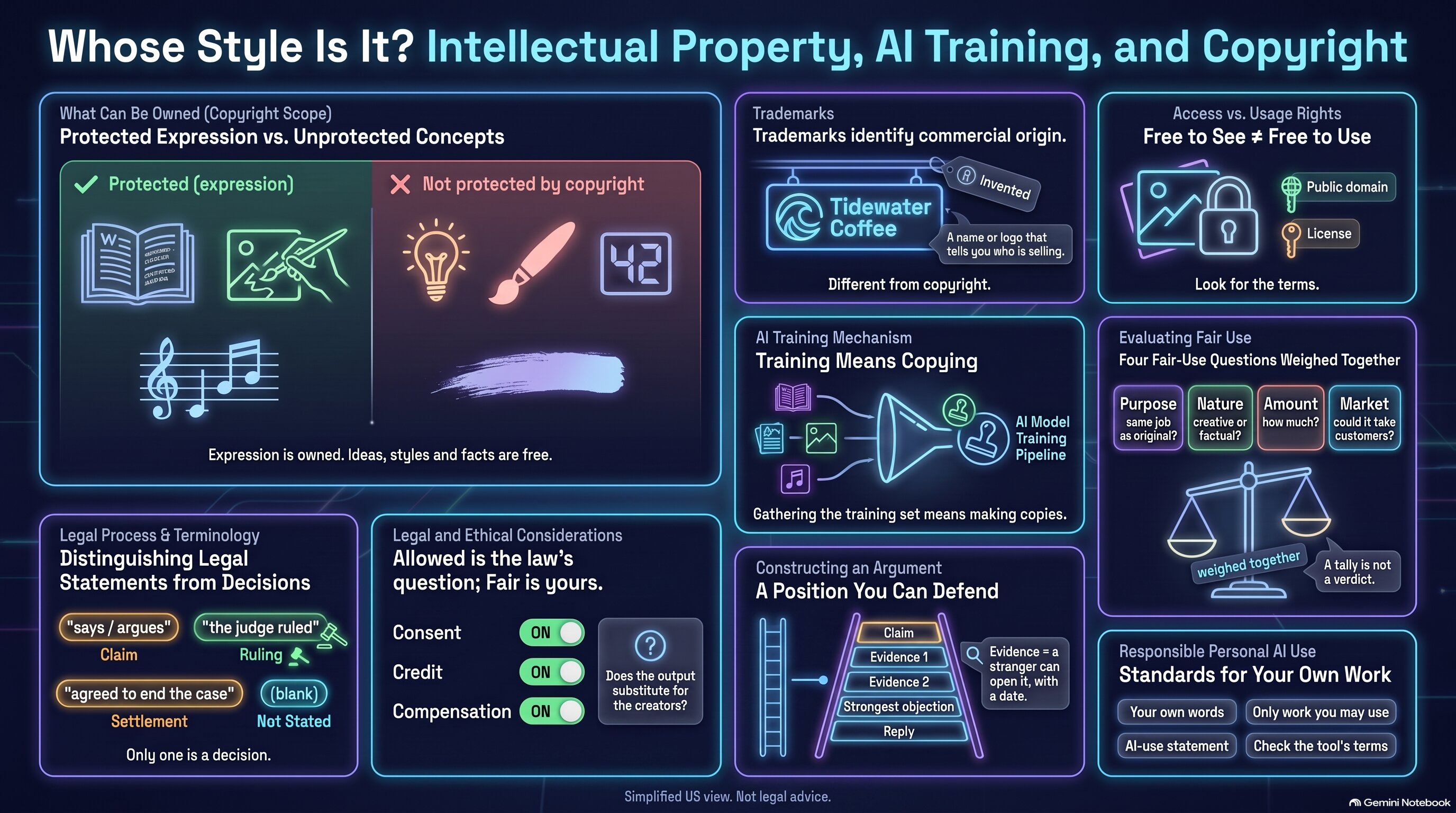
Quick reference for the whole activity: what copyright protects, the four fair-use questions, claim versus ruling versus settlement, and the three Cs plus substitution.
🧭 Plot Summary
Anyone can make a picture, a song or a story "in the style of" someone now. Some of the tools that do it learned from millions of works by people who were never asked. Is that allowed? Is it fair? Those are different questions, and the news often blurs them. In this activity you learn what the law protects, then work out a position you can defend.
You read two approved news stories about a dispute between AI companies and creators, and record what each side says on a Case Card. Then you run the four fair-use questions and the three Cs on the facts you wrote down, and write a short position. This is a simplified view of US law and it is not legal advice.
What you'll do in this activity
- Sort what copyright protects from what it doesn't: expression, ideas, styles, facts and trademarks.
- Read two approved news stories about a dispute between AI companies and creators, and fill in a Case Card.
- Tell apart what each side says, what a court decided, what was settled, and what the story doesn't say.
- Run the four fair-use questions and the three Cs on the facts you wrote down.
- Build a short position with a claim, two pieces of evidence, the strongest objection and a reply.
- Add an AI-use statement that says what you checked and which decisions were yours.
Ground rules
- Read only the sources your teacher approved, and open each one yourself. A chatbot can help you find sources, but it can invent links and mix up cases.
- Don't upload other people's work, or photos of people, and don't type anyone's personal details.
- Describe what you want in your own words. Don't name a living artist or a copyrighted character in a prompt. This activity is about why.
- Cases change. Write down the date of every source. Nothing here is legal advice, and it describes US law only.
Why it matters
The tools you choose and the work you share raise these questions every time. Knowing what can be owned, and how to read a dispute without taking a side too early, lets you use AI with open eyes.
✅ Self-Check Before You Share
Check off each item as you get there. These aren't grades. They're your own signal.