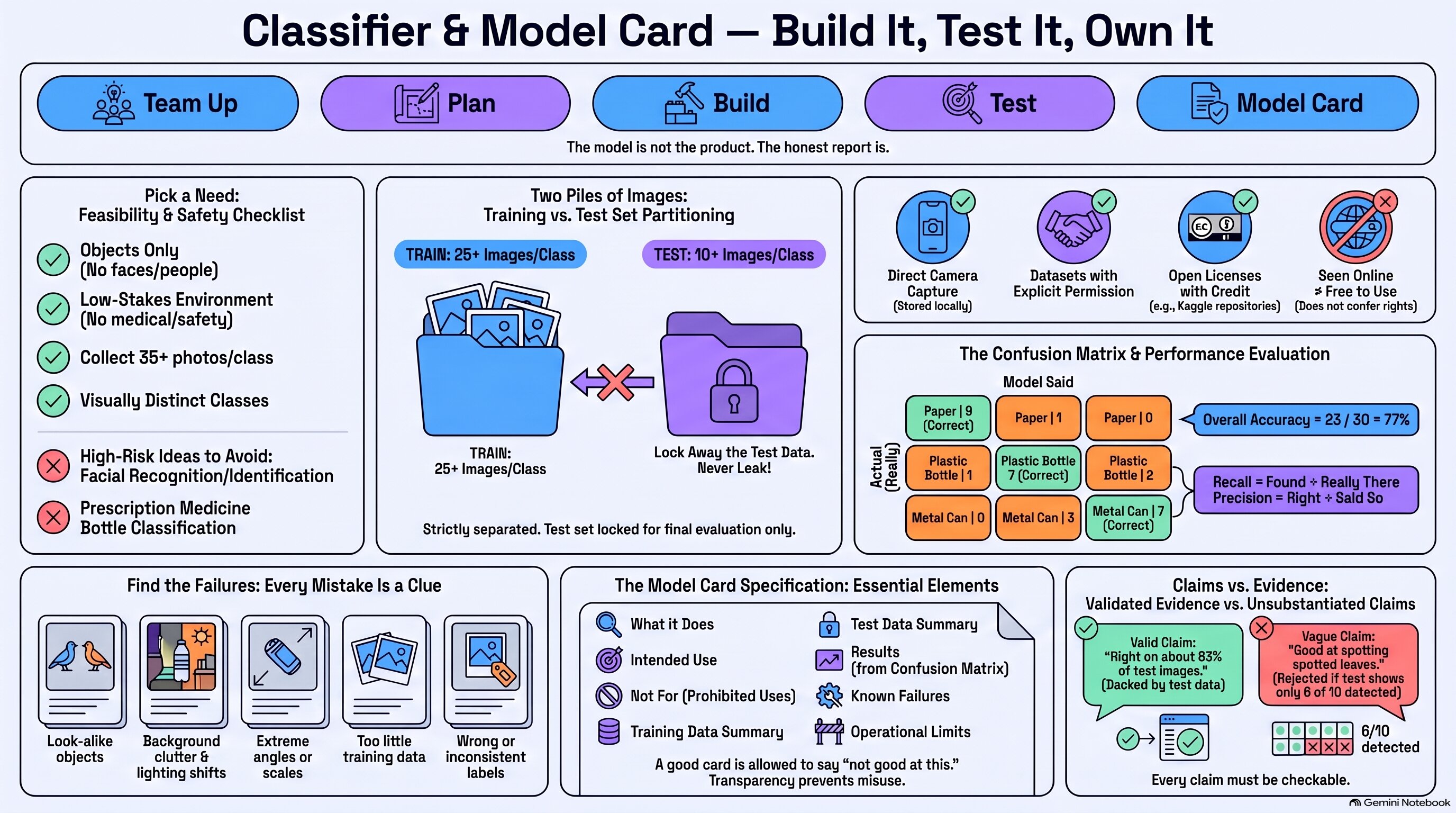
Quick reference for the project steps, the confusion matrix, and what goes on a model card.
🧭 Plot Summary
In 1.1.2 you trained a flower classifier on someone else's data and learned why a high accuracy number can lie. Now you do the whole job yourself. Your team picks a real need, collects and labels its own images, trains a classifier, and then does the part most demos skip: testing it honestly.
The final product is not the model. It is a model card: a one-page report that says what the model does, what data it learned from, how well it really performs, where it fails, and what it should not be used for. Another team will read your card and try to find the claim that doesn't hold up.
What you'll do in this project
- Form a team, assign roles, and agree on how you will work together before you touch any data.
- Pick a real need that a small image classifier could help with, and get your plan approved.
- Collect and label your own training images, then collect separate test images the model has never seen.
- Train a classifier, fill in a confusion matrix, and compute accuracy, recall and precision from it.
- Hunt for the images your model gets wrong and work out why.
- Write a model card that tells an honest story, then trade cards with another team and try to break their claims.
Ground rules
- 2 or 3 classes of objects. No photos of people or faces, and nothing medical, safety-critical or about security.
- At least 25 training images and 10 test images per class. Test images are collected separately and never used to train.
- Every image is yours, used with permission, or openly licensed. Your teacher approves the plan first.
Why it matters
Anyone can train a model and report a flattering number. Knowing how it was built, what it was tested on, and where it breaks is what lets other people decide whether to trust it. Real model cards exist for exactly that reason.
✅ Self-Check Before You Present
Check off each item as you get there. These aren't grades. They're your own signal.