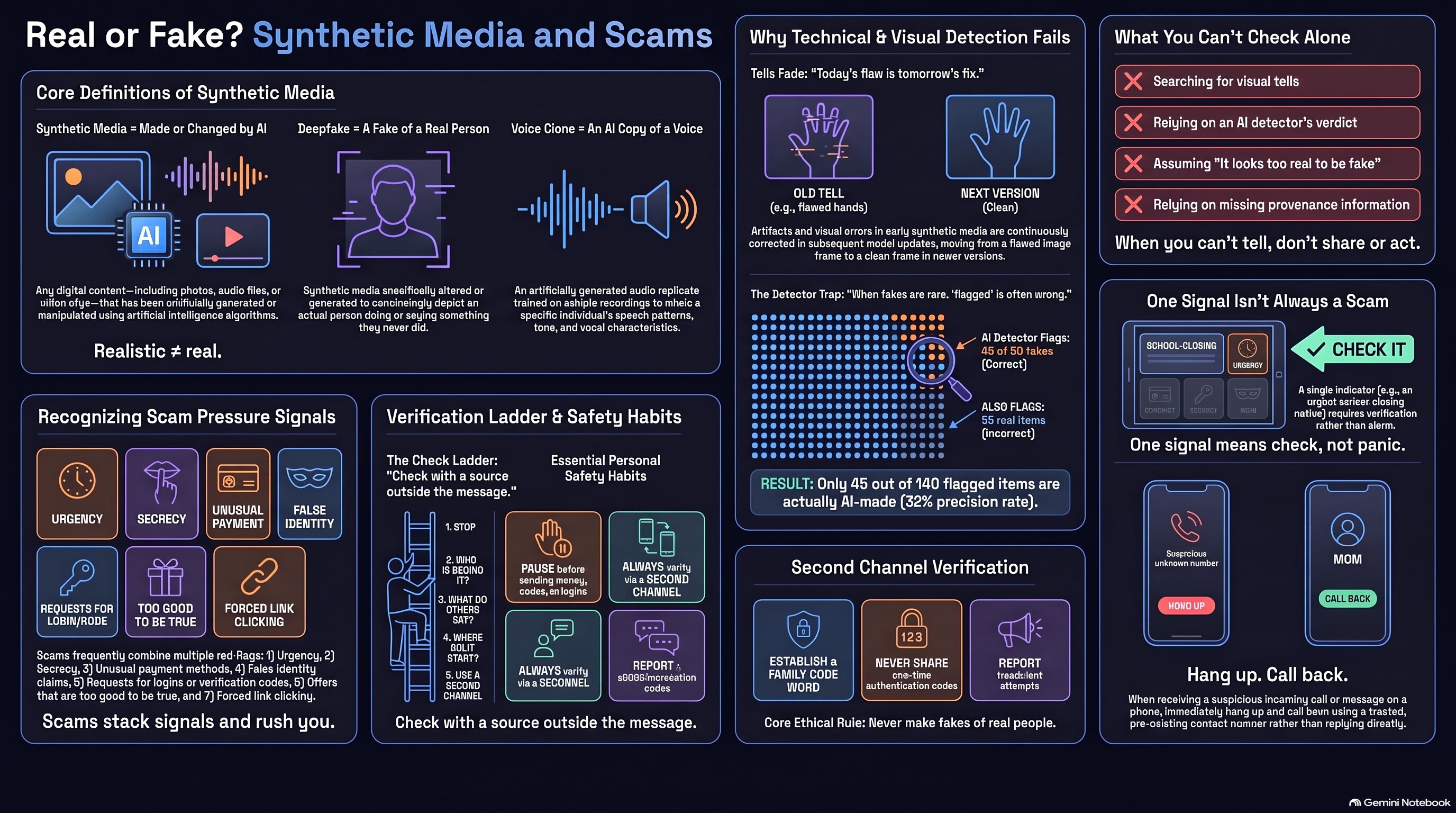
Quick reference for synthetic media, the seven scam pressure signals, the detector trap, and the check ladder.
🧭 Plot Summary
AI can now make images, voices and videos that look and sound real, and it can write messages that sound like they were meant just for you. You can't reliably tell real from fake by staring at the pixels, and the tells people learn tend to fade as the tools improve.
Your mission is to build habits that work anyway. You'll test your eye on a gallery, learn the pressure pattern that scams share, see why an AI-image detector can mislead you, and practice a check ladder that uses sources independent of the message itself.
What you'll do in this activity
- Vote on a gallery of real and AI-made images, say how sure you are, and compare your accuracy with chance.
- Learn the pressure pattern behind scam messages, and practice spotting it in invented examples.
- Use a made-up AI-image detector to see why its verdict can mislead, especially when fakes are rare.
- Practice the check ladder on a viral image and a suspicious call, using sources independent of the message.
- Learn what you can't check by yourself, and what to do when you can't tell.
- Walk away with habits you can use right now: a second channel, a family code word, and never sharing one-time codes.
Ground rules
- Don't create fake images, voices or videos of real people, even as a joke.
- Don't share personal information, or other people's photos or voices, with any AI tool.
- Use the made-up examples provided. If you find something real and suspicious, tell a trusted adult rather than passing it on.
Why it matters
Scams and fakes reach people your age every day. The habits here (pause, check, use a second channel) protect you whether the message was written by a person or by AI, and they link directly to the failure plans in Unit 2.
✅ Self-Check Before You Share
Check off each item as you get there. These aren't grades. They're your own signal.