Use this as a quick reference for the Cybersecurity Lifecycle and building your digital footprint inventory.
🧭 Plot Summary
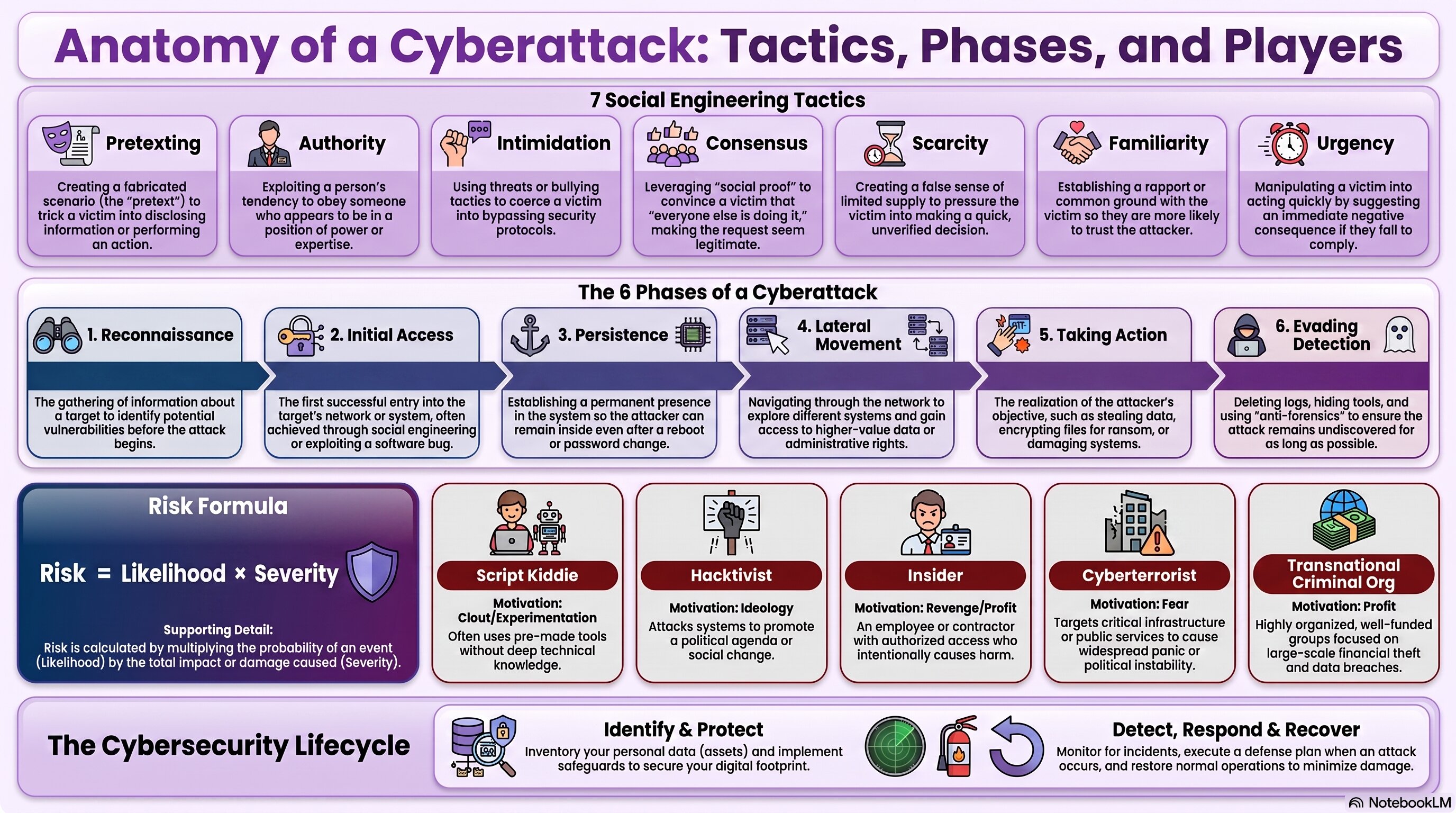
Before you can protect anything, you have to know what you're protecting. That's the idea behind the Cybersecurity Lifecycle — a five-stage process businesses and individuals use to keep information safe: Identify your assets, Protect them, Detect incidents, Respond with a plan, and Recover normal operations.
This activity starts at the very first stage — Identify — by turning the lens on you. You'll build an inventory of your own digital footprint: the devices you use, the apps and sites you access through them, and the personal information each one holds. Then, as a class, you'll draft a Code of Conduct — a shared set of rules for behaving responsibly, ethically, and legally in any classroom that uses technology.
The Cybersecurity Lifecycle
What you will do in this lesson
- Define cybersecurity and identify who it affects.
- Build a personal inventory of your digital footprint — devices, apps, and the information each one holds.
- Walk through the five stages of the Cybersecurity Lifecycle and see where your own habits fit.
- Draft, as a class, a Code of Conduct for any classroom that uses technology.
- Compare your classroom code against your school's actual computer use policy.
Why it matters
Every unit that follows assumes you already think in terms of the Cybersecurity Lifecycle — and every activity that follows assumes you've agreed to a standard of conduct. This is the foundation, not a footnote.
✅ Self-Check Before You Roll On
Check off each item as you get there. These are not grades — they are your own signal.