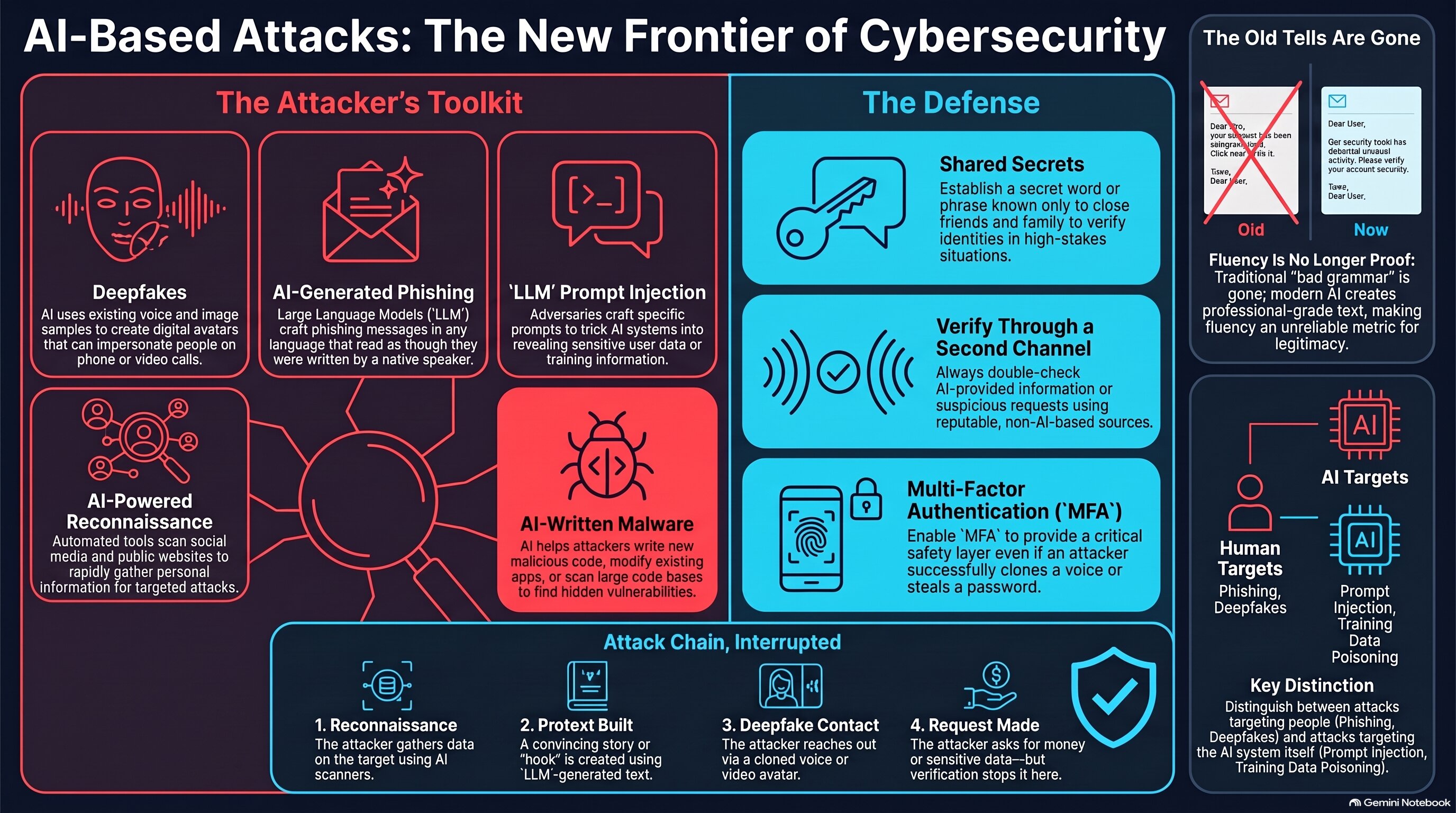
Use this as a quick reference for AI attack types and the human/technical defenses that counter them.
🧭 Plot Summary
Every attack you've studied so far assumed a human on the other end — typing, guessing, writing. That assumption is breaking down. AI now writes the phishing email, clones the voice on the phone call, and scrapes a target's entire digital footprint in seconds. This lesson is a tour of the attacker's new toolkit: deepfakes that impersonate a real person, AI-generated phishing that reads as fluent and personalized as a message from a coworker, prompt injection that attacks the AI system itself rather than the human using it, and AI-powered reconnaissance that automates the research phase of an attack. The good news: the best defenses against these new tricks are often old, boring, and reliable — shared secrets, verification protocols, and multi-factor authentication.
What you'll do in this lesson
- Identify the major categories of AI-powered attacks: deepfakes, AI phishing, LLM prompt injection, AI recon, and AI-written malware.
- Explain why AI lowers the skill and time needed to run a convincing attack.
- Describe practical human and technical defenses: shared secrets, verification protocols, and MFA.
- Evaluate a real-world scenario and decide whether it describes an attack technique or a defense.
Why it matters
AI doesn't invent new categories of attack so much as it removes the friction from old ones — bad grammar, accents, slow research — that used to help people catch a scam. Knowing what AI changes (and what it doesn't) is what keeps a verification habit useful instead of obsolete.
✅ Self-Check Before You Roll On
Check off each item as you get there. These aren't grades — they're your own signal.