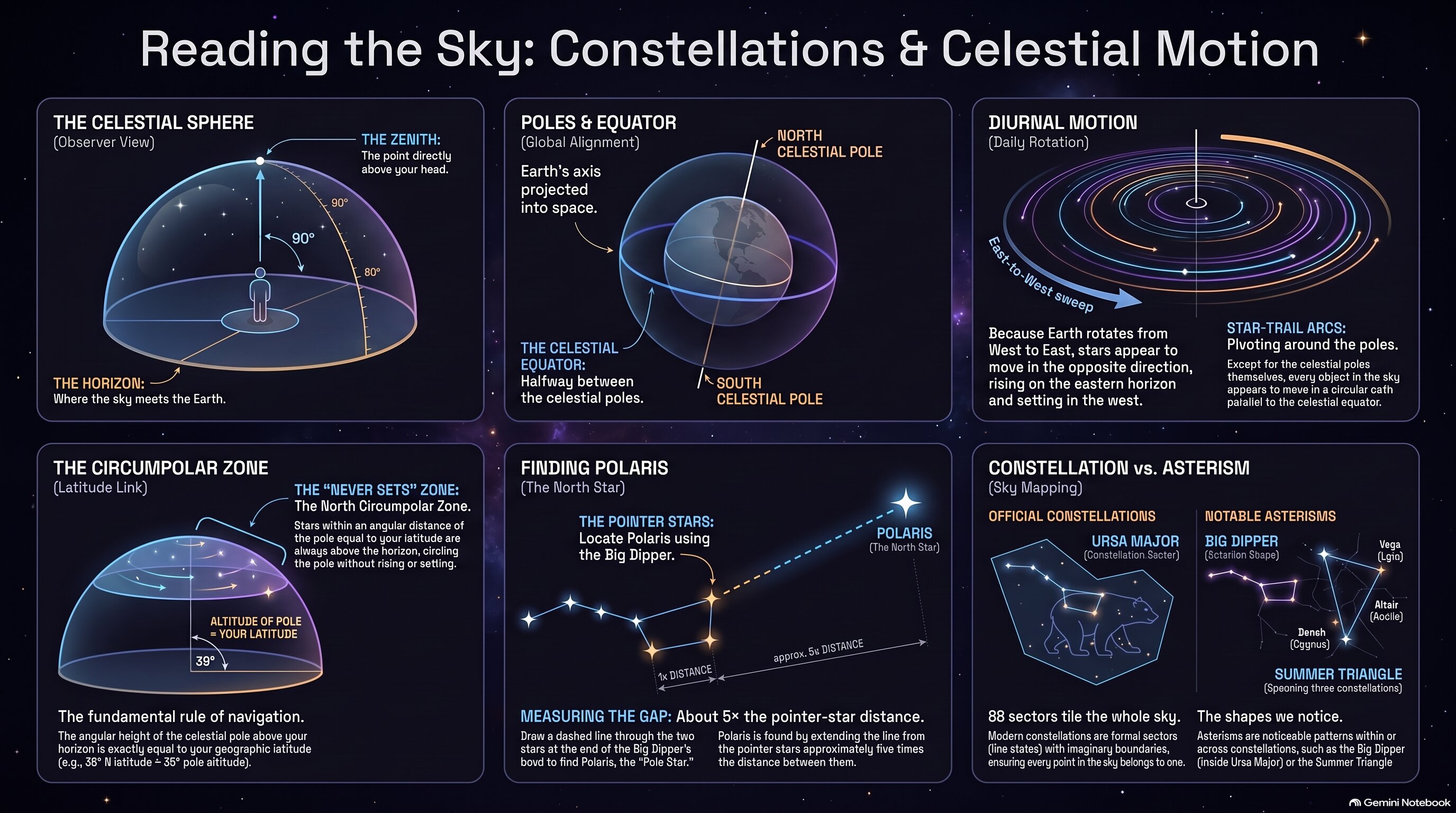
Use this as a quick reference for the celestial sphere, poles, circumpolar zone, and diurnal motion.
🧭 Plot Summary
Every night, the whole sky seems to turn slowly around a fixed point — as if it were painted on the inside of a giant dome with you standing at the center. That's the celestial sphere, and even though we've known for centuries that it isn't physically real, astronomers still use it constantly because it's the easiest way to talk about where things are and how they move. You'll learn to find your zenith and horizon, locate the celestial poles and celestial equator, and figure out why the sky's daily rotation — diurnal motion — is really just Earth spinning underneath a sky that isn't moving at all.
What you'll do in this activity
- Build the celestial sphere mental model — the imaginary dome of sky with you at the center.
- Locate your zenith, horizon, the north and south celestial poles, and the celestial equator.
- Explain diurnal motion as a reflection of Earth's own rotation, not the sky actually moving.
- Connect the altitude of the celestial pole directly to your own latitude on Earth.
- Define the circumpolar zone and use latitude to predict which stars never set — or never rise.
- Identify Polaris and explain why it holds nearly still while everything else wheels around it.
- Tell an official constellation (one of the 88 IAU sectors) apart from an informal asterism.
Why it matters
The circumpolar zone you build here is the tool you'll use in Activity 1.1.2 to actually plot where a star sits on any given night, and it's the reason your Star Chart & Sky Journal project works at all — you have to know which stars stick around all night before you can track one for a week. By the time you reach the unit's Sky Report, "what's up and when" should be second nature.
✅ Self-Check Before You Roll On
Check off each item as you get there. These aren't grades — they're your own signal.