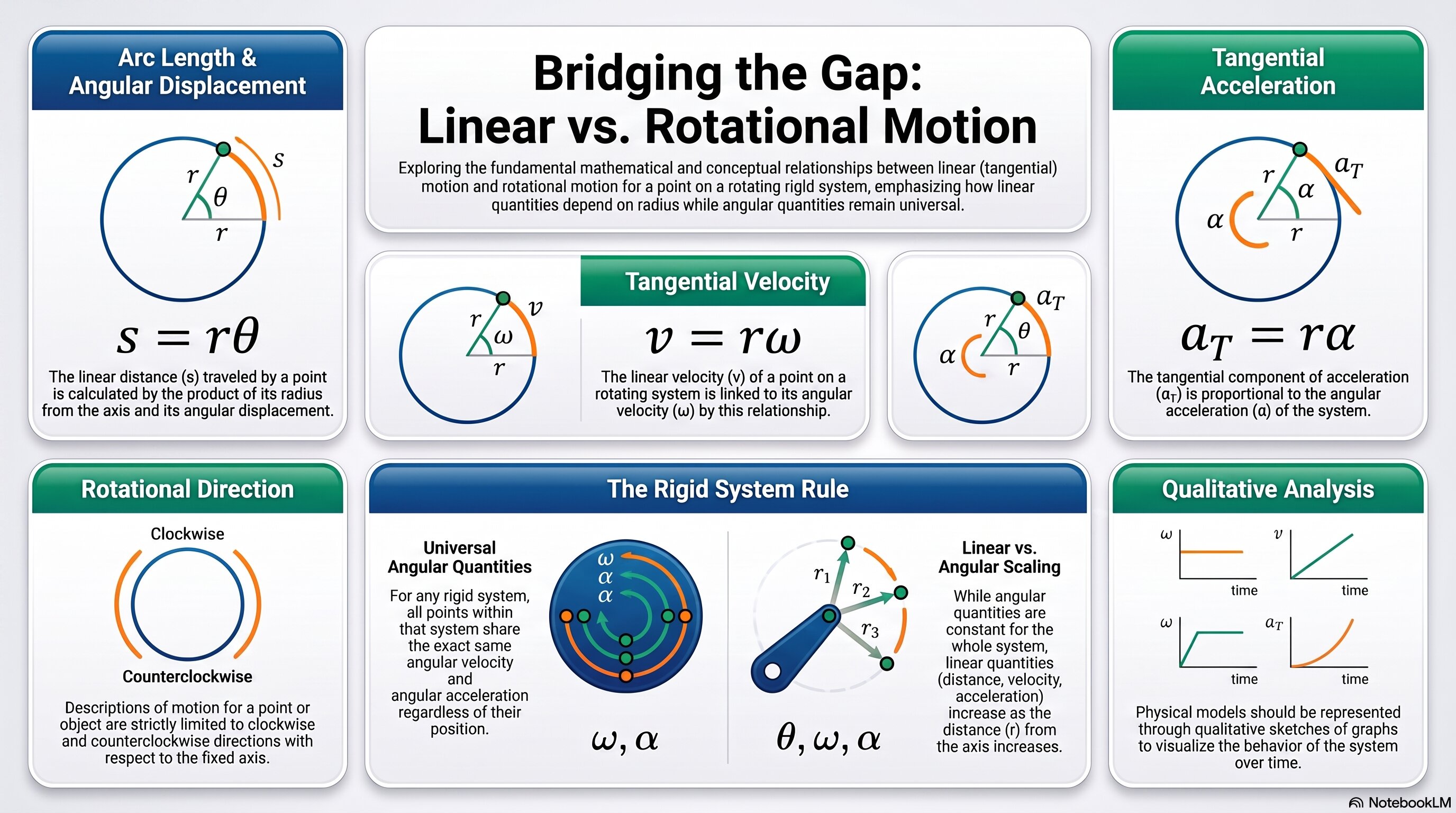
Use this as a quick reference for s=r*theta, v=r*omega, a_T=r*alpha, and the rigid system rule.
🧭 Plot Summary
Lesson 5.1 established the angular vocabulary — omega, alpha, Dtheta. This lesson builds the bridge between that world and the linear world you already know. The connector is always r — the distance from the axis of rotation to the point in question. Multiply any angular quantity by r and you get the corresponding linear quantity for that specific point.
The rigid system rule makes this powerful: since every point shares the same omega and alpha, you can find the linear speed or acceleration of any point just by knowing its distance from the axis. A point at 2r moves exactly twice as fast as a point at r.
The three bridge equations
What you will do in this lesson
- Calculate arc length: s = r*theta (theta in radians).
- Calculate tangential speed: v = r*omega — larger r means larger v for the same omega.
- Calculate tangential acceleration: a_T = r*alpha — not the same as centripetal acceleration.
- Apply the rigid system rule: omega and alpha are universal; v, a_T, and s depend on r.
- Apply the CCW = positive, CW = negative sign convention for direction.
- Sketch qualitative graphs of omega vs. t and v vs. t and explain their shapes.
Why it matters
Every torque and rotational dynamics problem from 5.3 onward requires moving fluidly between angular and linear quantities. When you know alpha and need the linear acceleration of a point on the rim — that is a_T = r*alpha. When a rolling wheel has velocity v and you need omega — that is omega = v/r. This lesson is the translation dictionary for the rest of the unit.
✅ Self-Check Before You Roll On
Check off each item as you get there. These are not grades — they are your own signal.