Use this as a quick reference for the three angular quantities, the kinematic equations, and the CCW/CW sign convention.
🧭 Plot Summary
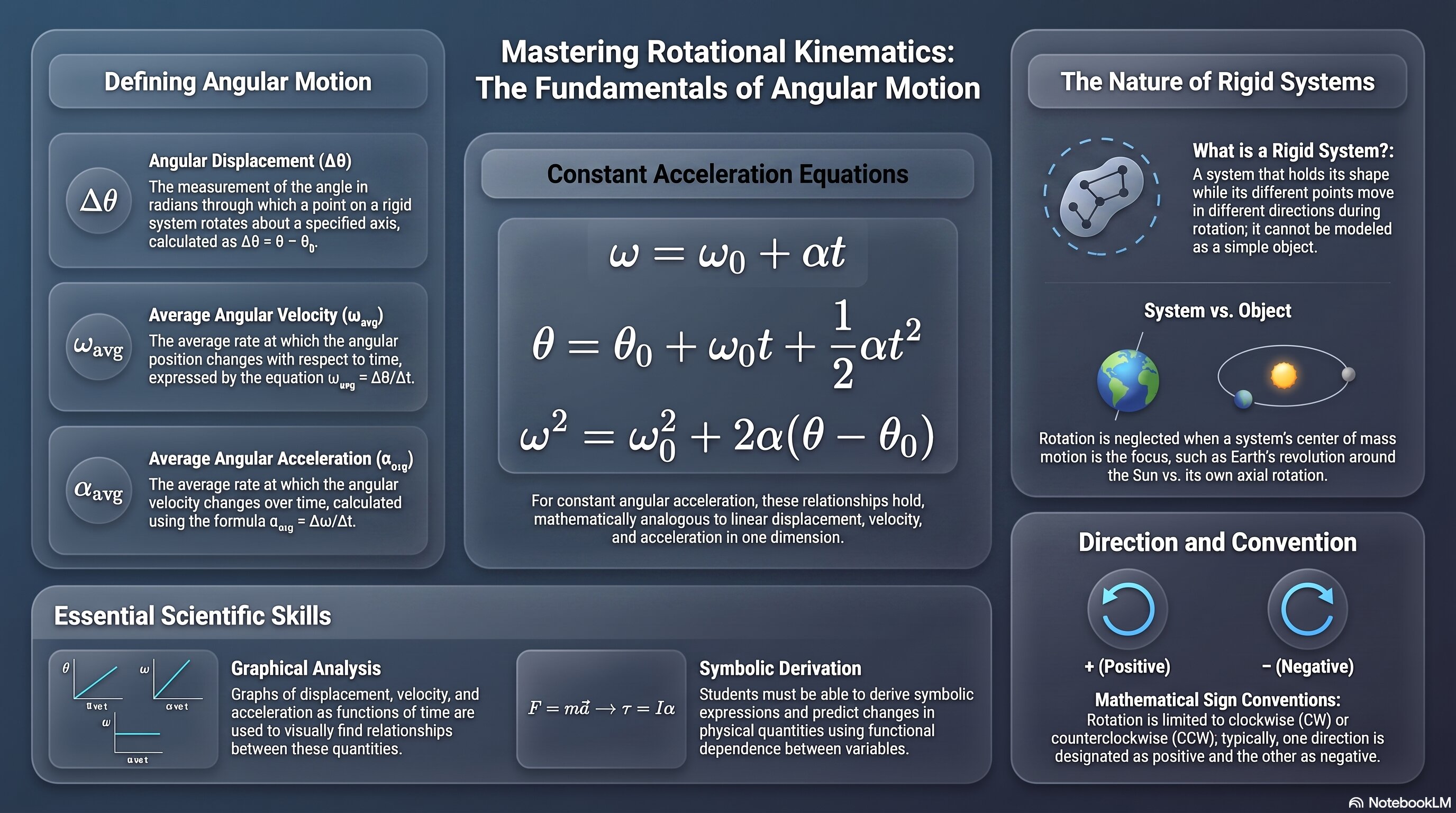
Everything you learned in Unit 1 — displacement, velocity, acceleration, and the three kinematic equations — applies directly to rotation. The only change is the variables. Angular displacement Dthetareplaces linear displacement. Angular velocity omegareplaces linear velocity. Angular acceleration alphareplaces linear acceleration. The mathematical structure is identical.
The key new idea is the rigid system model: all points on a rotating rigid object share the same omega and alpha, even though points farther from the axis move faster in linear terms. A wheel spinning at 10 rad/s has every point at 10 rad/s — but a point at r = 2 m has linear speed v = r*omega = 20 m/s while one at r = 0.5 m has only 5 m/s.
The linear-to-rotational analogy
What you will do in this lesson
- Define angular displacement, angular velocity, and angular acceleration in radians-based units.
- Apply the three rotational kinematic equations under constant angular acceleration.
- Explain the rigid system model — all points share the same omega and alpha.
- Relate angular quantities to linear quantities using s = r*theta, v = r*omega, and a_t = r*alpha.
- Apply CCW = positive, CW = negative sign convention throughout.
- Interpret theta-t, omega-t, and alpha-t graphs by slope and area.
Why it matters
Rotational kinematics is the language of everything that follows in Unit 5. You cannot do torque problems (5.2), rotational inertia (5.3), or Newton's Second Law for rotation (5.4) without fluency with omega, alpha, and the kinematic equations. The payoff is immediate — every Unit 1 problem-solving strategy transfers directly.
✅ Self-Check Before You Roll On
Check off each item as you get there. These are not grades — they are your own signal.