Use this as a quick reference for conservation conditions, internal vs. external forces, and center-of-mass velocity.
🧭 Plot Summary
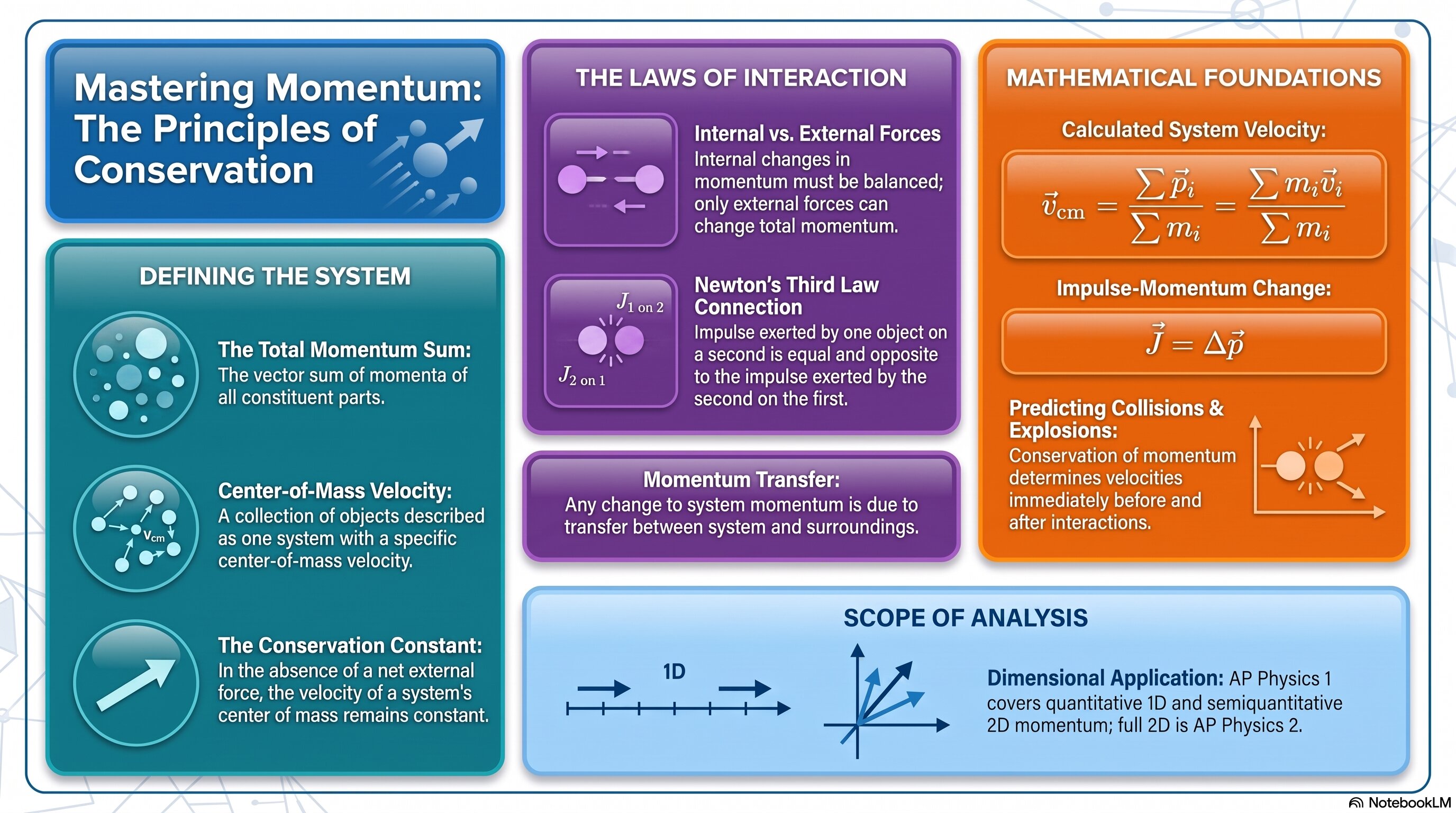
Lessons 4.1 and 4.2 established what momentum is and how forces change it. This lesson delivers the payoff: conservation of linear momentum. In any isolated system — one with no net external force — the total momentum before an interaction equals the total momentum after. It does not matter how violent the collision, how complex the explosion, or how many objects are involved. The total stays the same.
The key is understanding what makes a system isolated. Internal forces — the forces objects in the system exert on each other — come in Newton's Third Law pairs. They cancel in the total. Only external forces can change total momentum. When those are absent or negligible, momentum is conserved exactly.
Internal vs. External Forces
What you will do in this lesson
- State that total momentum of an isolated system is conserved: Sp_i = Sp_f.
- Define an isolated system as one with no net external force.
- Explain that internal forces change individual momenta but leave the total unchanged.
- Apply momentum conservation to solve 1D collision and explosion problems.
- Connect Newton's Third Law to momentum conservation — the two impulses cancel.
- Calculate center-of-mass velocity for multi-object systems.
Why it matters
Conservation of momentum is the tool that makes collision and explosion problems tractable. You never need to know the internal forces — only the before and after states. This parallels conservation of energy from Unit 3 perfectly. Together, energy and momentum conservation are the two most powerful algebraic tools you have for the rest of the AP course.
✅ Self-Check Before You Roll On
Check off each item as you get there. These are not grades — they are your own signal.