Use this as a quick reference for p = mv, the vector nature of momentum, and the collision vs. explosion distinction.
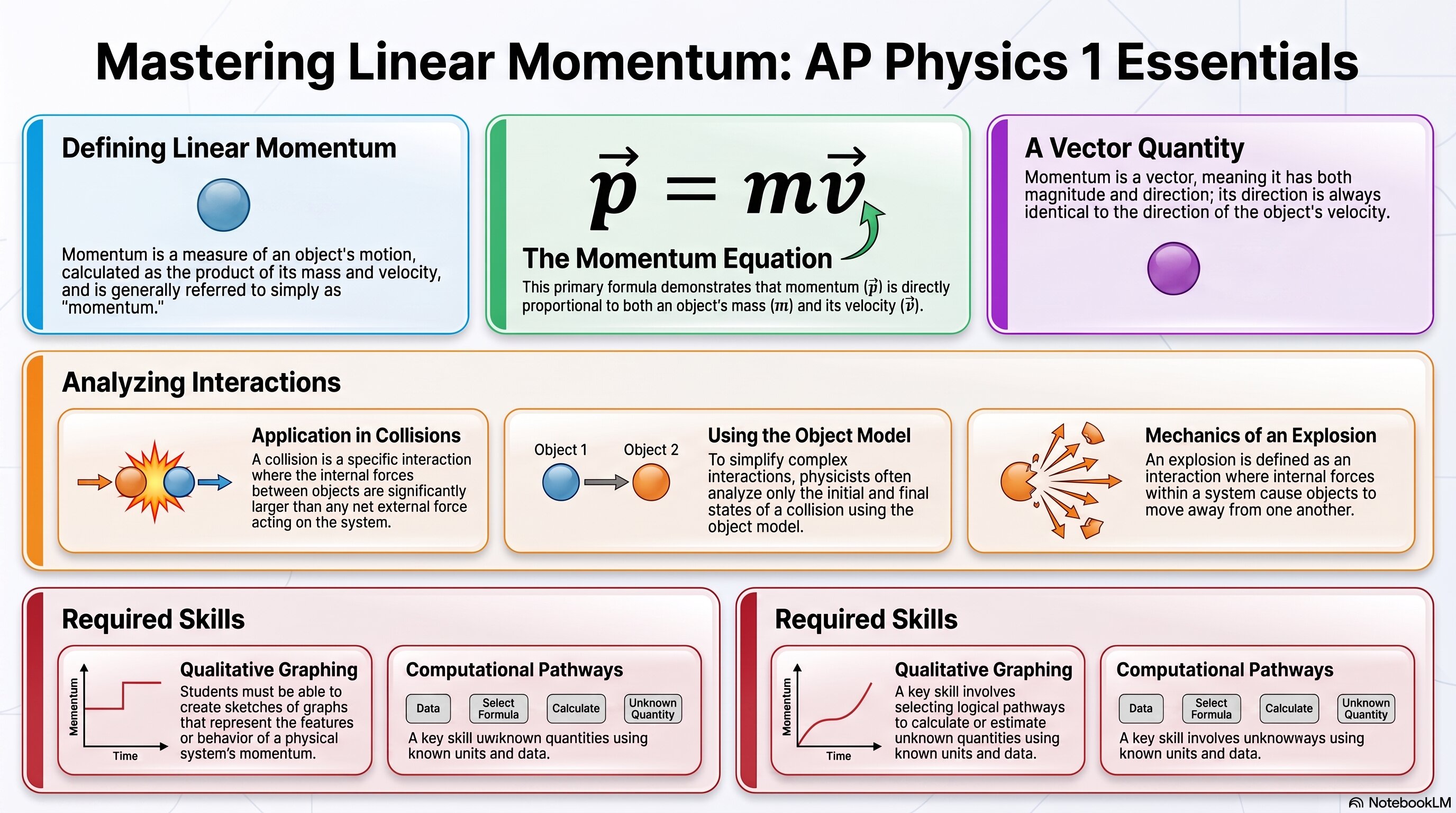
🧭 Plot Summary
Linear momentum is the product of an object's mass and velocity: p = mv. It measures how difficult it is to change an object's motion — a heavy truck moving slowly can have the same momentum as a light baseball thrown fast, and both are equally hard to stop. Unlike kinetic energy (a scalar), momentum is a vector — it has the same direction as velocity, and direction matters in every problem.
Collisions vs. Explosions
What you will do in this lesson
- Define linear momentum as p = mv — the product of mass and velocity.
- Identify momentum as a vector with the same direction as velocity.
- Express momentum in SI units: kg·m/s (equivalent to N·s).
- Set a sign convention and apply it consistently to all objects in a system.
- Calculate total system momentum by adding individual momentum vectors.
- Distinguish collisions (objects interact) from explosions (internal forces push objects apart).
Why it matters
Momentum is the foundation everything in Unit 4 builds on. You cannot do impulse problems (4.2), conservation problems (4.3), or collision analysis (4.4) without being completely fluent with p = mv and vector sign conventions. Get this right first and the rest of the unit flows naturally.
✅ Self-Check Before You Roll On
Check off each item as you get there. These are not grades — they are your own signal.