Use this as a quick reference for ME = KE + PE, conservation conditions, and the effect of nonconservative forces.
🧭 Plot Summary
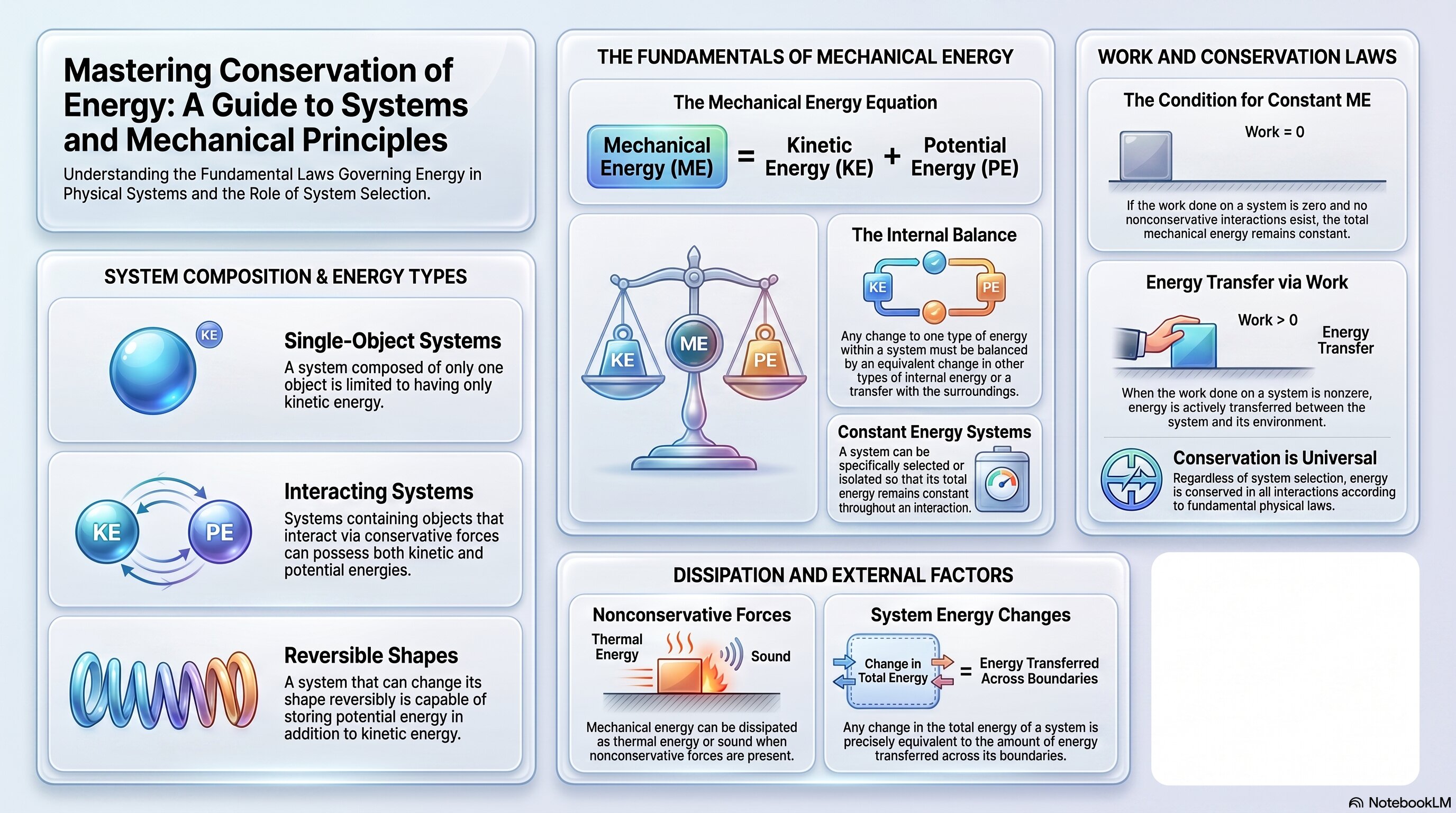
Lessons 3.1–3.3 built the components: kinetic energy, work, and potential energy. This lesson assembles them into the most powerful tool in the course. Conservation of energy says that in a system with no nonconservative forces, the total mechanical energy — the sum of kinetic and all potential energies — stays constant. KE and PE trade back and forth, but their sum never changes.
When nonconservative forces (friction, air resistance) are present, mechanical energy is not conserved — but total energy still is. The lost mechanical energy converts to thermal energy or sound. The general equation accounts for this: ΔE_system = W_external.
Three scenarios — one framework
What you'll do in this lesson
- Define mechanical energy as the sum of kinetic and all potential energies in a system.
- Apply conservation of energy to problems where only conservative forces act.
- Identify when mechanical energy is not conserved and account for energy lost to friction.
- Use the general energy equation: ΔE_system = W_external.
- Construct and interpret energy bar charts showing KE, PE, and thermal energy at each stage.
- Explain why conservation of energy is universal even when mechanical energy is lost.
Why it matters
Conservation of energy is the most frequently tested topic in Unit 3 on the AP exam. It appears in multi-step FRQs where you track energy through an entire scenario — launch, peak, landing, after friction. It also reappears in every subsequent unit: rotational motion (Unit 6), oscillations (Unit 7), and fluids (Unit 8) all rely on energy methods. This lesson is the payoff for everything you built in 3.1–3.3.
✅ Self-Check Before You Roll On
Check off each item as you get there. These aren't grades — they're your own signal.