Use this as a quick reference for U_g, U_s, the system requirement, and the zero reference point concept.
🧭 Plot Summary
In Lesson 3.2 you saw how work transfers energy. Now we look at where that energy can go when it's not kinetic — into storage. Potential energy is energy stored in the configuration of a system: how high something is, how much a spring is compressed, how far apart two charged particles sit. It's energy that's ready to become kinetic the moment the configuration changes.
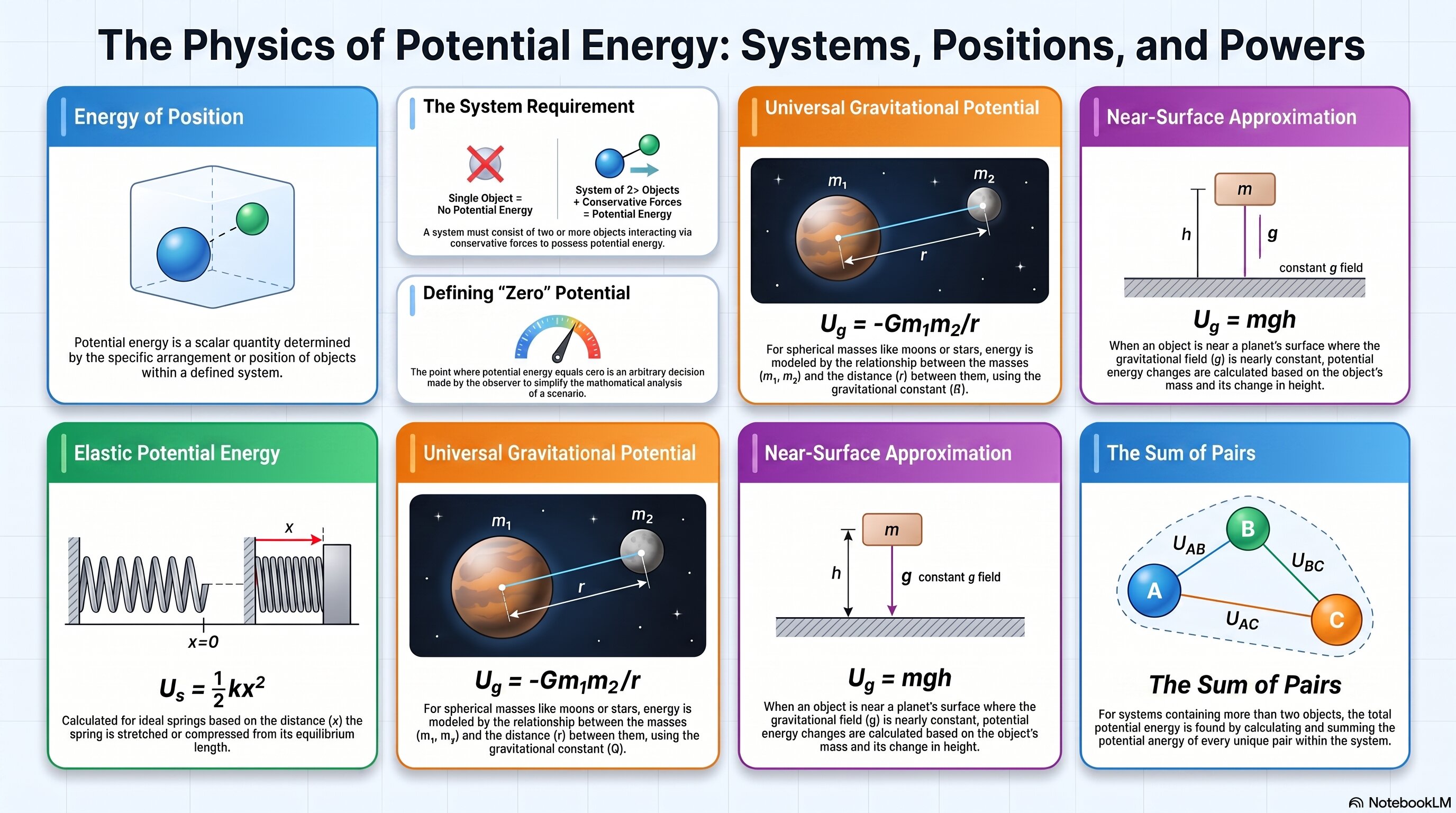
One critical point from your infographic: potential energy is a system property, not a property of a single object. A ball held above the floor doesn't have gravitational PE by itself — the ball-Earth system does. The energy lives in the interaction between the two objects.
The two types you need to know
What you'll do in this lesson
- Define potential energy as energy stored in the configuration of a system.
- Explain that a system must contain two or more objects interacting via conservative forces to have potential energy.
- Calculate U_g = mgh for objects near Earth's surface.
- Calculate U_s = ½kx² for ideal springs displaced from equilibrium.
- Justify why the zero reference point for PE is an arbitrary choice.
- Explain that only conservative forces (gravity, springs) are associated with potential energy.
Why it matters
Potential energy is the other half of mechanical energy. In Lesson 3.4 you'll see how KE and PE trade off in a system — and how their sum stays constant when no nonconservative forces act. Everything in 3.4 depends on being able to calculate U_g and U_s correctly, and on understanding that the choice of zero reference doesn't affect the answer.
✅ Self-Check Before You Roll On
Check off each item as you get there. These aren't grades — they're your own signal.