Use this as a quick reference for the work formula, conservative vs. nonconservative forces, and the work-energy theorem.
🧭 Plot Summary
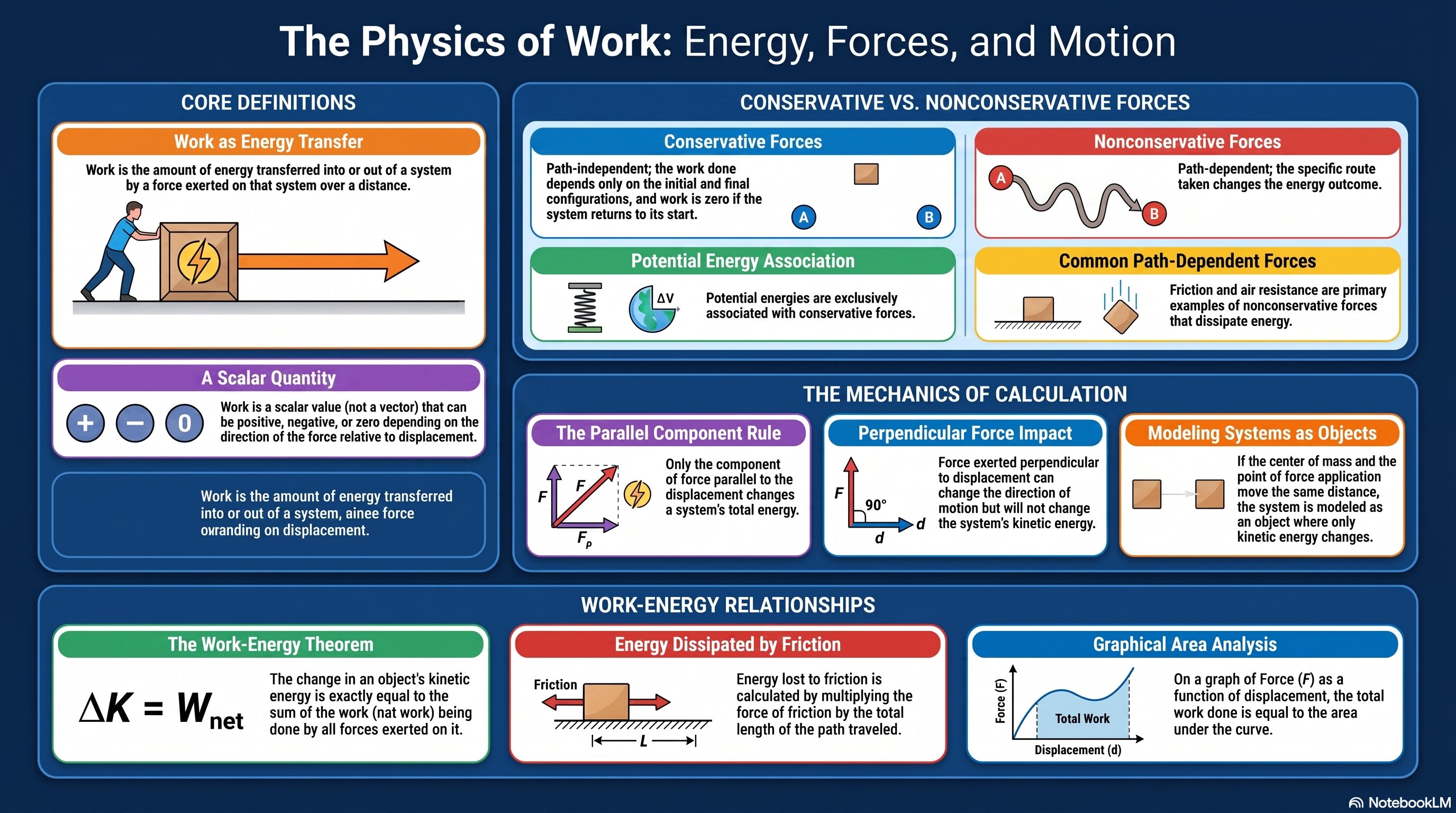
In Lesson 3.1 you learned what kinetic energy is. This lesson answers the next question: how does it change? The answer is work — the transfer of energy into or out of a system by a force acting over a displacement. Work is the only mechanism that changes a system's energy.
The critical detail is that only the component of force parallel to the displacement does work. A force perpendicular to motion — like the normal force on a horizontally moving object — does exactly zero work. It can change direction without changing speed, but it cannot transfer energy.
Conservative vs. Nonconservative Forces
What you'll do in this lesson
- Define work as energy transferred by a force over a displacement.
- Calculate W = F‖ · d using the component of force parallel to displacement.
- Explain that perpendicular forces do no work — they change direction, not speed.
- Apply the work-energy theorem: net work equals change in kinetic energy.
- Classify forces as conservative (gravity, springs) or nonconservative (friction, air resistance).
- Extract total work from the area under a force vs. displacement graph.
Why it matters
Work is the bridge between forces (Unit 2) and energy (Unit 3). The work-energy theorem — W_net = ΔK — is one of the most powerful problem-solving tools in the course. It lets you connect what a force does to an object directly to how fast that object moves, bypassing Newton's Second Law and kinematics entirely in many situations.
✅ Self-Check Before You Roll On
Check off each item as you get there. These aren't grades — they're your own signal.