Use this as a quick reference for K = ½mv², the scalar nature of KE, and the frame-dependence concept.
🧭 Plot Summary
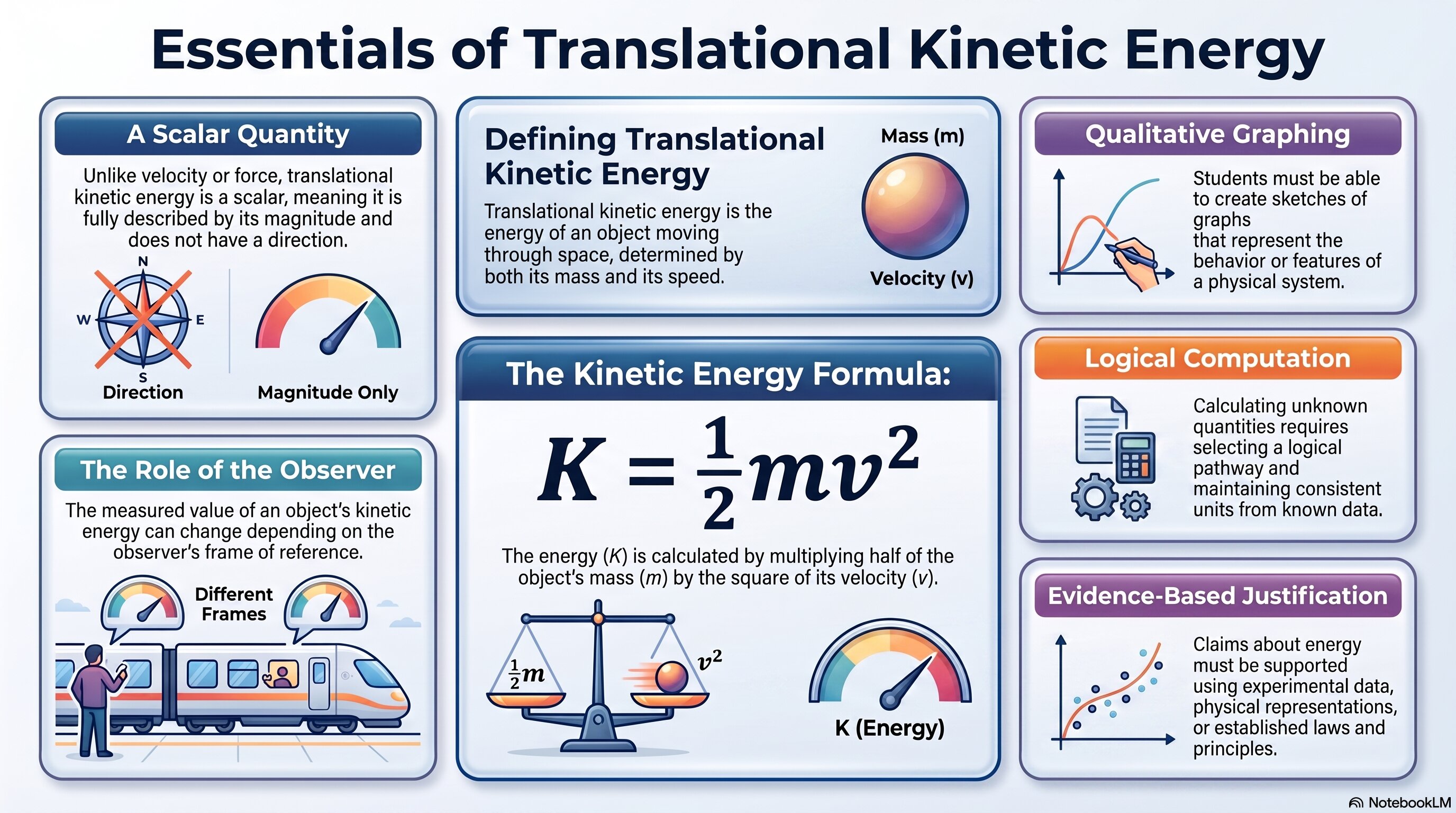
When an object is moving, it carries energy with it — energy that can do work, cause collisions, and be transferred to other objects. That energy is called translational kinetic energy, and it depends on exactly two things: the object's mass and its speed. The formula is simple: K = ½mv².
The most important thing to notice is that speed is squared. This makes velocity the dominant factor: double your mass and you double your kinetic energy, but double your speed and you quadruple it. This is why highway collisions are so much more dangerous than parking lot fender-benders — the math is not linear.
The v² effect — side by side
What you'll do in this lesson
- Define translational kinetic energy as the energy of an object due to its motion through space.
- Calculate K = ½mv² and express the result in Joules (kg·m²/s²).
- Explain why KE is a scalar: it depends only on speed (magnitude of velocity), not direction.
- Predict how changes in mass and speed affect kinetic energy — especially the v² relationship.
- Recognize that kinetic energy is frame-dependent: different observers measure different values.
- Sketch qualitative graphs of K vs. v and K vs. m for a moving object.
Why it matters
Kinetic energy is the starting point for everything in Unit 3. Work changes it. Potential energy converts to and from it. Conservation of energy tracks it across an entire problem. Get comfortable with K = ½mv² now — it's the foundation the rest of the unit builds on.
✅ Self-Check Before You Roll On
Check off each item as you get there. These aren't grades — they're your own signal.