Use this as a quick reference for centripetal acceleration, force sources, vertical loops, period, and orbits.
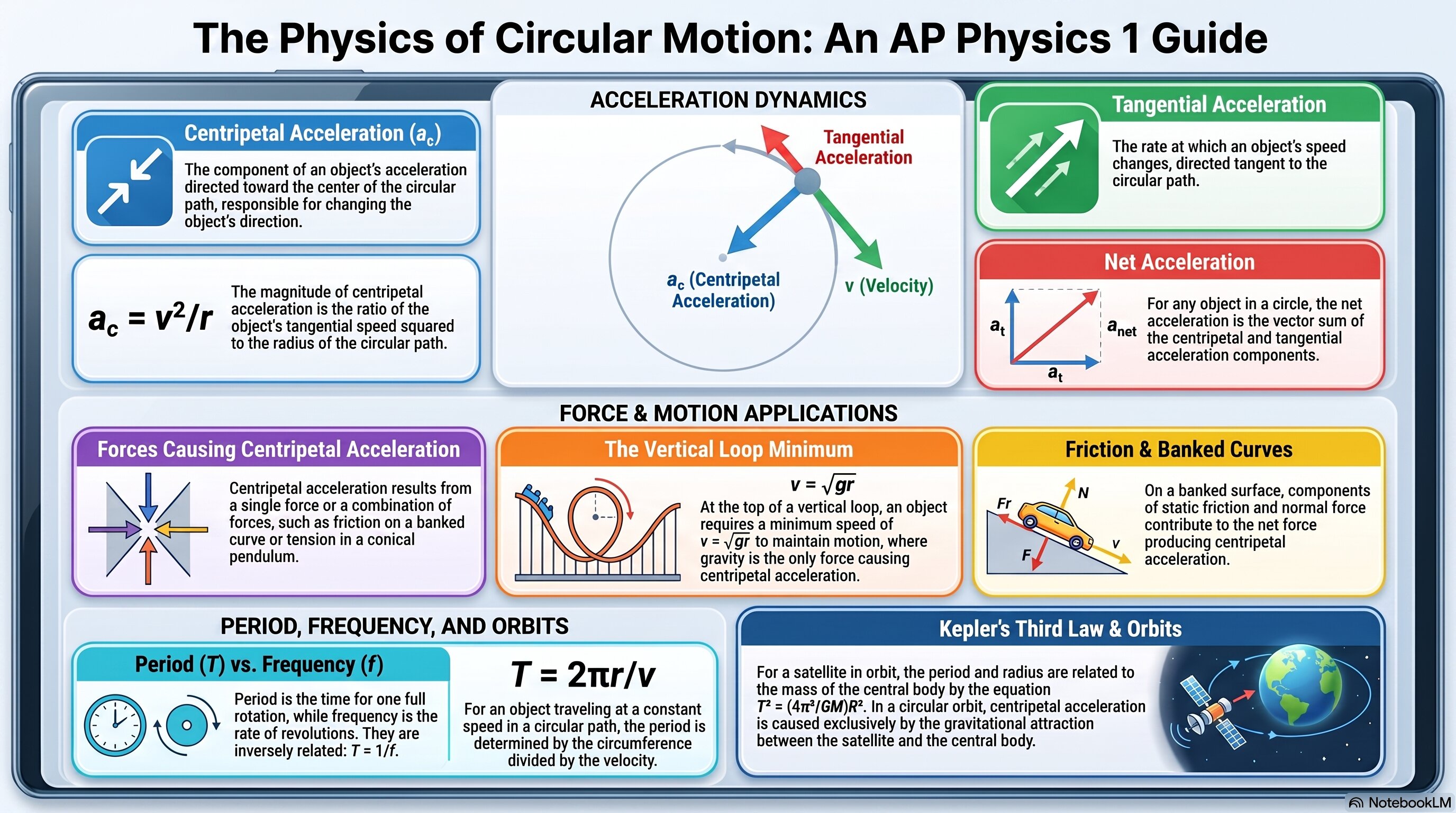
🧭 Plot Summary
Any object moving in a circle is constantly changing direction — which means it's constantly accelerating, even at constant speed. That acceleration always points toward the center and is called centripetal acceleration. The net force that causes it — centripetal force — isn't a new kind of force. It's whatever real force or combination of forces happens to be pointing toward the center in that specific problem: tension in a string, gravity for an orbit, friction on a curve, or normal force in a loop.
The three key equations
What provides centripetal force?
What you'll do in this lesson
- Define centripetal acceleration as the inward acceleration that changes an object's direction without changing its speed.
- Calculate centripetal acceleration using a_c = v²/r.
- Identify the real forces (tension, gravity, friction, normal) that provide centripetal force in different scenarios.
- Apply Newton's Second Law toward the center: ΣF_net = mv²/r.
- Solve vertical loop problems including the minimum speed condition at the top.
- Calculate period T = 2πr/v and relate it to frequency f = 1/T.
- Explain circular orbits as gravitational centripetal acceleration.
Why it matters
Circular motion is the unit finale because it genuinely requires everything that came before it. Free-body diagrams from 2.2, Newton's Second Law from 2.5, gravity from 2.6, and the idea that a net force doesn't have to be a new type of force — all of it converges here. It's also a bridge to Unit 6 (rotational dynamics) and appears in orbit problems throughout the rest of the course.
✅ Self-Check Before You Roll On
Seven items — this lesson synthesizes the whole unit. Work through them honestly.