Use this as a quick reference for Hooke's Law, the restoring force, and the ideal spring model.
🧭 Plot Summary
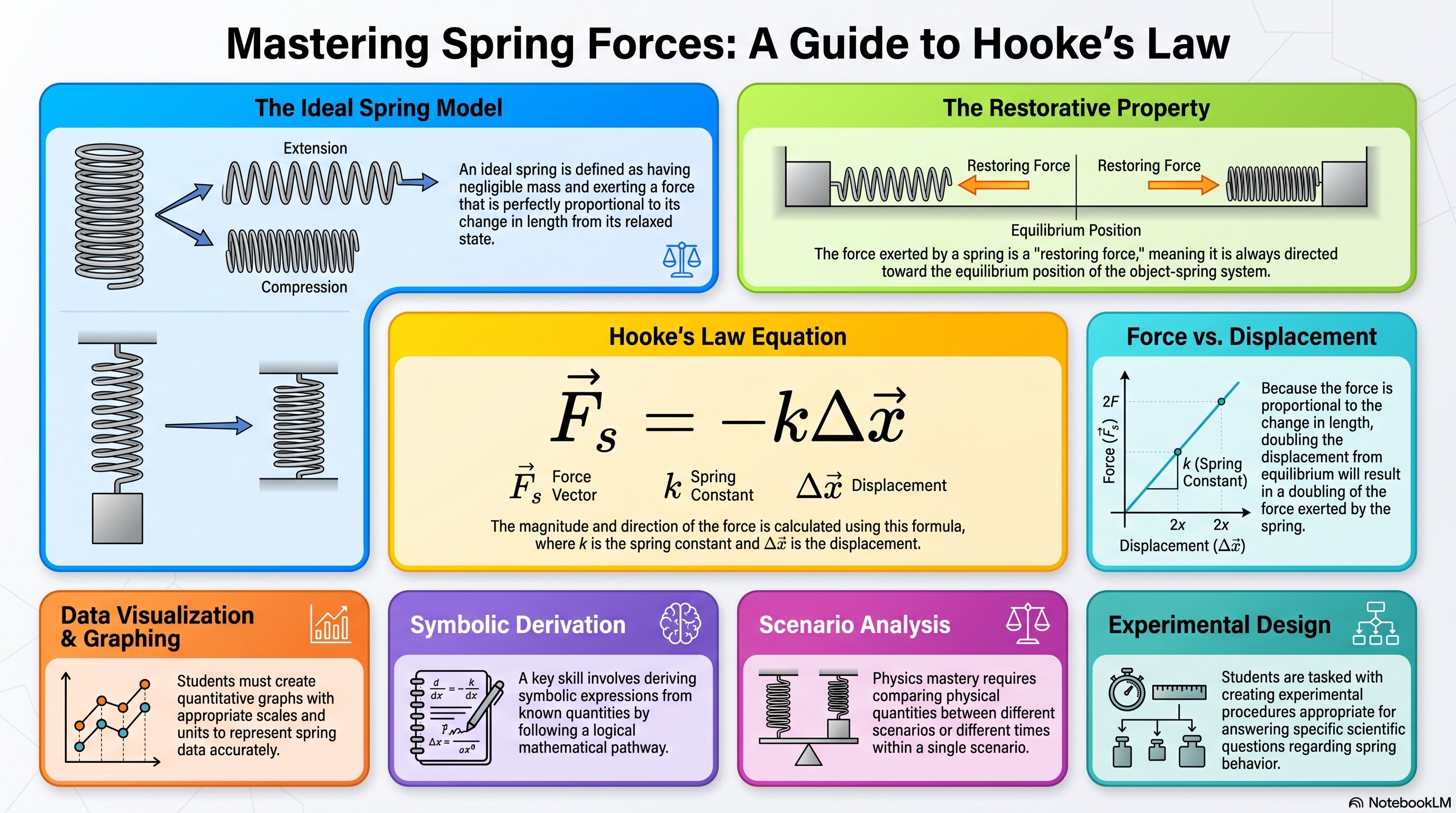
Springs follow one of the cleanest laws in all of physics: the force they exert is directly proportional to how far they've been stretched or compressed from their natural length. That relationship is Hooke's Law: F_s = −kΔx. The negative sign isn't a mistake — it's the whole point. It means the spring force always points back toward equilibrium, which is why it's called a restoring force. Stretch it right, it pulls left. Compress it left, it pushes right.
The restoring force in both directions
What you'll do in this lesson
- State Hooke's Law: the spring force is proportional to displacement from equilibrium.
- Explain that the negative sign in F_s = −kΔx makes the force a restoring force.
- Identify the spring constant k (in N/m) as the slope of a force vs. displacement graph.
- Apply the ideal spring model — negligible mass, perfectly linear, no energy loss.
- Calculate spring force, constant, or displacement using Hooke's Law.
- Predict how doubling displacement changes force, and how doubling k changes force.
Why it matters
Springs appear everywhere in the rest of the course — in oscillation problems (Unit 7), energy storage problems (Unit 3), and any scenario involving elastic forces. The force vs. displacement graph is also a direct test of AP skill 1.B (quantitative graphing) and 2.D (predicting how changing variables affects outcomes). Learn Hooke's Law well here and it pays off for the rest of the year.
✅ Self-Check Before You Roll On
Check off each item as you get there. These aren't grades — they're your own signal.