Use this as a quick reference for kinetic vs. static friction, coefficients, and the static inequality.
🧭 Plot Summary
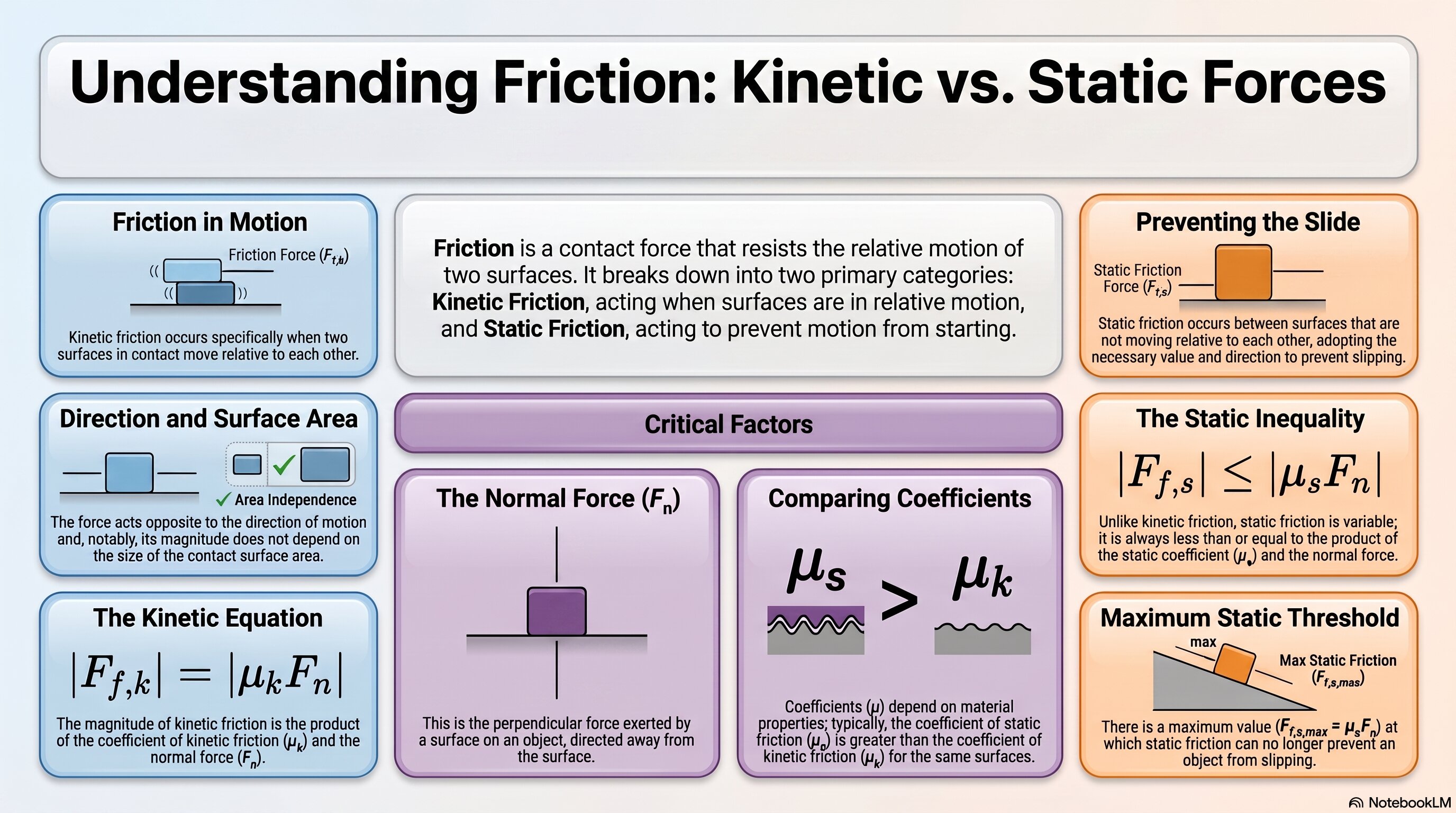
Friction is a contact force that resists relative motion between surfaces. It comes in two types. Kinetic friction acts when surfaces are already sliding — it's constant, calculable, and always opposes the direction of motion. Static friction acts when surfaces aren't sliding yet — it's variable, matching whatever applied force is trying to start the slide, up to a maximum. Once the applied force exceeds that maximum, the object starts moving and kinetic friction takes over.
The two equations side by side
The critical comparison
It takes more force to get something moving than to keep it moving. That's why your car tires grip better when they're rolling than when they're locked up and skidding — and why anti-lock brakes exist.
What you'll do in this lesson
- Define kinetic friction as the friction force between surfaces in relative motion.
- Calculate kinetic friction using |F_f,k| = μk × F_N.
- Define static friction as a variable force that prevents sliding, up to a maximum of μs × F_N.
- Apply the static friction inequality |F_f,s| ≤ μs × F_N to determine if an object slides.
- Explain that the coefficient of static friction is always greater than kinetic for the same surfaces.
- Recognize that friction magnitude is independent of contact surface area.
Why it matters
Friction shows up in virtually every dynamics problem from here forward. Inclines, Atwood machines, connected systems, circular motion — friction is always a candidate force on a free-body diagram. Getting comfortable with when to use μk vs. μs and what the static inequality actually means will pay dividends for the rest of Unit 2 and beyond.
✅ Self-Check Before You Roll On
Check off each item as you get there. These aren't grades — they're your own signal.