Use this as a quick reference for universal gravitation, gravitational fields, weight, and mass.
🧭 Plot Summary
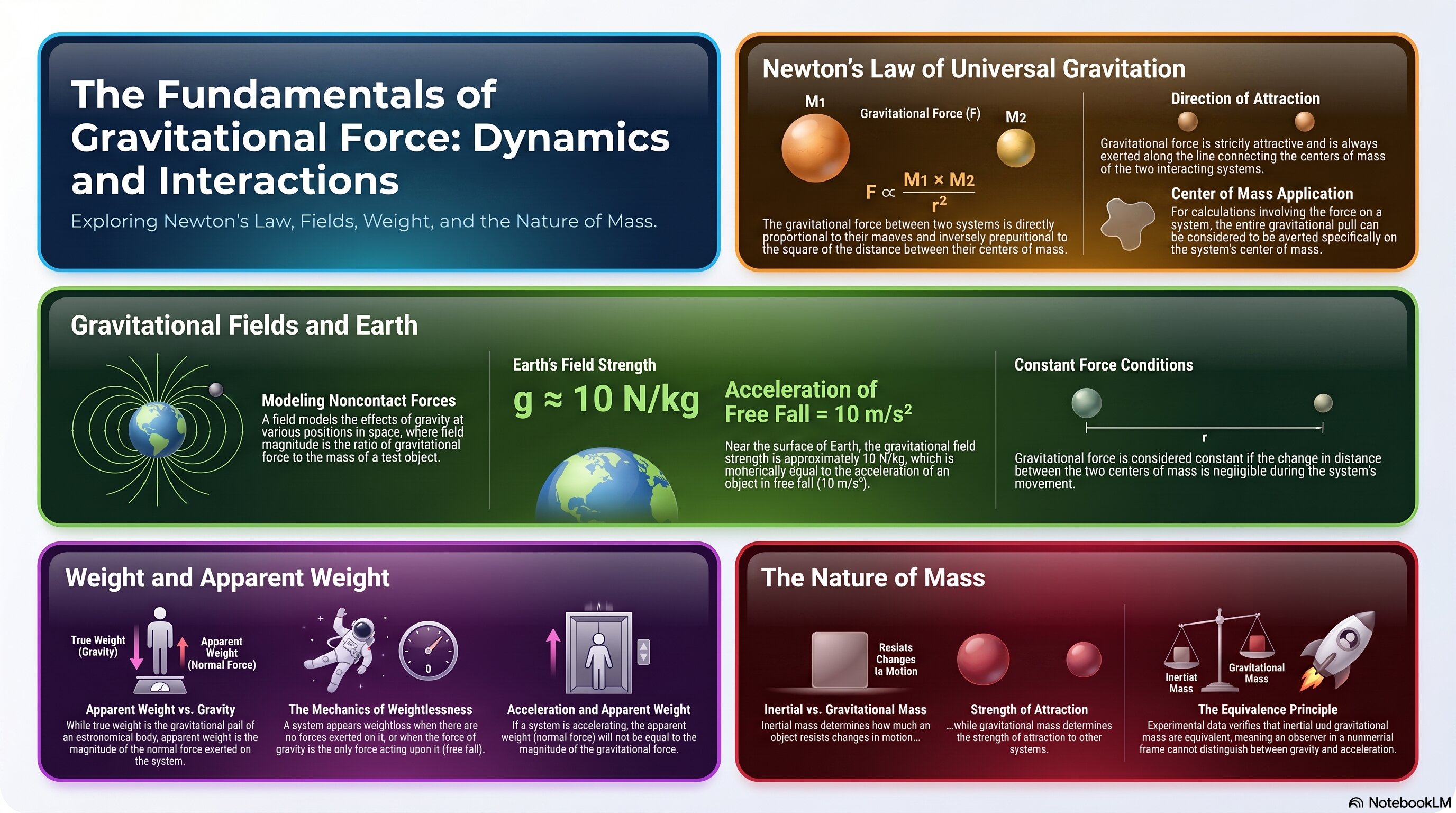
Every object with mass attracts every other object with mass. That's universal gravitation — the force is proportional to both masses and drops off with the square of the distance between their centers. Near Earth's surface, the gravitational field is approximately 10 N/kg, which is numerically identical to the free-fall acceleration of 10 m/s². This lesson also draws a critical distinction: true weight is the gravitational force pulling you down, while apparent weight is what a scale actually reads — the normal force — which can be more, less, or zero depending on how you're moving.
True weight vs. apparent weight
F_g = mg. Always pulling down. Doesn't change unless mass or g changes.
Normal force. What the scale reads. Changes with acceleration.
What you'll do in this lesson
- Describe gravitational force as proportional to both masses and inversely proportional to the square of the distance between centers.
- Explain that gravity always acts along the center-of-mass line between two systems and is purely attractive.
- Define the gravitational field strength g ≈ 10 N/kg and connect it to the free-fall acceleration of 10 m/s².
- Distinguish true weight (F_g = mg) from apparent weight (the normal force the scale reads).
- Identify conditions for apparent weightlessness — free fall or no contact forces.
- Explain why inertial mass and gravitational mass are experimentally equivalent.
Why it matters
Gravity is the foundation of every projectile problem, every incline problem, every circular-orbit problem, and every free-fall scenario for the rest of the course. The weight vs. apparent weight distinction shows up constantly — in elevators, on scales, in orbit — and is a reliable source of AP exam questions.
✅ Self-Check Before You Roll On
Check off each item as you get there. These aren't grades — they're your own signal.