Use this as a quick reference for the core equation, unbalanced forces, and velocity change conditions.
🧭 Plot Summary
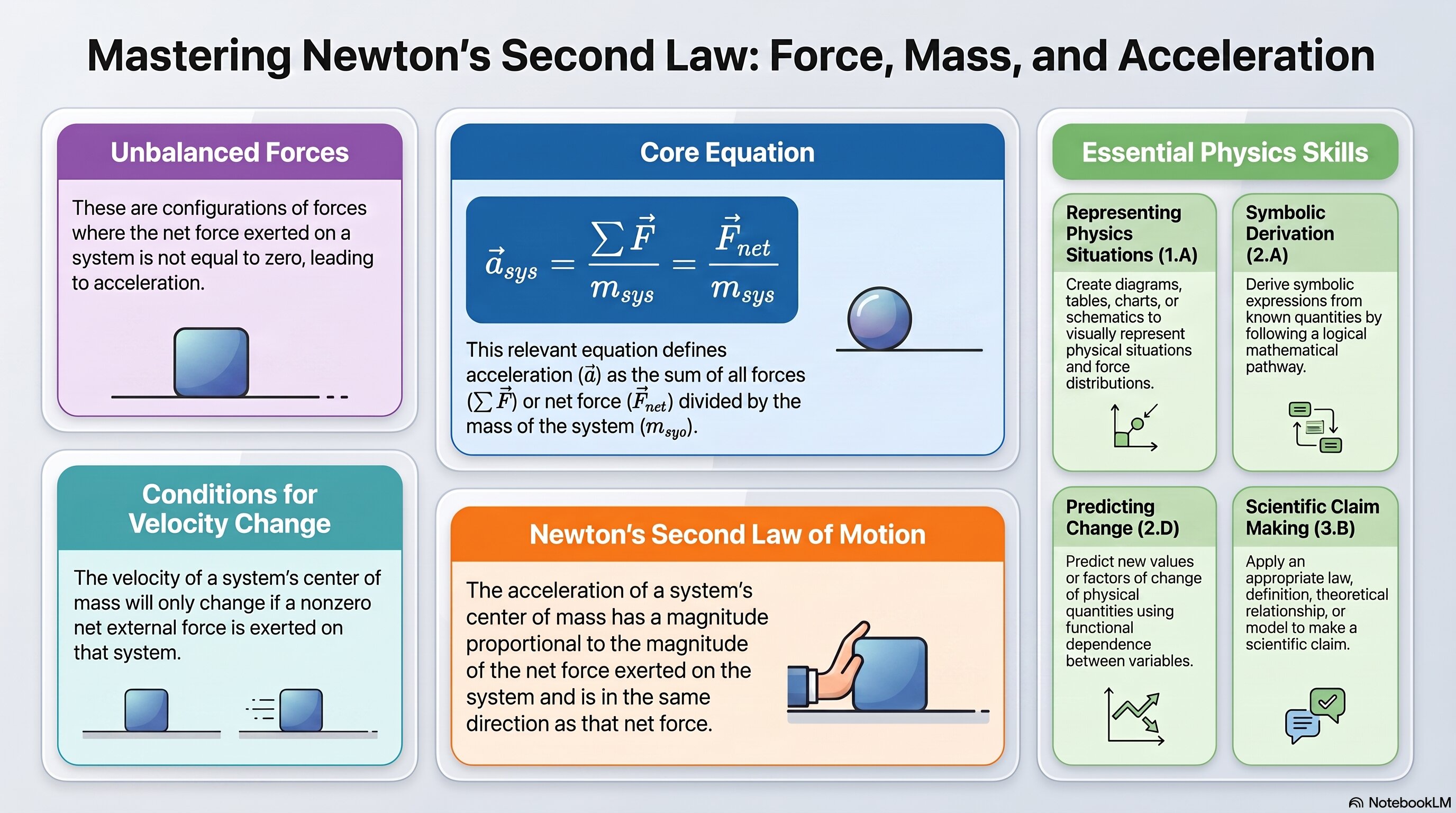
This is the centerpiece of Unit 2. Newton's Second Law gives you a precise, quantitative relationship between three things you now know well: force, mass, and acceleration. It says the acceleration of a system's center of mass is proportional to the net force acting on it and inversely proportional to the system's mass. The direction of acceleration is always the same as the direction of the net force — not the direction of motion, not the direction of the applied force, but the net force specifically.
The two proportionalities
What you'll do in this lesson
- State that acceleration is proportional to net force and inversely proportional to mass.
- Apply a_sys = ΣF / m_sys to find acceleration, net force, or system mass.
- Confirm that acceleration always points in the same direction as the net force.
- Distinguish unbalanced forces (net force ≠ 0, object accelerates) from equilibrium.
- Predict how changes in force or mass affect the acceleration — functional dependence.
- Apply the Second Law per axis in two-dimensional force problems.
Why it matters
Every lesson that follows in Unit 2 is just Newton's Second Law with a different force plugged in. Gravity (2.6), friction (2.7), springs (2.8), centripetal force (2.9) — all of them eventually become ΣF = ma problems. Get this equation second nature and the rest of the unit falls into place.
✅ Self-Check Before You Roll On
Check off each item as you get there. These aren't grades — they're your own signal.