Use this as a quick reference for force pairs, tension, and ideal components.
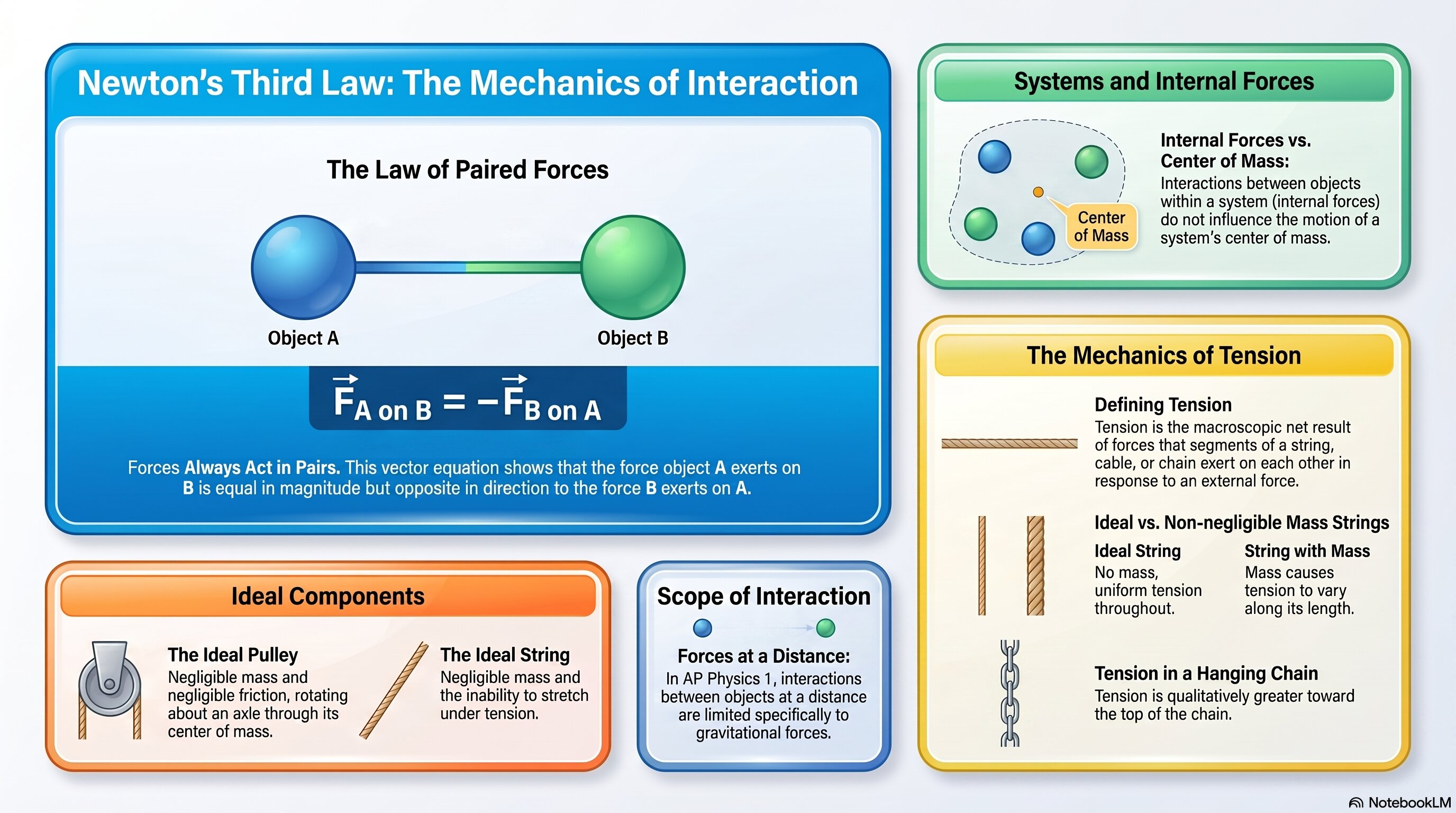
🧭 Plot Summary
"For every action, there's an equal and opposite reaction" is the most quoted physics line of all time — and one of the most misunderstood. Newton's Third Law says when object A pushes on object B, B pushes back on A with the exact same strength, in the exact opposite direction. These two forces never cancel, because they act on two completely different objects. This lesson also introduces tension — the pulling force in a rope or string — which is really just Newton's Third Law happening at a microscopic scale, segment by segment.
Spotting a real third-law pair: D.O.S.E.
What you'll do in this lesson
- State Newton's Third Law and apply it to identify force pairs.
- Use agent-on-object notation to correctly label which object each force acts on.
- Distinguish true third-law pairs from forces that merely look similar (like normal force and weight).
- Explain why tension is the macroscopic result of forces between string segments.
- Apply the ideal string and ideal pulley assumptions — negligible mass, no stretch, no friction.
- Explain why internal force pairs cancel and cannot move a system's center of mass.
Why it matters
Third-law pairs show up constantly — in collisions, momentum problems, pulley systems, and circular motion. Get comfortable identifying them now, because misidentifying a pair (like thinking normal force and weight form one) is one of the most common point-losers on the exam.
✅ Self-Check Before You Roll On
Check off each item as you get there. These aren't grades — they're your own signal.