Use this as a quick reference for force types and free-body diagram rules.
🧭 Plot Summary
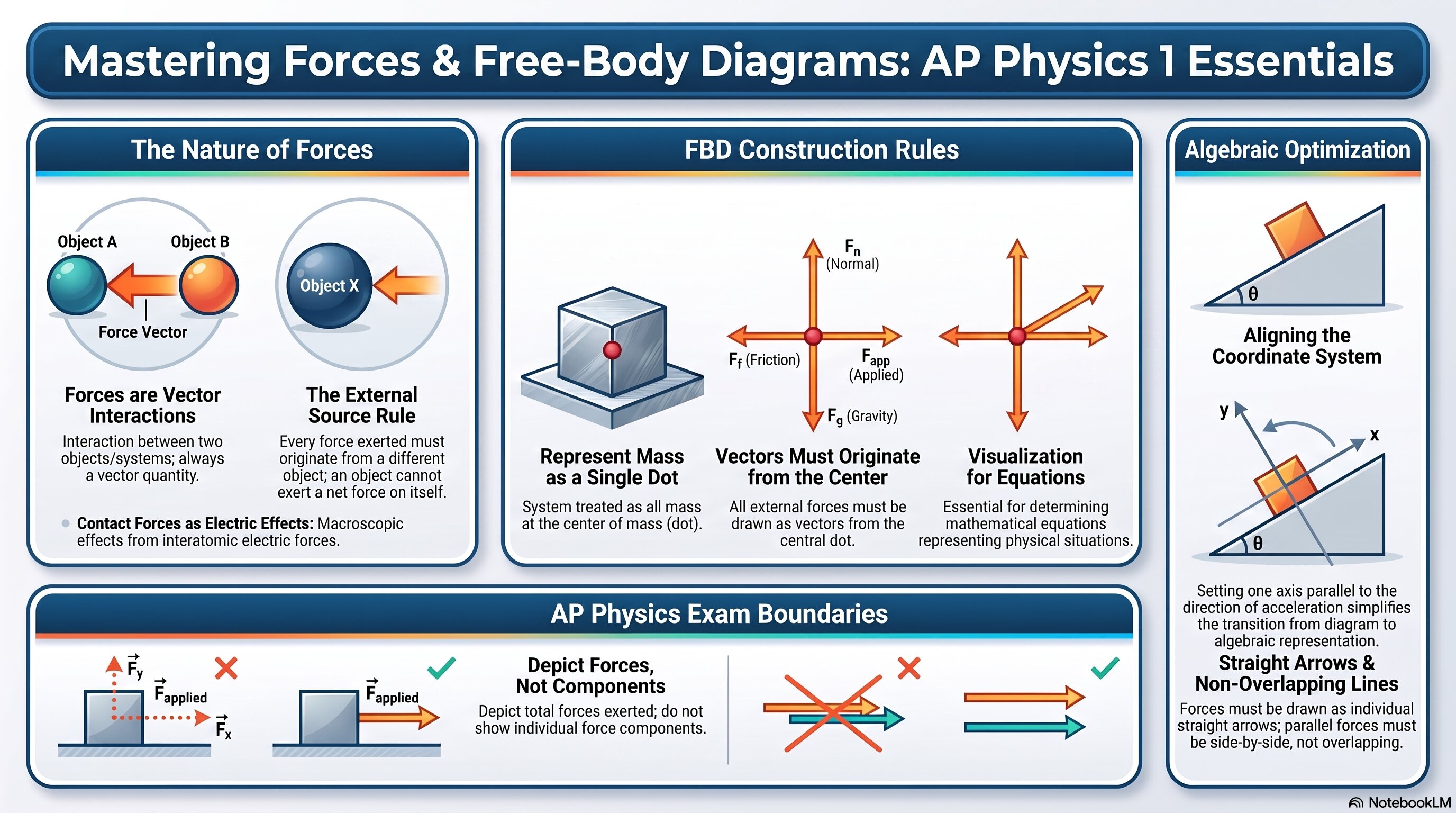
This is the lesson everything else in AP Physics 1 depends on. A force is a push or a pull — and it always requires two objects. Nothing can exert a net force on itself. Forces come in two flavors: contact forces (normal, friction, tension, applied — anything that requires touching) and the one field force you'll use constantly: gravity. Once you can identify every force acting on an object, you draw a free-body diagram — a dot representing the object, with each force as a straight arrow pointing away from it.
The four contact forces
What you'll do in this lesson
- Recognize that every force requires two interacting objects — nothing can exert a net force on itself.
- Classify forces as contact forces (normal, friction, tension, applied) or the field force of gravity.
- Represent an object as a single dot at its center of mass for a free-body diagram.
- Draw each force as a straight arrow starting from the dot, scaled roughly by magnitude.
- Draw same-direction forces side by side rather than stacked or overlapping.
- Leave force components off the diagram — components are an algebra step, not a drawing step.
Why it matters
Nearly every free-response question on the AP exam asks you to draw or interpret a free-body diagram. If your diagram is wrong, the math that follows will be wrong too — no matter how good your algebra is. This is the single most reused skill in the entire course.
✅ Self-Check Before You Roll On
Check off each item as you get there. These aren't grades — they're your own signal.