Use this as a quick reference for systems, internal/external forces, and finding center of mass.
🧭 Plot Summary
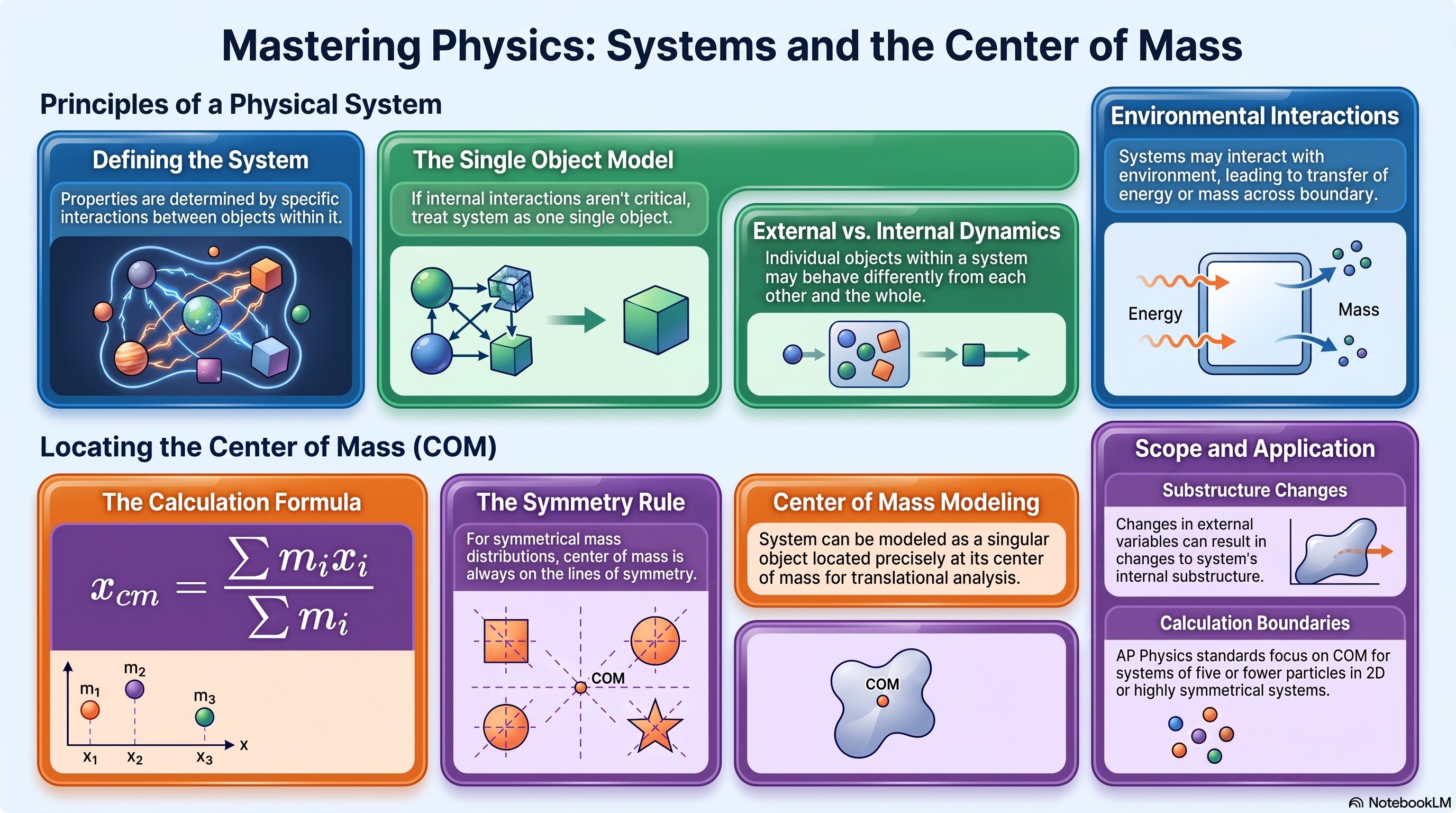
Before you can apply a single force to anything, you need to know exactly what you're applying it to. A system is the collection of objects you've chosen to study — everything else is the environment. That choice determines which forces are internal (between objects inside your system, and they always cancel out) and which are external (from outside the system, and these are the only ones that can move it). Once you've defined your system, you can often shrink the whole thing down to a single point — its center of mass — and treat the entire system's motion as if it were one object.
What you'll do in this lesson
- Define a system and distinguish it from its environment.
- Classify forces acting on a system as internal or external.
- Decide when a system can be modeled as a single object.
- Recognize that internal forces cancel and cannot move the center of mass.
- Use symmetry to locate the center of mass of regularly shaped objects.
- Calculate the center of mass of a system of point masses using the weighted average formula.
Why it matters
Every force problem in this unit starts by defining a system. Get sloppy here and free-body diagrams later in the unit will be sloppy too. This lesson is short, but it's the foundation everything else in Unit 2 stands on.
✅ Self-Check Before You Roll On
Check off each item as you get there. These aren't grades — they're your own signal.